

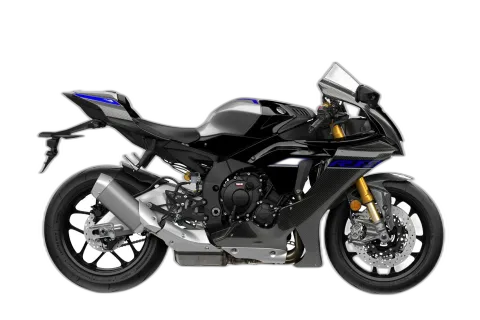
Yamaha YZF-R1M (RN32M) — Supersport
Yamaha Press

2015–2016 · Supersport · Buyer's Guide

YZF-R1M (RN32M)

The Track Bike That Rewards Commitment

The Machine's Character

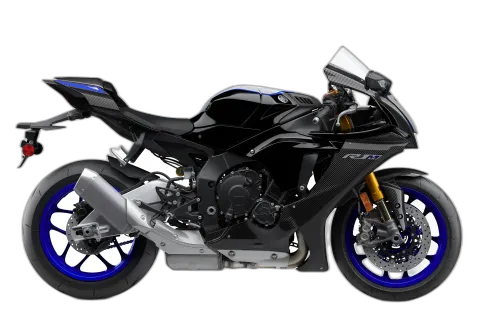
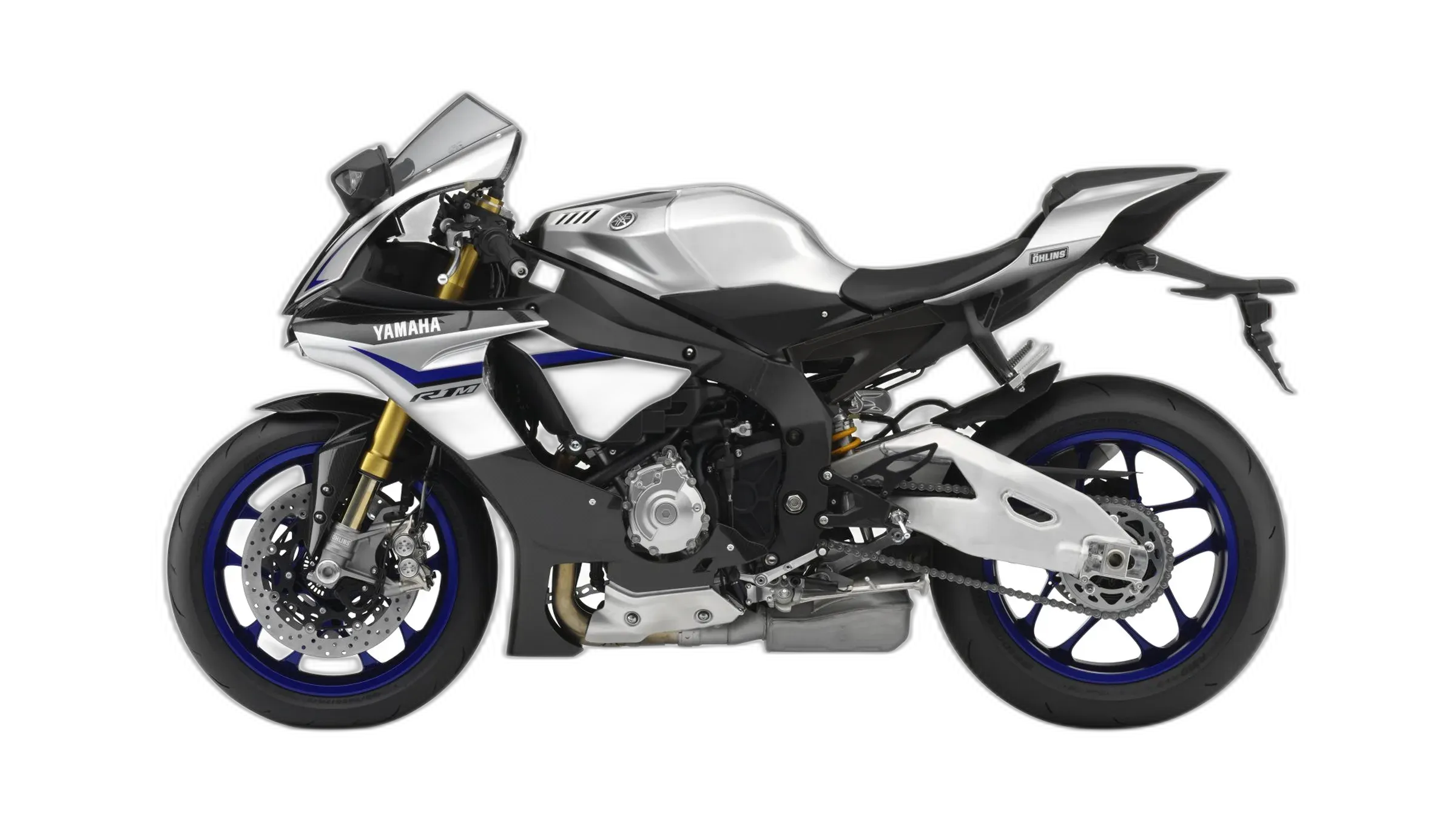
The R1M is the circuit-focused build of Yamaha's 998 cc crossplane platform, and every part of it points at the same job. The inline-four makes 200 hp at 13,500 rpm and 83 lb-ft at 11,500, wrapped in factory carbon bodywork and hung on Öhlins electronic suspension that reads live sensor data and re-adjusts itself dozens of times each lap. A 6-axis IMU sits under the cornering ABS, traction control, wheelie control and launch control, while the Communication Control Unit links the bike to a tablet for GPS-referenced session data. At 441 lb wet, it sits at the sharp end of the class rather than the comfortable end.

It rides like a machine built for riders who commit. Load it hard and hold the throttle open and the chassis feels bottomless; feedback and lean clearance are as good as this class gets. Ease off and it turns stubborn on you. Ownership asks for the same seriousness. Some 2015 motors have shown accelerated wear on crank journals, wrist pins and rod big-ends under hard track use, and there are safety recalls covering second, third and fourth gear strength plus an improperly tightened rear shock piston rod nut. This is a trackday rider's bike first, a canyon bike only if you accept race ergonomics on the road.

Hard Numbers

Spec sheets don't ride bikes, but they set the baseline.

Show full specs & equipment Hide specs & equipment
Key specifications
Power 200 hp (147 kW) @ 13,500 rpm
Torque 83 lb-ft (112 Nm) @ 11,500 rpm
Displacement 998 cc
Engine Inline-four
Cooling Liquid-cooled
Gearbox 6-speed
Final drive Chain
Fork Upside-down (USD)
Front brake 320 mm
Front tire 120/70-17
Rear tire 200/55-17
Wheelbase 55.3 in (1405 mm)
Seat height 33.7 in (855 mm)
Wet weight 441 lb (200 kg)
Fuel capacity 4.5 gal (17 L)

Equipment check

Chassis

  • Front Suspension Adjustable Standard
  • Rear Suspension Adjustable Standard
  • Steering Damper Standard

Connectivity

  • TFT Display Standard
  • Smartphone Connectivity Standard

Drivetrain

  • Quickshifter Standard
  • Slipper Clutch Standard

Lighting

  • LED Headlight Standard

Safety

  • ABS Standard
  • Cornering ABS Standard
  • Traction Control Standard
  • Ride Modes Standard
  • Wheelie Control Standard
  • Launch Control Standard

Signature Tech

The named systems that set this bike apart — and what each one does for you.

Connectivity

  • Yamaha Communication Control Unit (CCU) Standard
    • Onboard data logging

The Voice of Experience

Portrait of NastyNils

The test ride

My first laps on it were honestly disappointing. It felt heavy, reluctant, and I sat there wondering what everyone else was hearing. Then the noise got me. The crossplane four barks unevenly under load, closer to a race paddock than a road bike, and you take it through the tank and the pegs as much as through your ears. The riding position is uncompromising: 33.7 in seat, weight stacked onto your wrists, hips shoved forward. On a fast road that gets old inside an hour, and the 4.5 gal tank measures your day in sessions rather than miles. Between runs you sit on the pit wall with the tablet instead of squinting at the dash, scrolling through settings, and by then the thing has stopped pretending to be a street bike at all.

Rated point by point — where it earns its keep

My own 0–100 score for this bike against the class, area by area — the marker on each bar is the class average.

What decides how this bike handles is which mode you're willing to admit suits you. A1 is aimed at slicks and a dry, grippy surface, and it comes with a condition attached: the fork has to be driven deep into its travel on the way into a corner or the front simply won't take the line. Ride it with any restraint and the geometry never arrives, and it feels obstinate rather than sharp. A2 keeps the identical automatic behavior at lower thresholds, and I turned quicker laps on it. Most riders will too. A3 is there for rain or road rubber. What I like is that none of it wants preparation from you. There's no setup session and no laptop in the pits, because the control unit is reading sensors and revising itself dozens of times a lap. The limit is that you can't bind a setting to one specific corner by GPS. Yamaha calls that a philosophy. A serious race team will call it a gap.

I'll put this plainly: the performance is conditional on your commitment. Approach it tentatively and the bike feels heavy and unwilling, as though it's waiting for evidence you mean it. Work the front properly on the brakes, then keep your resolve the whole way through the turn, and it stops resisting and starts delivering. The drive off the corner went beyond anything the standard bike gave me on street tires. Hesitate and you'll never see it.

The thing worth flagging here is a repair bill that never arrives. Suspension is the first component most standard R1 owners end up replacing, and getting it genuinely right costs money plus two or three race weekends of testing. That work is already done on this one. Yamaha and Öhlins put the development hours in before the bike reached you, so you start from a sorted setup instead of building toward one.

Two things make this bike easier to live with at a circuit than its reputation suggests. Switch the suspension to M and the electronics stop intervening. You get traditional high-spec behavior, adjusted through the display rather than with a screwdriver, and nothing shifts underneath you mid-corner. That matters if you want a fixed reference to work against. The other is the bodywork. Series with rules that only permit factory carbon have nothing to object to here, so you're eligible out of the crate.

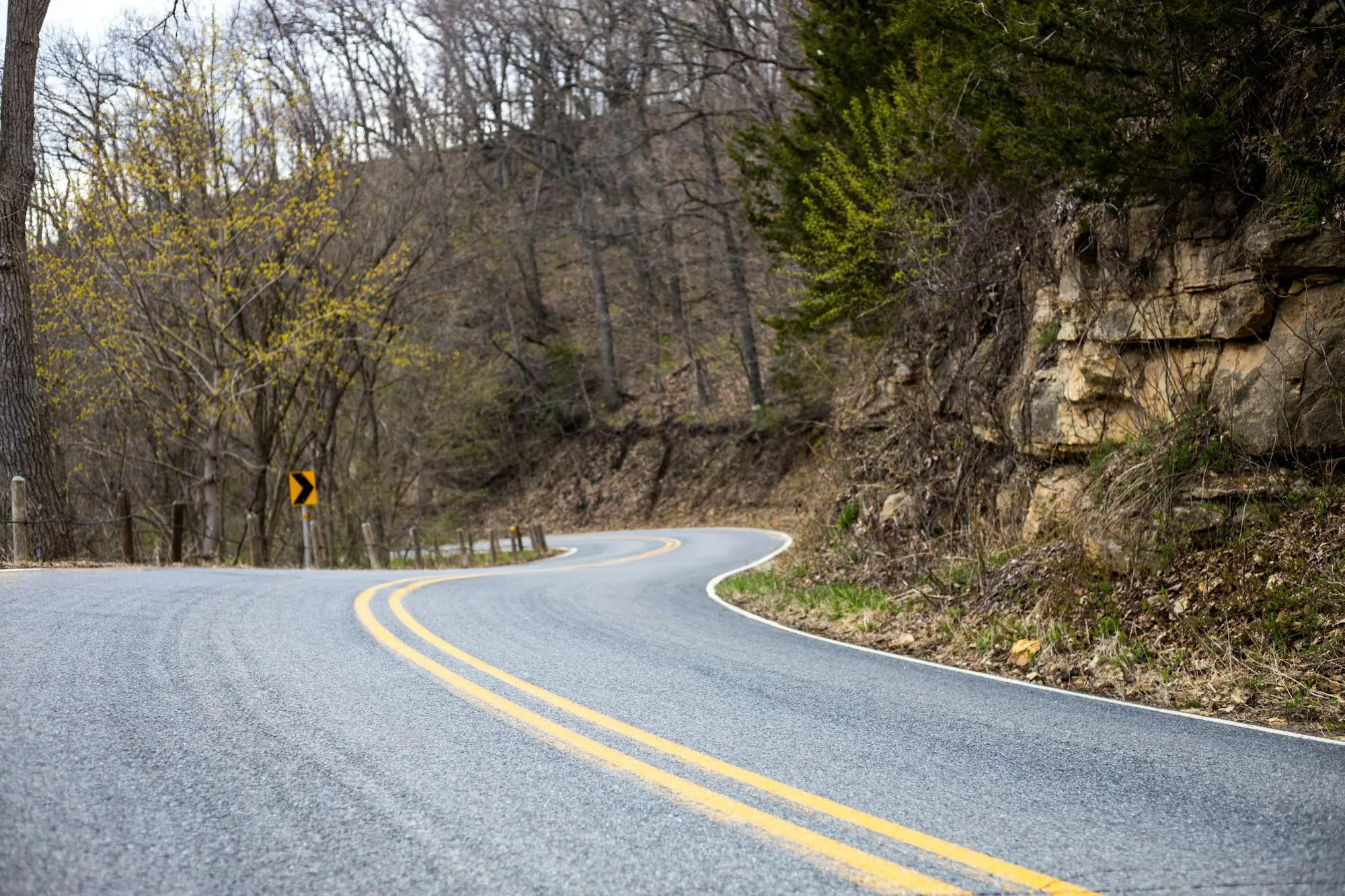
A winding two-lane asphalt road in the Appalachian mountains, photographed in dry daylight. Yellow double-center line markings guide through a series of tight left-hand curves. Dense deciduous and evergreen forest flanks both sides; a rock cut is visible on the right. The road surface and geometry suggest a technical, high-traffic riding corridor popular with motorcyclists.
Chris Flaten / Pexels

The Truth on the Street

I've had this bike come up in conversation for years now: at circuits between sessions, at bike nights and club evenings, and in the messages riders keep sending me about what theirs is actually like to own. The picture they paint is remarkably consistent. Almost everything they admire sits at the top of the rev range, and almost everything they complain about sits underneath it.

The turn-in they keep mentioning

The chassis is the first thing most riders bring up. They describe turn-in as immediate and the feedback as clear enough to lean on in fast corners, and they put it down to the short wheelbase and the light forged wheels. The engine follows straight after: hard top-end, a strange twin-like weight to the torque, and a rear tire that keeps talking to them on corner exit.

Under 8,000 rpm the mood changes

The complaints gather at the bottom of the rev range. Riders say the motor feels hollow below 8,000 rpm, which makes ordinary road speeds a chore, and plenty describe the standard throttle as jerky at small openings. Fueling modules and reflashes come up regularly as the answer. Fuel economy is the other steady grumble, well off average once anyone rides it the way it asks to be ridden.

Known issues

  • Transmission gear failure (recall)

    drivetrain very common Recall

    Second, third, and fourth gears may break under high stress or from improper shifting due to inadequate strength and stress concentration. This can cause the transmission to lock up, leading to a crash. Yamaha recalled all 2015 R1 and R1M motorcycles sold in the US (NHTSA campaign 15V802000) and replaced the transmission internals with redesigned, stronger gears. The repair requires approximately 16 hours of labour.

  • Rear shock absorber manufacturing defect (recall)

    suspension occasional Recall

    The rear shock absorber may have been manufactured with an improperly tightened piston rod nut, which could loosen and prevent proper suspension action, potentially causing loss of control. Dealers replace the shock with a correctly manufactured unit.

  • Premature engine wear on 2015 ('silver') motors

    engine rare

    Some owners of 2015 R1 engines report accelerated wear on crank journals, wrist pins, and connecting rod big-ends when subjected to hard track use. The titanium con-rods are said to have a service life of around 3,000 racing miles. Yamaha strengthened the crankshaft and changed engine cases for 2017, suggesting latent durability concerns. However, this has not been widely reported at low mileages on street bikes.

The Expert Benchmark

Where this Yamaha YZF-R1M pulls ahead of — or falls behind — its rivals on the numbers, and the typical bike in its class on character.

What kind of bike this is — character vs. the class

This bike Class average

The shape of the Yamaha YZF-R1M — numbers and character vs. the average Supersport

Head-to-head: Yamaha YZF-R1M vs. its rivals

The Handshake Score

Forget spec-sheet bragging. Here's who the YZF-R1M is actually built for.

A scenic view of Angeles Crest Highway winding through rugged Southern California canyon terrain. Rocky mountainsides with golden earth tones frame the asphalt road with tight sweeping curves. Double yellow center line visible, sparse vegetation along the shoulders, clear blue sky with white clouds. Daylight, dry conditions. Iconic location for canyon-road enthusiasts.
Josh Sorenson / Pexels

Best motorcycle for Laguna Seca?

This is your bike. The suspension sorts itself while you work on braking markers and lean angle, and the session data is waiting on the tablet when you come in.

Made for Barber Motorsports Park · WeatherTech Raceway Laguna Seca · Circuit of the Americas
Best motorcycle for Angeles Crest?

Fast and precise on your favorite road, but the wrists and the 33.7 in seat make the traffic between canyons a chore. Buy it if the riding matters more than the ride there.

Made for Angeles Crest Highway · Coronado Trail / US 191 · Highway 1 / Big Sur

Best motorcycle for Tail of the Dragon?

The feedback and lean clearance suit tight, repeated corner work perfectly. Just know this bike wants commitment on the brakes, and on public roads that ceiling stays out of reach.

Made for Back of the Dragon · Blue Ridge Parkway · Cherohala Skyway