By NastyNils·
Motorcycle comparison · Supersport
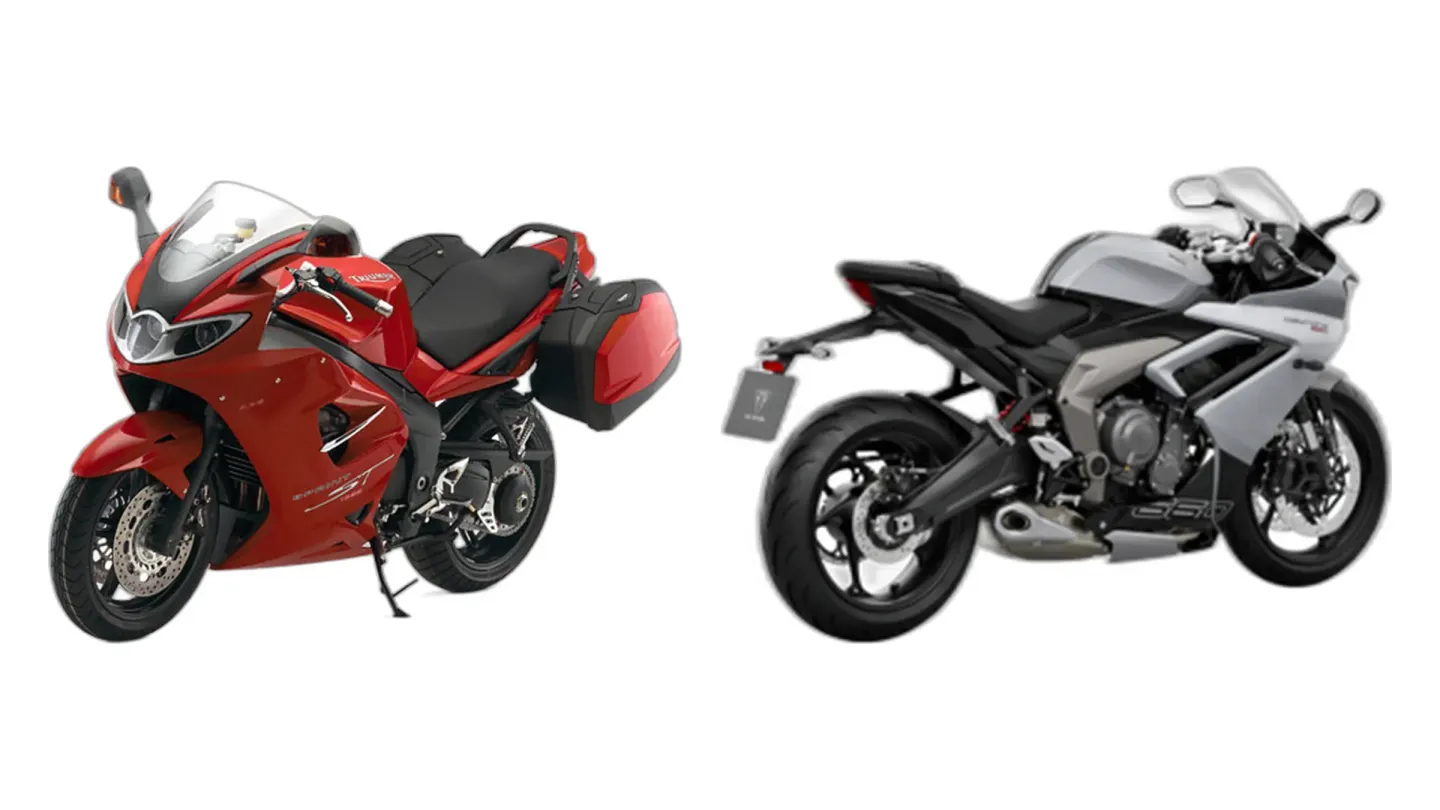
Triumph Daytona 675 (D67LC) vs Daytona 660 (MY2024)
Triumph Daytona 675 vs Daytona 660: which one to buy for the riding you do.
You'll feel the Triumph Daytona 675 soak up a sharp bump once you've backed off its damping. The Triumph Daytona 660's soft fork dives and won't settle.
So which one do you buy?
The Daytona 675 has the edge if…
Racetrack use
Inches ahead: Daytona 675
For a day at the track, the Daytona 675 makes slightly more sense. Most of that is more suspension adjustment and a sportier chassis.
Sporty riding on twisty roads
Nose ahead: Daytona 675
On a winding road, the Daytona 675 comes out a touch ahead. Thank better suspension for that. You wouldn't bet much on a gap like that.
The Daytona 660 has the edge if…
Daily commuting & city riding
By a nose: Daytona 660
On the way to work, the Daytona 660 asks a little less of you. It's down to easier everyday riding. Close enough that the test ride should settle it.
What makes each one tick
Daytona 675
Slim at the tank, the Daytona 675 goes exactly where the bars aim it, and there's no wrestling the chassis through the flick of an S-bend. Second gear covers most of a mountain road, since the triple's broad spread of torque doesn't protest a lazy throttle. Mid-corner ripples don't upset the chassis.
Daytona 660
A plush seat and clip-ons a moderate reach away set the Daytona 660 up for full days that won't leave you sore. A hard pull on the brake lever pitches the nose down quickly, since the front suspension doesn't have the support to hold it. Pushed harder, the front goes vague. The triple's howl keeps climbing to the redline.
The Voice of Experience

What actually separates them
- The Daytona 660 has the lower seat: 31.9 in (810 mm) vs 32.5 in (825 mm).
- The Daytona 675 has the lower wet weight: 408 lb (185 kg) vs 443 lb (201 kg).
- The Daytona 675 makes more peak power: 123 hp (92 kW) vs 94 hp (70 kW).
Which one for the way you ride
A confidence-building first motorcycle
Off its turf: Daytona 675
No first-bike verdict for the Daytona 675. It's a step up for later.
On running costs, these two are a wash. That's where your budget and your inseam get the final say.
Who each one is built for
What's good, and what you'll live with
Daytona 675
Strengths
- Goes Exactly Where You Point
- Settled On Rough Corners
- Holds Up To Hard Use
- One Gear, Most Situations
- Characterful inline-triple engine
Trade-offs
- Throttle Lag Off A Closed Corner
- Rear Moves Under Hard Braking In Lean
- Track Tires Wear Fast
- Cramped, track-focused ergonomics
Daytona 660
What owners say
Strengths
- Characterful triple-cylinder engine
- Comfortable and all-day friendly ergonomics
- Excellent value for money
Trade-offs
- Soft, underdamped suspension
- Heavier than some competitors
Known problems to check before you buy
Daytona 675
- Regulator/rectifier overheating and failure Recall 12V445000 The regulator/rectifier can overheat, preventing charging and causing the motorcycle to stall. An NHTSA recall (12V445000) was issued covering 2006–2009 Daytona 675 models.
- EXUP valve sticking The exhaust valve (EXUP) can seize or become noisy, triggering the check engine light and potentially affecting mid-range power. Often requires adjustment or replacement.
Daytona 660
No confirmed faults on file yet. That's not the same as fault-free.
What they share
- Engine
- Inline-three
- Cooling
- Liquid-cooled
- Gearbox
- 6-speed
- Front tire
- 120/70-17
- Rear tire
- 180/55-17
Where the spec sheets split
| Daytona 675 | Daytona 660 | |
|---|---|---|
| Seat height | 32.5 in (825 mm) | 31.9 in (810 mm) |
| Wet weight | 408 lb (185 kg) | 443 lb (201 kg) |
| Daytona 675 | Daytona 660 | |
|---|---|---|
| Displacement | 675 cc | 660 cc |
| Power | 123 hp (92 kW) | 94 hp (70 kW) |
| Peak power at | 12,600 rpm | 11,250 rpm |
| Torque | 53 lb-ft (72 Nm) | 51 lb-ft (69 Nm) |
| Peak torque at | 11,750 rpm | 8,250 rpm |
| Daytona 675 | Daytona 660 | |
|---|---|---|
| Fuel capacity | 4.6 US gal (17.5 L) | 3.7 US gal (14 L) |
| Daytona 675 | Daytona 660 | |
|---|---|---|
| Wheelbase | 54.9 in (1395 mm) | 56.1 in (1425 mm) |
What comes fitted, what costs extra
| Daytona 675 | Daytona 660 | |
|---|---|---|
| ABS | Not offered | Standard |
| Traction Control | Not offered | Standard |
| Ride Modes | Not offered | Standard |
| Manually Adjustable Front Suspension | Standard | Not offered |
| Quickshifter | Not offered | Option |
Head to head, area by area
Both bikes on the same scale, one area at a time.