-
Kokusan regulator/rectifier overheating and failure
electrics very common Recall
The factory-fit Kokusan regulator/rectifier overheats and fails, leading to undercharge or overcharge of the battery, dimming dashboard illumination, stalling and progressive damage to the wiring harness and stator. Triumph issued a global recall in 2012 to replace the Kokusan unit with a Shindengen FH012 MOSFET-type unit. Failures continued to be reported on units outside the recall VIN scope (notably MY2010–2011 US-market bikes that were not covered by the NHTSA campaign despite carrying the same Kokusan part).
-
Needle roller bearings in rear linkage seize from inadequate grease intervals
suspension common
The needle roller bearings in the rear suspension linkage corrode and seize because the factory-recommended grease interval (12,000 mi / 20,000 km) is too long for typical use, particularly in salt-belt regions where bearings can be destroyed before scheduled service. Multiple sources additionally report that the Base model's rear shock damping degrades noticeably between 10,000 and 20,000 mi.
-
Stator winding insulation breakdown
electrics common
The stator can fail through heat-driven breakdown of winding insulation. Failure often co-occurs with regulator/rectifier failure: an unregulated R/R can cook the stator through prolonged voltage abuse. Symptoms are loss of charging, occasionally accompanied by visibly burned windings or a melted connector between stator and R/R.
-
Inner tank coating bubbling and flaking
fuel system occasional
The internal coating of the fuel tank can bubble and flake, with fragments entering the fuel pump filter and lines. Symptoms include stumbling, stalling, hard starting and backfire. Triumph has acknowledged the issue under warranty in some markets.
-
Auto cam chain tensioner spring weakening
engine common
The factory automatic cam chain tensioner uses a spring that weakens over time, allowing the cam chain to slacken. Symptoms include cold-start rattle progressing to rattle at idle and low RPM in all gears. In severe neglected cases, the chain can deposit aluminium filings in the cases or, in worst-case scenarios, fail catastrophically. The platform-shared issue is well documented across both the Street Triple 675 and its Daytona 675 sibling. Triumph subsequently moved to a hydraulic tensioner design on later platforms.
-
Closed-throttle to part-throttle stumble at low RPM
fuel system common
A bog or stumble in the 4,000–6,000 rpm range when transitioning from closed throttle to small openings. Causes attributed across owner discussions include throttle position sensor calibration drift, idle stepper (ISCV) carbon buildup and throttle body fouling. The issue is commonly mitigated by ECU re-mapping (TuneECU community).
-
Two-piston Nissin sliding-pin front caliper seizure
brakes occasional
The Base model's front caliper sliders seize from corrosion, leading to uneven pad wear, spongy lever feel and accelerated disc wear. Particularly common in damp climates. The R variant uses different (Daytona-spec radial-mount four-piston) calipers and is not affected by this specific failure mode.
-
Factory coolant hose clamps leak prematurely
cooling common
Several factory coolant hose clamps are reported as under-torqued or poorly positioned at assembly, with hose 22 (between engine and radiator, per Triumph parts diagrams) most commonly cited. Coolant weeping or dripping near the mid-engine is sometimes observed within the first 500–1,200 miles.
-
Speedometer reads approximately 8% high
electrics very common
The speedometer reads optimistically, showing a higher speed than the bike is actually traveling, and the gap widens as the indicated speed rises. The over-read stays on the legally permitted side, since a speedometer is not allowed to under-read. The odometer also runs slightly high, though by a smaller margin.
-
Matt-finish engine case paint bubbling, peeling and corroding
bodywork common
The matt powder-coated engine cases show bubbling, cracking and peeling due to inadequate factory surface preparation. Underlying corrosion forms, progressing if untreated. The issue is widely cited across both Street Triple 675 and Daytona 675 first-generation owner communities.
-
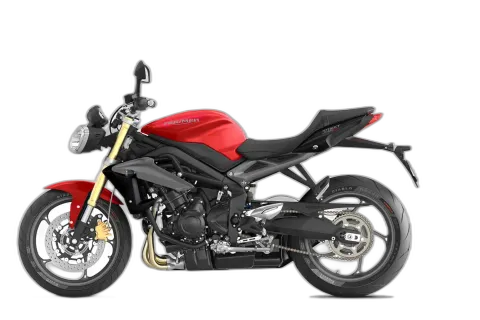
Headlight lens cracking on the final-year angular units
bodywork occasional
The plastic lenses of the angular twin headlights fitted to the final model year of this generation can crack without any impact damage, with fine cracks spreading across the lens over time. The earlier round headlights are not part of this pattern. Triumph answered with a dealer service bulletin rather than a safety recall, and owners report cracked units being replaced free of charge with a revised, tougher part.