By NastyNils·
Motorcycle comparison · Supersport
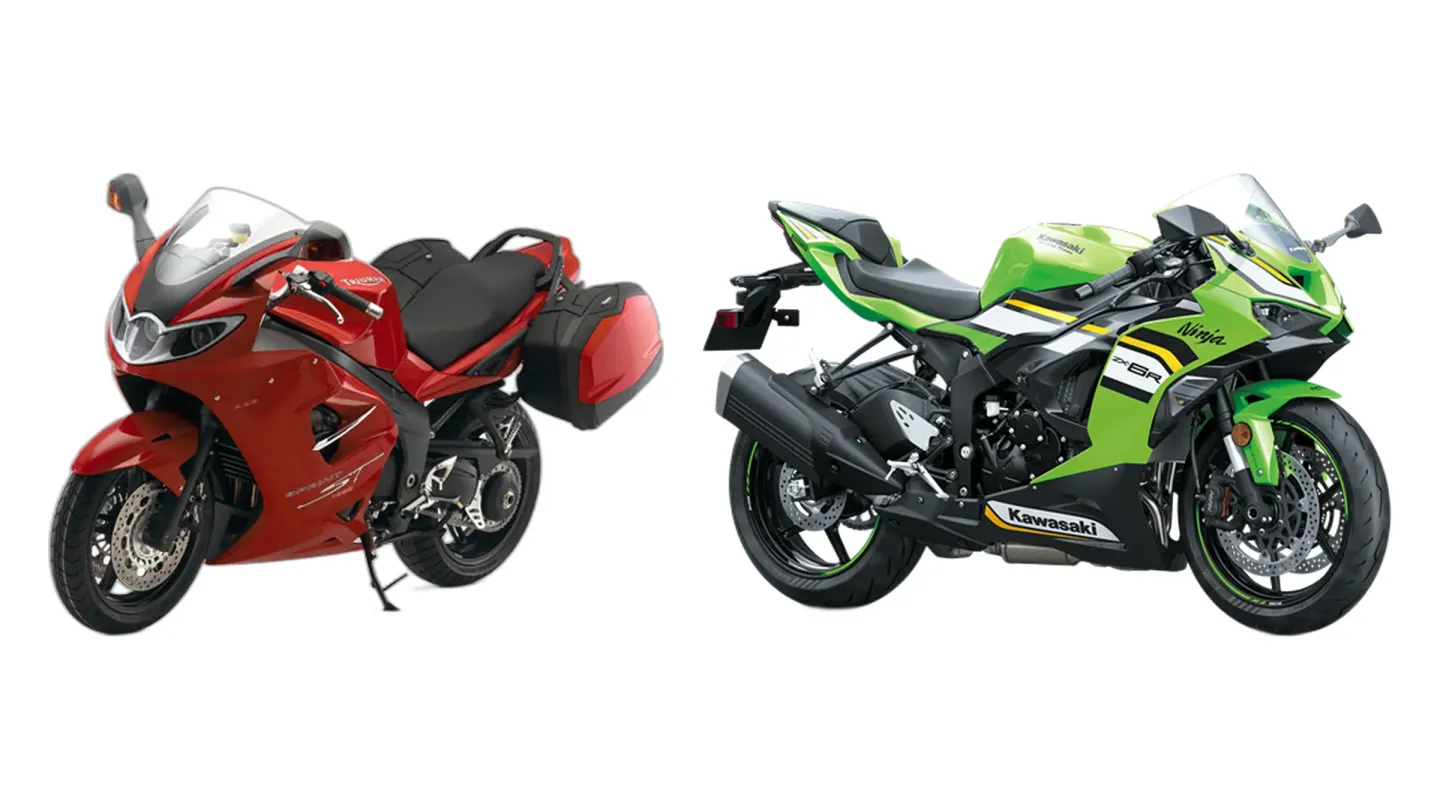
Triumph Daytona 675 (D67LC) vs Kawasaki Ninja ZX-6R (ZX600R)
Triumph Daytona 675 vs Kawasaki Ninja ZX-6R: which one to buy for the riding you do.
Rolling through a run of sweepers in second gear, the Triumph Daytona 675's motor doesn't protest at lazy revs. On the Kawasaki Ninja ZX-6R, the inline-four's happiest wound up toward the redline. Past the midrange, it keeps pulling harder.
So which one do you buy?
The Ninja ZX-6R has the edge if…
Racetrack use
Nose ahead: Ninja ZX-6R
On a circuit, the Ninja ZX-6R feels a little sharper. Credit stronger brakes. The margin is thin, and setup can close it.
Keeping running costs low
Edges it: Ninja ZX-6R
On running costs, the Ninja ZX-6R edges it. Not by enough to bank on.
Sporty riding on twisty roads
A touch ahead: Ninja ZX-6R
On a winding road, the Ninja ZX-6R comes out a touch ahead. You wouldn't bet much on a gap like that.
Daily commuting & city riding
Slight edge: Ninja ZX-6R
For the ride to work, the Ninja ZX-6R noses ahead. Don't let that alone make the call.
What makes each one tick
Daytona 675
Slim at the tank, the Daytona 675 goes exactly where it's pointed and flicks from one lean to the other through an S-bend. The suspension soaks up a mid-corner bump on patchy asphalt, and there's no hard jolt sent up to the bars. The chassis stays quiet on exit. Its damping hasn't faded by the final lap.
Ninja ZX-6R
Up top, the Ninja ZX-6R's four-cylinder keeps rushing, yet it pulls cleanly from low engine speed for relaxed road work. At corner entry, the Showa Big Piston Fork sends back clear feedback, and the front's quick to tuck in. Its brakes won't fade. The intake howls as the tach climbs.
Nils rode the Ninja ZX-6R in Japan in 2008 (NastyNils Testride).
The Voice of Experience

What actually separates them
- The Daytona 675 has the lower wet weight: 408 lb (185 kg) vs 421 lb (191 kg).
- The Daytona 675 makes more peak torque: 53 lb-ft (72 Nm) vs 49 lb-ft (67 Nm).
- The Daytona 675 has the larger engine: 675 cc vs 599 cc.
Which one for the way you ride
A confidence-building first motorcycle
Not built for this
Neither one is where you should learn. Get a season on something gentler first.
Who each one is built for
What's good, and what you'll live with
Daytona 675
Strengths
- Goes Exactly Where You Point
- Settled On Rough Corners
- Holds Up To Hard Use
- One Gear, Most Situations
- Characterful inline-triple engine
Trade-offs
- Throttle Lag Off A Closed Corner
- Rear Moves Under Hard Braking In Lean
- Track Tires Wear Fast
- Cramped, track-focused ergonomics
Ninja ZX-6R
What owners say
Strengths
- Sharp, race‑derived handling
- Class‑leading power and top‑end rush
Known problems to check before you buy
Daytona 675
- Regulator/rectifier overheating and failure Recall 12V445000 The regulator/rectifier can overheat, preventing charging and causing the motorcycle to stall. An NHTSA recall (12V445000) was issued covering 2006–2009 Daytona 675 models.
- EXUP valve sticking The exhaust valve (EXUP) can seize or become noisy, triggering the check engine light and potentially affecting mid-range power. Often requires adjustment or replacement.
Ninja ZX-6R
- Regulator/rectifier charging failure (recall) Recall 12V064000 A manufacturing error causes the regulator/rectifier to insufficiently charge the battery. This may lead to sudden stalling without warning. Kawasaki recalled MY2009–2012 ZX‑6R models to replace the unit free of charge.
- Intermittent ticking noise from engine top‑end Some owners report a pronounced ticking or knocking sound, often attributed to the automatic cam‑chain tensioner or piston slap when cold. Usually considered a characteristic rather than a mechanical fault, but valves and CCT should be inspected if noise is excessive.
What they share
- Cooling
- Liquid-cooled
- Gearbox
- 6-speed
- Final drive
- Chain
- Front tire
- 120/70-17
- Rear tire
- 180/55-17
Where the spec sheets split
| Daytona 675 | Ninja ZX-6R | |
|---|---|---|
| Seat height | 32.5 in (825 mm) | 32.1 in (815 mm) |
| Wet weight | 408 lb (185 kg) | 421 lb (191 kg) |
| Daytona 675 | Ninja ZX-6R | |
|---|---|---|
| Displacement | 675 cc | 599 cc |
| Engine | Inline-three | Inline-four |
| Power | 123 hp (92 kW) | 128 hp (94 kW) |
| Peak power at | 12,600 rpm | 14,000 rpm |
| Torque | 53 lb-ft (72 Nm) | 49 lb-ft (67 Nm) |
| Daytona 675 | Ninja ZX-6R | |
|---|---|---|
| Fuel capacity | 4.6 US gal (17.5 L) | 4.5 US gal (17 L) |
| Daytona 675 | Ninja ZX-6R | |
|---|---|---|
| Fork | Upside-down (USD) | Telescopic |
| Front brake | 308 mm | 300 mm |
| Wheelbase | 54.9 in (1395 mm) | 55.1 in (1400 mm) |
What comes fitted, what costs extra
| Daytona 675 | Ninja ZX-6R | |
|---|---|---|
| Slipper Clutch | Not offered | Standard |
Head to head, area by area
Both bikes on the same scale, one area at a time.