By NastyNils· ·
Motorcycle comparison · Supersport
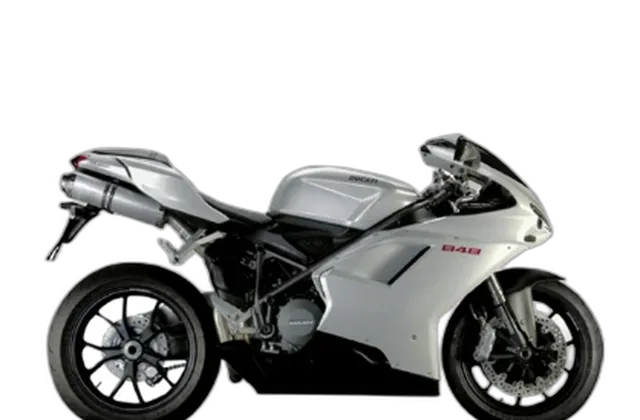
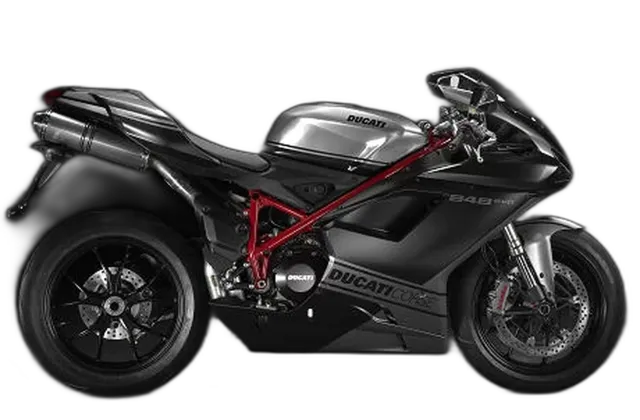
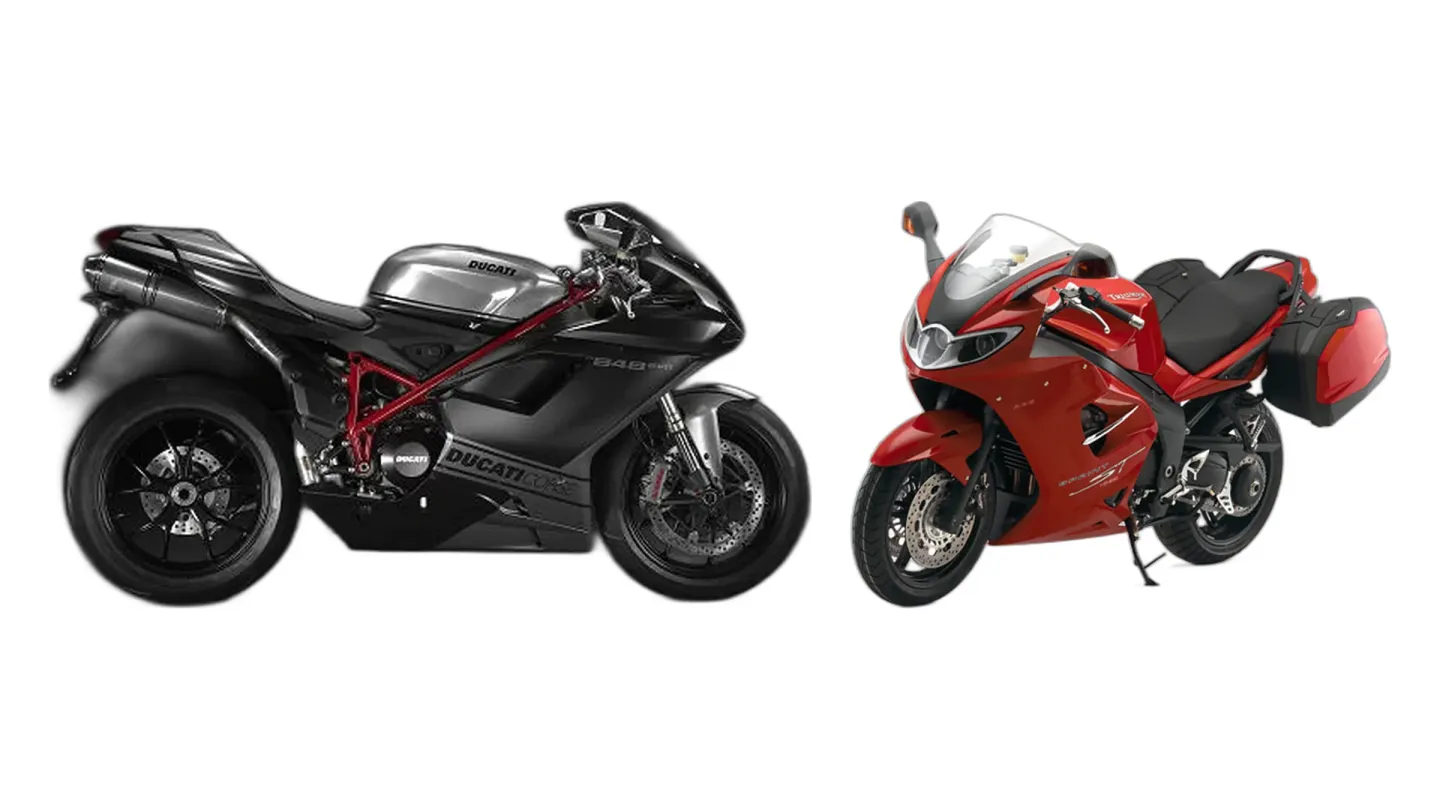
Ducati 848 EVO (MY2011) vs Triumph Daytona 675 (D67LC)
Ducati 848 EVO vs Triumph Daytona 675: which one to buy for the riding you do.
Tip the Ducati 848 EVO into a bend and it's pointed at the apex the instant you ask, with the front reporting every inch of the way in. The Triumph Daytona 675 doesn't need a downshift for it.
So which one do you buy?
The Daytona 675 has the edge if…
Daily commuting & city riding
Slight edge: Daytona 675
Day in, day out, the Daytona 675 nudges ahead in traffic. It's down to a smaller footprint. It isn't a big enough gap to plan around.
What makes each one tick
848 EVO
There's a hard bark from under the seat every time the 848 EVO's V-twin answers the throttle. A bump on broken pavement comes straight up through the seat. The firm setup won't hide it. The bars keep telling you what the tire's doing.
Daytona 675
Broken mountain asphalt doesn't rattle the Daytona's chassis or send sharp jolts up through the seat. Back the damping off and the ride quality transforms. The brake lever's bite doesn't fade after hours of hard laps. The triple doesn't protest at low revs, and second gear handles most of a twisty road. The slim chassis flicks through S-bends.
The Voice of Experience

What actually separates them
- The Daytona 675 has the lower wet weight: 408 lb (185 kg) vs 430 lb (195 kg).
- The 848 EVO makes more peak power: 140 hp (103 kW) vs 123 hp (92 kW).
- The 848 EVO makes more peak torque: 72 lb-ft (98 Nm) vs 53 lb-ft (72 Nm).
Which one for the way you ride
A confidence-building first motorcycle
Not their thing
If this is your first motorcycle, keep looking. Neither one makes learning easy.
Call it even on track days, twisty roads, and running costs. Choose on fit, price and the one that makes you grin.
Who each one is built for
What's good, and what you'll live with
848 EVO
What owners say
Strengths
- Iconic Italian design
- Precise, race-bred handling
- Soulful, charismatic V-twin engine
- Strong Brembo braking system
Trade-offs
- Excessive engine heat in slow riding
- Unforgiving ergonomics for street use
- Firm suspension on rough roads
- No ABS or electronic rider aids
Daytona 675
Strengths
- Goes Exactly Where You Point
- Settled On Rough Corners
- Holds Up To Hard Use
- One Gear, Most Situations
- Characterful inline-triple engine
Trade-offs
- Throttle Lag Off A Closed Corner
- Rear Moves Under Hard Braking In Lean
- Track Tires Wear Fast
- Cramped, track-focused ergonomics
Known problems to check before you buy
848 EVO
- Rear brake pad friction material detachment (recall 12V-188) Recall 12V188000 On 2012 models, the rear brake pad friction material may separate from the backing plate, causing sudden loss of rear braking efficiency. Ducati issued a recall to replace pads.
- Hard starting due to low-capacity battery terminals Many owners report slow cranking and failure to start, especially when cold. Upgrading to heavier-gauge battery cables (e.g., Motolectric HICAP) often resolves this.
- Fuel tank swelling from ethanol-blended fuel The plastic fuel tank can deform and swell when exposed to ethanol, making removal difficult and potentially causing fitment issues.
- Voltage regulator / rectifier failure The stock voltage regulator is prone to overheating and failure, causing charging system problems and electrical gremlins. Upgrading to a more robust unit is a common fix.
Daytona 675
- Regulator/rectifier overheating and failure Recall 12V445000 The regulator/rectifier can overheat, preventing charging and causing the motorcycle to stall. An NHTSA recall (12V445000) was issued covering 2006–2009 Daytona 675 models.
- EXUP valve sticking The exhaust valve (EXUP) can seize or become noisy, triggering the check engine light and potentially affecting mid-range power. Often requires adjustment or replacement.
What they share
- Cooling
- Liquid-cooled
- Gearbox
- 6-speed
- Final drive
- Chain
- Fork
- Upside-down (USD)
- Front tire
- 120/70-17
- Rear tire
- 180/55-17
Where the spec sheets split
| 848 EVO | Daytona 675 | |
|---|---|---|
| Seat height | 32.7 in (830 mm) | 32.5 in (825 mm) |
| Wet weight | 430 lb (195 kg) | 408 lb (185 kg) |
| 848 EVO | Daytona 675 | |
|---|---|---|
| Displacement | 849 cc | 675 cc |
| Engine | 90° V-twin | Inline-three |
| Power | 140 hp (103 kW) | 123 hp (92 kW) |
| Peak power at | 10,500 rpm | 12,600 rpm |
| Torque | 72 lb-ft (98 Nm) | 53 lb-ft (72 Nm) |
| Peak torque at | 9,750 rpm | 11,750 rpm |
| 848 EVO | Daytona 675 | |
|---|---|---|
| Fuel capacity | 4.1 US gal (15.5 L) | 4.6 US gal (17.5 L) |
| 848 EVO | Daytona 675 | |
|---|---|---|
| Front brake | 320 mm | 308 mm |
| Wheelbase | 56.3 in (1430 mm) | 54.9 in (1395 mm) |
Head to head, area by area
Both bikes on the same scale, one area at a time.