By NastyNils·
Motorcycle comparison · Supersport
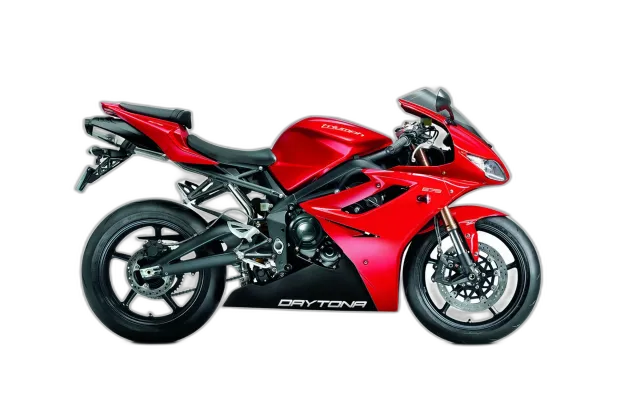
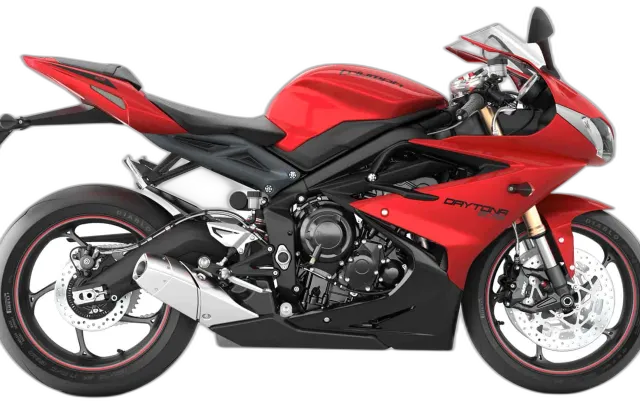
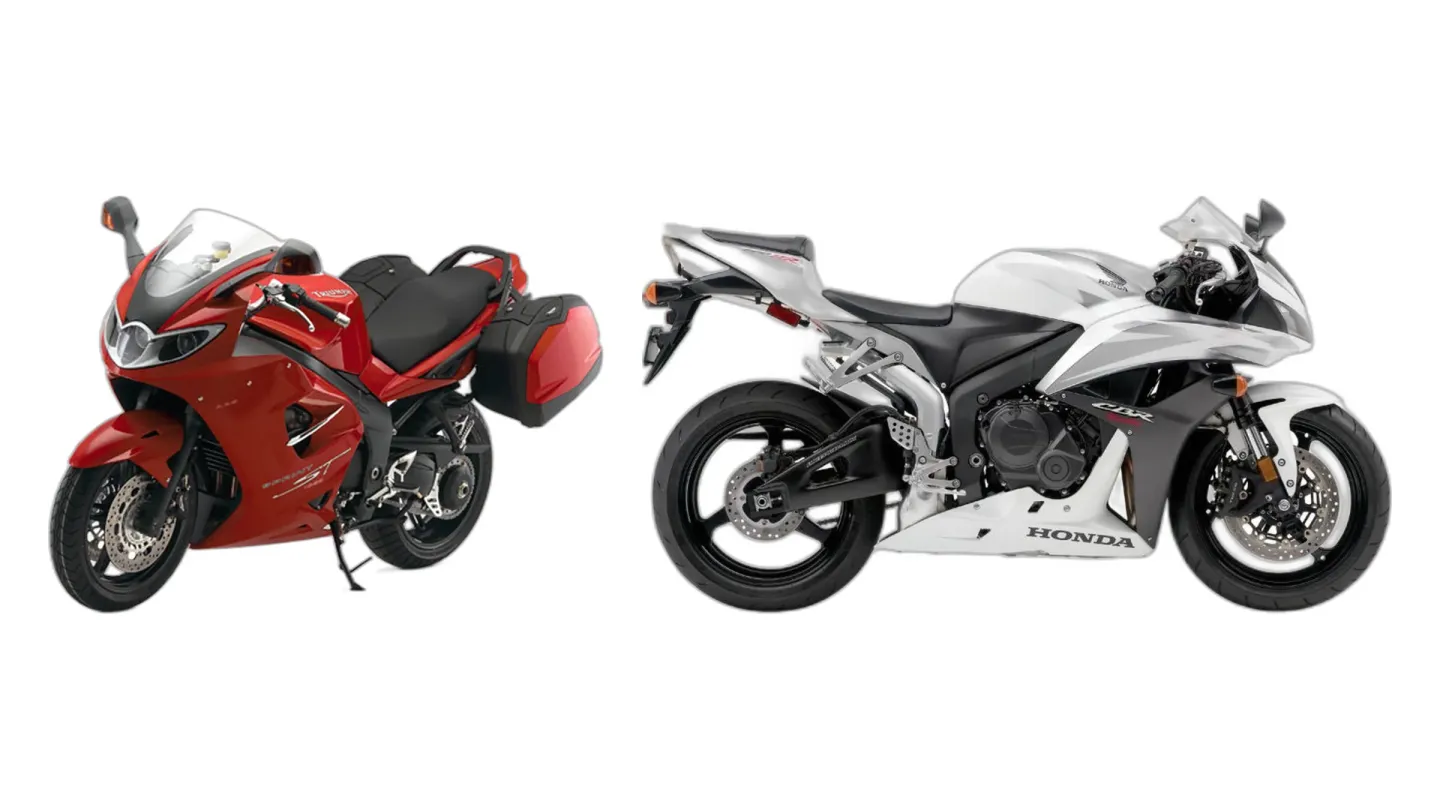
Triumph Daytona 675 (D67LC) vs Honda CBR600RR (PC 40)
Triumph Daytona 675 vs Honda CBR600RR: one garage spot. Here's what should decide it.
A long run of bends held in a single gear, and the Triumph Daytona 675 doesn't mind being ridden lazy. The Honda CBR600RR's engine shoves out of each exit with muscle that's already waiting in the middle revs. It doesn't keep begging for a downshift.
So which one do you buy?
The CBR600RR has the edge if…
Racetrack use
Slight edge: CBR600RR
On a circuit, the CBR600RR feels a little sharper. The margin is thin, and setup can close it.
Daily commuting & city riding
Inches ahead: CBR600RR
The CBR600RR makes slightly more sense as a commuter. Don't read much into a gap this small.
Keeping running costs low
Small edge: CBR600RR
Day to day, the CBR600RR works out slightly cheaper to own. The saving is small.
Sporty riding on twisty roads
Narrow edge: CBR600RR
The CBR600RR nudges ahead once the pavement starts to wiggle. Don't expect a night-and-day difference.
What makes each one tick
Daytona 675
Through a tight S-section, the Daytona's slim chassis and light tail swap from one side to the other without a fight. Mid-corner bumps and patchy track edges don't get the chassis twitching, and the bars stay quiet as the power comes back on. There's no fade at the brake lever, even after hours of hard laps on a demanding track. The fork keeps pace all day.
CBR600RR
Packed tight around its center, the CBR600RR's weight lets the bars swing it from side to side on the smallest nudge. Its compact perch folds you up tight, and the crouch doesn't stay easy over a full day. Corner entry is quick, since the front drops toward the apex the instant you ask and it stays steady once it's leaned over. On a backroad, the front's still carving its chosen line.
Nils rode the CBR600RR in Hungary in 2007, in Qatar in 2008, in Croatia/Dalmatia in 2013, and in Germany in 2017 (1000PS test reports).
The Voice of Experience

What actually separates them
- The Daytona 675 makes more peak torque: 53 lb-ft (72 Nm) vs 49 lb-ft (66 Nm).
- The Daytona 675 has the larger engine: 675 cc vs 599 cc.
- ABS: option (from 2009) on the CBR600RR, not offered on the Daytona 675.
Which one for the way you ride
Comfortable long-distance riding
Both fall short
Big miles aren't where either one shines. You'll be watching for the next rest stop.
Who each one is built for
What's good, and what you'll live with
Daytona 675
Strengths
- Goes Exactly Where You Point
- Settled On Rough Corners
- Holds Up To Hard Use
- One Gear, Most Situations
- Characterful inline-triple engine
Trade-offs
- Throttle Lag Off A Closed Corner
- Rear Moves Under Hard Braking In Lean
- Track Tires Wear Fast
- Cramped, track-focused ergonomics
CBR600RR
What owners say
Strengths
- Excellent build quality and reliability
- Strong midrange for a supersport
Trade-offs
- Cramped riding position
Known problems to check before you buy
Daytona 675
- Regulator/rectifier overheating and failure Recall 12V445000 The regulator/rectifier can overheat, preventing charging and causing the motorcycle to stall. An NHTSA recall (12V445000) was issued covering 2006–2009 Daytona 675 models.
- EXUP valve sticking The exhaust valve (EXUP) can seize or become noisy, triggering the check engine light and potentially affecting mid-range power. Often requires adjustment or replacement.
CBR600RR
- Fuel pump impeller may deform and cause failure Recall 24V864000 A recall covers certain 2007 and 2009-2017 CBR600RR models: improperly molded fuel pump impellers can deform, leading to sudden fuel pump failure and stalling.
What they share
- Cooling
- Liquid-cooled
- Gearbox
- 6-speed
- Final drive
- Chain
- Fork
- Upside-down (USD)
- Front tire
- 120/70-17
- Rear tire
- 180/55-17
Where the spec sheets split
| Daytona 675 | CBR600RR | |
|---|---|---|
| Seat height | 32.5 in (825 mm) | 32.3 in (820 mm) |
| Wet weight | 408 lb (185 kg) | 410 lb (186 kg) |
| Daytona 675 | CBR600RR | |
|---|---|---|
| Displacement | 675 cc | 599 cc |
| Engine | Inline-three | Inline-four |
| Power | 123 hp (92 kW) | 121 hp (89 kW) |
| Peak power at | 12,600 rpm | 13,500 rpm |
| Torque | 53 lb-ft (72 Nm) | 49 lb-ft (66 Nm) |
| Peak torque at | 11,750 rpm | 11,250 rpm |
| Daytona 675 | CBR600RR | |
|---|---|---|
| Fuel capacity | 4.6 US gal (17.5 L) | 4.8 US gal (18.2 L) |
| Daytona 675 | CBR600RR | |
|---|---|---|
| Front brake | 308 mm | 310 mm |
| Wheelbase | 54.9 in (1395 mm) | 54.1 in (1375 mm) |
What comes fitted, what costs extra
| Daytona 675 | CBR600RR | |
|---|---|---|
| ABS | Not offered | Option (from 2009) |
| Quickshifter | Not offered | Option |
Head to head, area by area
Both bikes on the same scale, one area at a time.