By NastyNils·
Motorcycle comparison · Hyper Naked vs Naked Bike
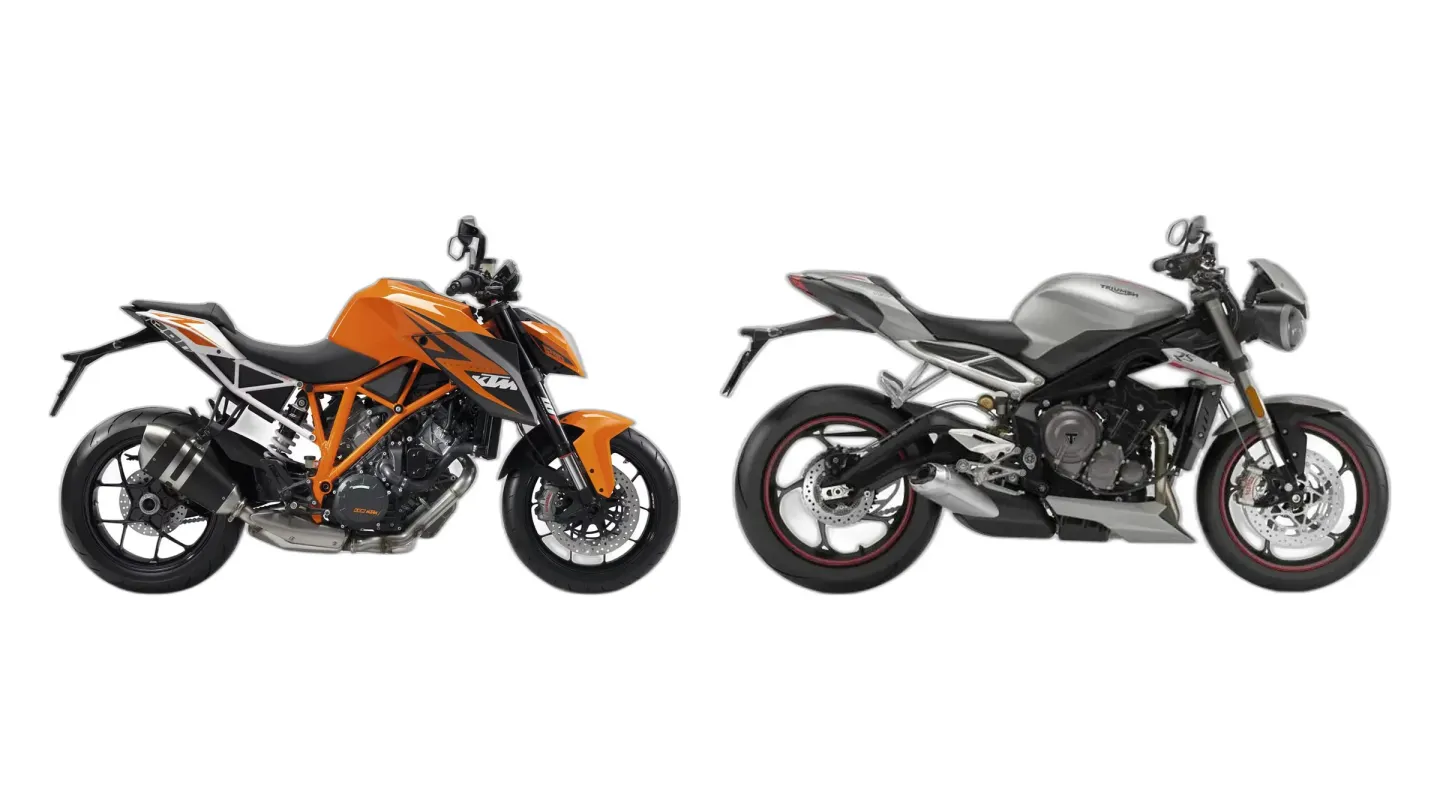
KTM 1290 Super Duke R (MY2014) vs Triumph Street Triple 765 RS (MY2017)
Roll the throttle wide open down a long straight, and the KTM 1290 Super Duke R doesn't give a superbike an inch. On the Triumph Street Triple 765 RS, the throttle digs in from low revs and keeps winding up. Up top, it surges with a howl that's its own.
So which one do you buy?
The Street Triple 765 RS has the edge if…
Keeping running costs low
Narrow edge: Street Triple 765 RS
The Street Triple 765 RS comes out a little ahead on upkeep. Only a little.
Daily commuting & city riding
Inches ahead: Street Triple 765 RS
The Street Triple 765 RS edges it for the daily grind. That comes from lighter steering and a smaller footprint. It's a small gap, not a reason on its own.
Sporty riding on twisty roads
By a nose: Street Triple 765 RS
In the twisties, the Street Triple 765 RS asks a bit less of you to go quickly. Call it a modest edge.
Which one's the smarter buy
Different bikes, different deals
These bikes sit in different classes, so there's no clear better buy for the money. The Street Triple 765 RS costs less, but that doesn't make it the value winner.
What makes each one tick
1290 Super Duke R
There's a supermoto stance to the Super Duke's riding position, and it isn't set up for all-day touring. On the brake lever, the bike stops while the fork sends back feedback you can read. The shock talks back too. On a racetrack, it doesn't need to make excuses.
Nils rode the 1290 Super Duke R in Andalusia in 2013, in Andalusia, Austria, Hungary, and the Czech Republic in 2014, in 2015, and in Austria in 2017 (NastyNils Testride).
Street Triple 765 RS
There's so little weight and wheelbase to the Street Triple that it flicks from bend to bend. On the Angeles Crest Highway, the bike steers into each bend while the Showa fork and Öhlins shock keep the front settled. Legal speeds don't feel slow. The Brembos bite progressively and hold up on long descents.
Nils rode the Street Triple 765 RS in Austria in 2017 (NastyNils Testride).
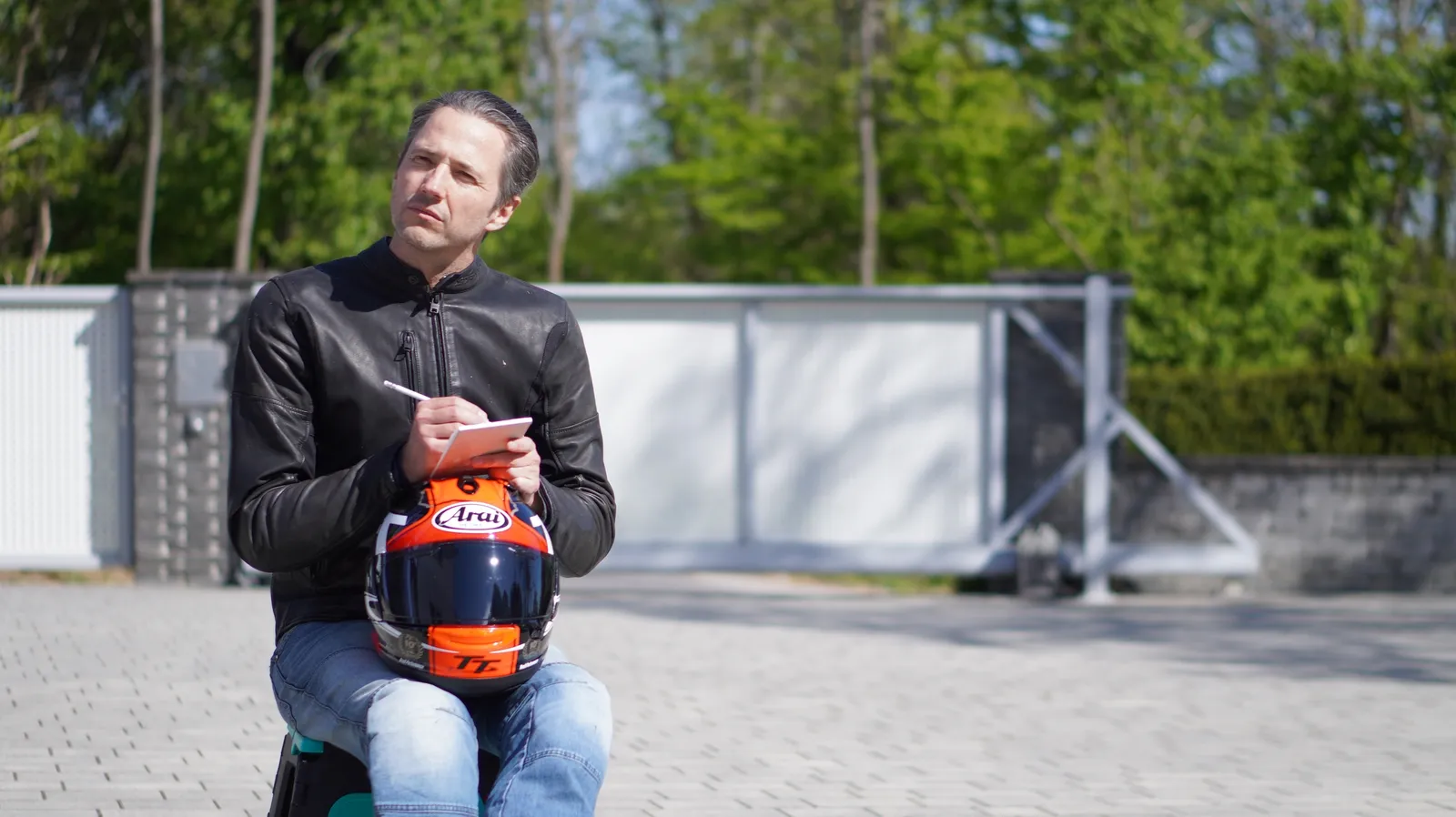
The Voice of Experience
What actually separates them
- The 1290 Super Duke R makes more peak power: 179 hp (132 kW) vs 121 hp (90 kW).
- The 1290 Super Duke R makes more peak torque: 106 lb-ft (144 Nm) vs 57 lb-ft (77 Nm).
- The 1290 Super Duke R has the larger engine: 1301 cc vs 765 cc.
Which one for the way you ride
Comfortable long-distance riding
Not their thing
Both of these get tiring on a long day. A proper tourer will treat you better on big miles.
Traveling with luggage
Neither is a natural fit
Multi-day trips with luggage aren't their thing. Travel light, or travel on something else.
Who each one is built for
What's good, and what you'll live with
1290 Super Duke R
Strengths
- Lean Clearance For Days
- Built Right For Tall Riders
- Electronics That Enable, Not Dull
- It Holds Up Long Term
- Brembo M50 stopping power
Trade-offs
- Stock Pipe Sounds Lifeless
- Nothing Between You And The Wind
- Long Sweepers Expose The Chassis
- Insurance Bites Younger Buyers
- Aggressive ergonomics, limited long-distance comfort
Street Triple 765 RS
What owners say
Strengths
- Exceptional engine character
- Class-leading handling and agility
- Build quality and finish
- Premium braking performance
Trade-offs
- Bar-end mirror vibration (RS only)
- Firm, track-oriented suspension
- Snatchy low-speed throttle response
- Heat in traffic
- TFT readability issues
Known problems to check before you buy
1290 Super Duke R
- Brembo radial master cylinder plastic piston cracking — recall (NHTSA Recall 18V-033) Recall 18V033000 The plastic (PPS polymer) piston in the front master cylinder could crack or break under heavy load, hard ABS engagement, or after a tip-over, leading to loss of front-brake function. Remedy: dealer replaces the plastic piston with an aluminum piston.
- Fuel tank threaded-insert leak — recall (NHTSA Recall 15V-441) Recall 15V441000 Threaded inserts at the rear of the plastic fuel tank could leak fuel due to a coating-process irregularity in tank manufacture. Risk of fuel ignition if combined with an ignition source. KTM notified affected owners; remedy was inspection and sealing of the inserts, or tank replacement where an existing leak was found.
- Radiator top-rail seam splitting The top-right (sometimes top-left) seam of the radiator splits along the upper rail. Owners attribute the failure to radiator-mount design and stress transfer from the freely-rotating exhaust clamp. Symptom: visible coolant weep from the upper radiator seam, eventual coolant loss and overheating risk.
- Clutch slave cylinder rubber-seal swelling and air ingress The OEM clutch slave cylinder rubber seal swells over time, causing internal corrosion and air ingress in the hydraulic line. Symptoms: milky or dark clutch fluid, hard-to-find neutral, hot-clutch fade, repeated bleeding required. Re-sealing rarely lasts; owners typically replace with billet aftermarket units (Oberon, Rottweiler).
- Hydraulic cam chain tensioner loses pressure The factory cam chain tensioner is hydraulic and runs on engine oil pressure. It can bleed down or fail to hold pressure, which leaves the timing chain slack. The usual symptom is a ticking or rattling noise from the cam chain area, most noticeable at idle or just after a cold start before oil pressure builds.
- Fuel pump failure — low fuel pressure, stalling, no-start "Fuel Pump Failure" warning, bike cuts out, hangs at approximately 5,500 rpm, will not restart. KTM identified the fuel filter and/or pump motor as the cause of low fuel pressure; a replacement kit (seals, gaskets, filters, motor) is supplied by the dealer.
- Rear wheel bearing failure due to swingarm water ingress The Gen 1 single-sided swingarm has no internal drain hole. Water collects inside the swingarm, corroding the rear wheel hub bearings. Symptoms: vague "steering" feel from the rear wheel under on/off throttle. Owners frequently find a half-cup of water when removing the axle adjuster. KTM addressed this on the Gen 2 swingarm by adding a drain hole — a tacit confirmation of the Gen 1 design defect.
- Side-stand sensor failure — no-start or stalling Side-stand sensor fails — often a magnet-related fault contaminated by chain-area debris. Bike will not start or stalls when in gear. The 1290 sensor uses a 50% duty-cycle pulse, so a simple bypass requires a dedicated dongle (Rottweiler, Vanasche).
- Jerky on/off throttle transition at low rpm Snatchy on/off transition at 2,500–3,500 rpm, particularly noticeable in Rain mode. Stock fueling is lean for emissions compliance. Many owners install aftermarket fueling modules (Rottweiler, Power Commander) or apply ECU updates from the dealer; outcomes vary.
- Front fork seals develop weeping / "tide marks" The seals on the WP upside-down fork can start to weep over time. Oily tide marks show up on the fork tubes just below the seals. The leak tends to come on gradually with use rather than being present from new. If left alone, the seeping fork oil leaves a residue that collects road grime and slowly lowers the oil level in the affected leg.
- Front brake light switch error / brake light stuck on Omron switch on the Brembo master cylinder fails. "Front Brake Switch" error appears on the dash; brake light may be stuck on, or a fault code is logged. Wire-routing strain at the master cylinder is the documented cause. Some owners report MTC (traction control) faults as a downstream side effect.
Street Triple 765 RS
- TFT display total failure or partial failure The TFT instrument cluster can fail completely with a dead screen, or fail partially with white patches, dead pixels or flickering. Because the cluster is part of the immobilizer handshake, a total failure can stop the bike from starting. The cluster housing is bonded shut, so it can't be repaired at component level and the whole unit has to be replaced. Earlier model years of this generation are more prone to total failure. Later model years more often show partial white-patch failures. Known triggers include battery replacement or disconnection, moisture getting into the housing, and age. The manufacturer has replaced some units as a goodwill gesture but has not acknowledged a systemic defect.
- Catastrophic inlet valve head detachment An inlet valve head can separate from its stem and drop into the combustion chamber. The loose valve head then destroys the piston, the cylinder bore and the combustion chamber surfaces, and the engine fails outright. Failures have happened at moderate mileage with no warning, in different cylinders, and on more than one engine. Metallurgical analysis and dyno testing have not found a clear root cause. Across the wider fleet the failure appears to be very rare, but when it happens the engine is destroyed and the rear wheel can lock.
- Engine cutting out randomly while riding Multiple owners report the engine cutting out randomly while riding — including at constant speed, during braking, and after acceleration. Display stays on and no error codes are stored, making diagnosis difficult. Confirmed root causes across different cases include: faulty stator/pickup coil, dislodged fuel pump seal causing intermittent fuel delivery, and ECU map issues (resolved by dealer reflash). Affects primarily 2020 and 2022 models based on forum reports.
- Quickshifter intermittent failure and false neutrals The Triumph Shift Assist (TSA) quickshifter can exhibit intermittent failures, particularly on the 1st-to-2nd upshift, resulting in false neutrals or missed gears. Some units had a faulty quickshifter sensor that Triumph revised during production. Known remedies: ECU reset (battery disconnect + cycling through all gears), software reflash, and sensor replacement. The first oil change (from factory fill to service oil) reportedly improves shifting behaviour.
- Front brake disc warping or pad deposit causing pulsation Some owners report pulsation through the front brake lever, particularly during hard braking at higher speeds. Can be caused by actual disc warping or by uneven brake pad material deposits on the disc surface (more common). Cleaning discs and pads with acetone and a re-bedding procedure often resolves deposit-related pulsation. Some owners have had discs replaced under warranty.
- Stock bar-end mirrors vibrate excessively at speed The OEM bar-end mirrors on the RS model vibrate significantly at most engine speeds, rendering rearward visibility poor at higher speeds. This is one of the most commonly cited owner complaints and a near-universal first modification. Most owners replace them with aftermarket units (Rizoma, CRG, etc.). Note: this is an RS-specific issue — the R model uses conventional stalk mirrors that do not exhibit this problem.
- Oil weeping from alternator cover gasket Minor oil weeping from the alternator cover gasket is a widely reported issue. Dealers confirm "it happens on a lot of these bikes." Root cause is frequently undertorqued bolts from the factory — mechanics report bikes arriving for the first service with alternator cover bolts at a lower torque than specified. The leak is typically a slow weep (one drop after each ride) rather than a heavy drip. Oil levels usually remain stable. Retorquing the bolts to specification resolves the issue in most cases; some bikes require gasket replacement. Affects all trim levels (S/R/RS).
- Cam chain rattle/slap on cold startup The hydraulic cam chain tensioner can bleed down after the bike sits for extended periods (overnight or longer), causing a noticeable chain rattle on cold startup until oil pressure builds. Common to many Triumph triple engines. Aftermarket manual cam chain tensioners available as a permanent fix. Dealers report that many 765 engines develop tight exhaust valves, which can exacerbate perceived engine noise.
What they cost used
These prices compare a 7-year-old 1290 Super Duke R with a 7-year-old Street Triple 765 RS.
- 1290 Super Duke R
- about $10,000
- Street Triple 765 RS
- about $7,500
At seven years old, the KTM 1290 Super Duke R sits around $10,000 while the Triumph Street Triple 765 RS lands near $7,500. That's a $2,500 gap in the Street Triple's favor. These are US market estimates, not live listings.
What they share
- Cooling
- Liquid-cooled
- Gearbox
- 6-speed
- Final drive
- Chain
- Front tire
- 120/70-17
Where the spec sheets split
| 1290 Super Duke R | Street Triple 765 RS | |
|---|---|---|
| Seat height | 32.9 in (835 mm) | 32.5 in (825 mm) |
| Dry weight | 417 lb (189 kg) | 366 lb (166 kg) |
| 1290 Super Duke R | Street Triple 765 RS | |
|---|---|---|
| Displacement | 1301 cc | 765 cc |
| Engine | 75° V-twin | Inline-three |
| Power | 179 hp (132 kW) | 121 hp (90 kW) |
| Torque | 106 lb-ft (144 Nm) | 57 lb-ft (77 Nm) |
| Top speed | 180 mph (290 km/h) | 145 mph (233 km/h) |
| 1290 Super Duke R | Street Triple 765 RS | |
|---|---|---|
| Fuel economy | 31 mpg (US) / 7.5 L/100 km | 50 mpg (US) / 4.7 L/100 km |
| Fuel capacity | 4.8 US gal (18 L) | 4.6 US gal (17.4 L) |
| 1290 Super Duke R | Street Triple 765 RS | |
|---|---|---|
| Front brake | 320 mm | 310 mm |
| Rear tire | 190/55-17 | 180/55-17 |
| Wheelbase | 58.3 in (1482 mm) | 55.3 in (1405 mm) |
What comes fitted, what costs extra
| 1290 Super Duke R | Street Triple 765 RS | |
|---|---|---|
| Cornering ABS | Standard (from 2017) | Not offered |
| Steering Damper | Standard | Not offered |
| Cruise Control | Standard (from 2017) | Not offered |
| Quickshifter | Not offered | Standard |
| TFT Display | Standard (from 2017) | Standard |
| Tire Pressure Monitoring (TPMS) | Standard | Option |
| LED Headlight | Standard (from 2017) | Not offered |
Head to head, area by area
Both bikes on the same scale, one area at a time.