By NastyNils· ·
Motorcycle comparison · Supersport
Yamaha YZF-R1 (RN22) vs Honda CBR1000RR (SC59)
Yamaha YZF-R1 vs Honda CBR1000RR: which one to buy for the riding you do.
Winding out of a fast bend on stock rubber, the Yamaha YZF-R1 doesn't hide what its rear tire's doing from your right hand. On that same grip the Honda CBR1000RR hauls out of the exit with its frame and steering damper holding the front quiet. Its bars don't twitch as the speed piles on.
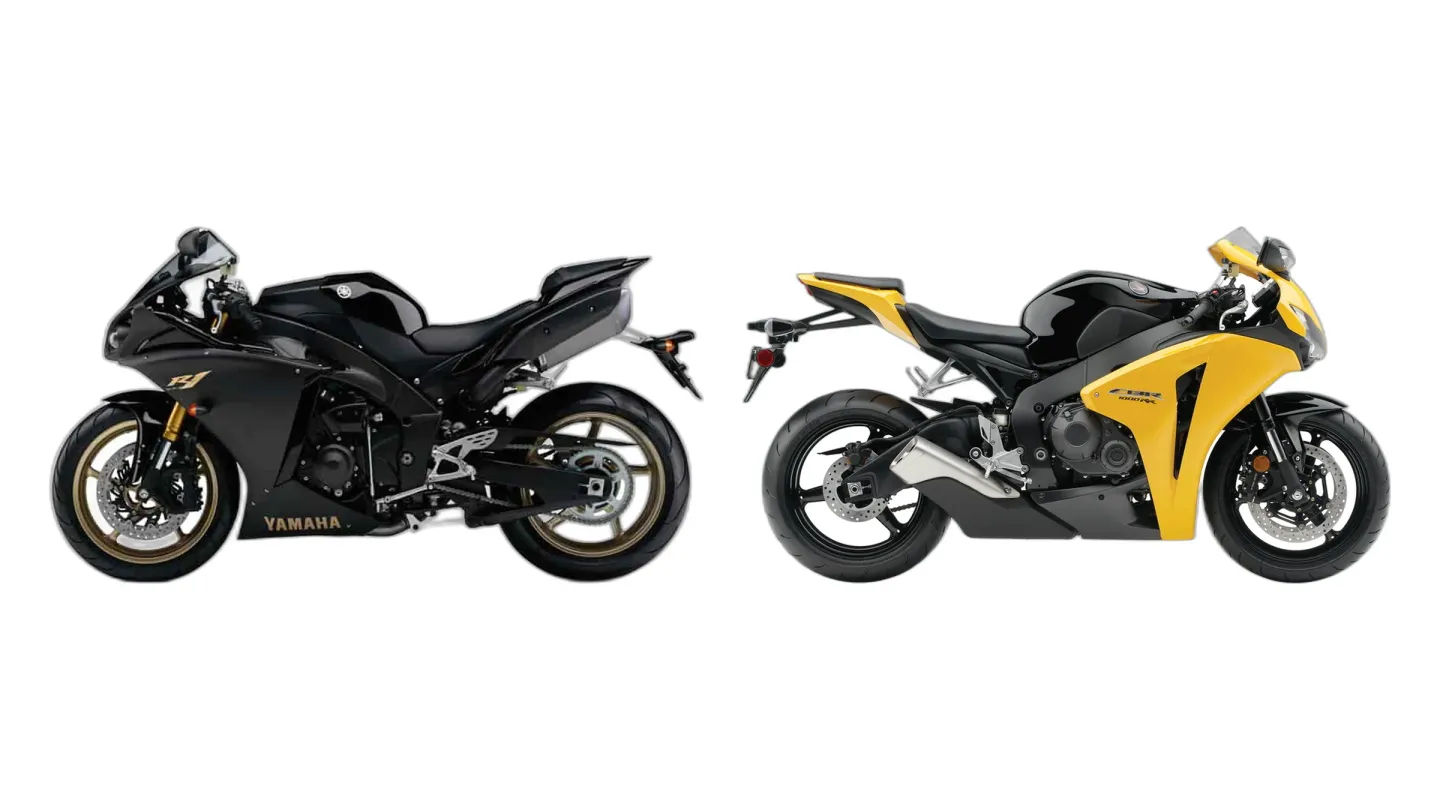
So which one do you buy?
The YZF-R1 has the edge if…
Racetrack use
A touch ahead: YZF-R1
On a closed course, the YZF-R1 edges ahead. What tips it: stronger brakes. Not by enough to settle it.
The CBR1000RR has the edge if…
Daily commuting & city riding
Narrow edge: CBR1000RR
The CBR1000RR makes slightly more sense as a commuter. Most of that is lighter steering. Don't read much into a gap this small.
Sporty riding on twisty roads
Slight edge: CBR1000RR
Back-road fun leans slightly toward the CBR1000RR. That comes from a sportier chassis and more feel through the bars. It's a narrow call, so trust your test ride.
Which one's the smarter buy
Even on value
At these used prices, neither bike is the clear better buy for the money.
What makes each one tick
YZF-R1
Into a slow corner, a string of hard downshifts doesn't unsettle the YZF-R1's tail as it steers in. Blow the entry and the bike lets you fix it on the arc without a fight. Through a tight chicane it's slower to switch sides, and each change of direction takes an extra beat. At track pace, the soft suspension wallows. Its crossplane four puts traction ahead of headline numbers.
Nils rode the YZF-R1 in Australia in 2009, in 2010, in Spain in 2011, and in Portugal in 2012 (1000PS test reports).
CBR1000RR
Light on its wheels, the CBR1000RR flicks into a turn like a far smaller sportbike. There's clear feedback through the fork and shock when a bump comes up. The chassis stays rock-solid. Up top, the four's rush keeps building to redline.
The Voice of Experience

What actually separates them
- The CBR1000RR has the lower seat: 32.3 in (820 mm) vs 32.9 in (835 mm).
- The CBR1000RR has the lower wet weight: 439 lb (199 kg) vs 454 lb (206 kg).
- ABS: option (from 2009) on the CBR1000RR, not offered on the YZF-R1.
Which one for the way you ride
Comfortable long-distance riding
Look elsewhere
Hours in the saddle won't flatter either of these. They're happier on shorter runs.
There's no real gap on running costs. Sit on both and let fit and price decide.
Who each one is built for
What's good, and what you'll live with
YZF-R1
From Nils' own saddle time
Strengths
- Crossplane Voice, No Equal
- Forgiving, Planted Chassis
- Rear-Wheel Feel You Can Trust
- Crisp, Willing Gearbox
Trade-offs
- Top-End Trails The Class
- Suspension Too Soft For Track
- No ABS On Offer
- Heavy, Slow In Transitions
CBR1000RR
What owners say
Strengths
- Exceptionally balanced and stable chassis
- Lightweight, 600-like agility
- Renowned Honda build quality and reliability
- Smooth, top-end-focused engine
Known problems to check before you buy
YZF-R1
- Regulator/rectifier failure The factory regulator/rectifier is known to overheat and fail, leading to either a flat battery or, in worse cases, fried wiring at the connector.
- Cam chain tensioner wear and rattle Original spring-loaded cam chain tensioners can lose tension, causing a top-end rattle at idle and on overrun. The aftermarket APE manual tensioner is a popular fix.
- Stator failure The charging stator can fail prematurely, sometimes related to or causing R/R failure; symptoms include erratic voltage and progressive electrical issues.
- Fuel pump failure Some owners report fuel pump degradation leading to power loss at higher rpm or stalling; usually requires pump replacement.
- Snatchy fuelling at low rpm in STD/A mode Abrupt throttle response just off closed makes smooth low-speed riding difficult; many owners default to the softer B-map for town use.
CBR1000RR
- Fuel pump impeller stalling (safety recall) Recall 24V864000 A manufacturing defect in the fuel pump can cause the rubber impeller to swell and lock, cutting off fuel flow and causing the engine to stall without warning. Honda issued a safety recall for affected 2008–2016 CBR1000RR models to inspect and replace the fuel pump assembly.
What they cost used
Both bikes priced used at the same age: 15 years old.
- YZF-R1
- about $7,700
- CBR1000RR
- about $7,600
What they share
- Engine
- Inline-four
- Cooling
- Liquid-cooled
- Gearbox
- 6-speed
- Final drive
- Chain
- Fork
- Upside-down (USD)
- Front tire
- 120/70-17
Where the spec sheets split
| YZF-R1 | CBR1000RR | |
|---|---|---|
| Seat height | 32.9 in (835 mm) | 32.3 in (820 mm) |
| Wet weight | 454 lb (206 kg) | 439 lb (199 kg) |
| YZF-R1 | CBR1000RR | |
|---|---|---|
| Displacement | 998 cc | 999 cc |
| Power | 182 hp (134 kW) | 178 hp (131 kW) |
| Peak power at | 12,500 rpm | 12,000 rpm |
| Torque | 85 lb-ft (116 Nm) | 83 lb-ft (112 Nm) |
| Peak torque at | 10,000 rpm | 8,500 rpm |
| YZF-R1 | CBR1000RR | |
|---|---|---|
| Fuel economy | 33 mpg (US) / 7.2 L/100 km | 30 mpg (US) / 7.85 L/100 km |
| Fuel capacity | 4.8 US gal (18 L) | 4.7 US gal (17.7 L) |
| YZF-R1 | CBR1000RR | |
|---|---|---|
| Front brake | 310 mm | 320 mm |
| Rear tire | 190/55-17 | 190/50-17 |
| Wheelbase | 55.7 in (1415 mm) | 55.4 in (1407 mm) |
What comes fitted, what costs extra
| YZF-R1 | CBR1000RR | |
|---|---|---|
| ABS | Not offered | Option (from 2009) |
| Traction Control | Standard (from 2012) | Not offered |
| Ride Modes | Standard | Not offered |
Head to head, area by area
Both bikes on the same scale, one area at a time.