By NastyNils·
Motorcycle comparison · Supersport vs Naked Bike
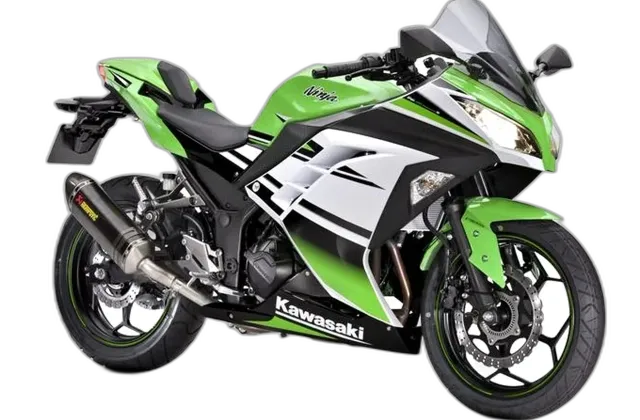
Kawasaki Ninja 300 (MY2013) vs KTM 390 Duke (MY2013)
Kawasaki Ninja 300 vs KTM 390 Duke: where they split, and which one to buy.
You'll feel the Kawasaki Ninja 300 tip into a bend on a light nudge, and it's happy to flick straight over into the next one. The KTM 390 Duke's front doesn't ease in at all: it darts for the apex with a snap. Then it settles without biting back.
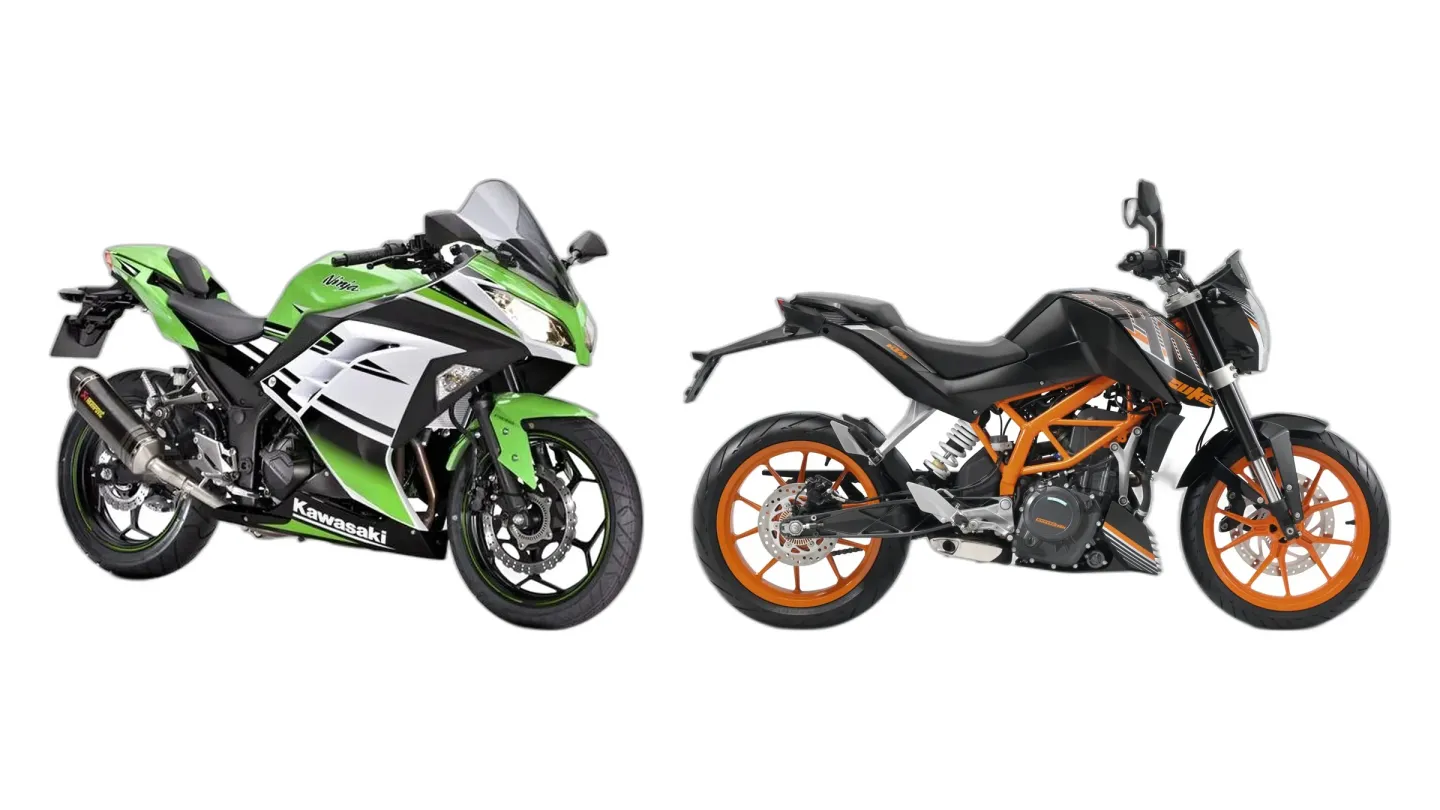
So which one do you buy?
Buy the 390 Duke if…
Daily commuting & city riding
The pick: 390 Duke
The 390 Duke suits a daily commute clearly better. In traffic, it's simply less work.
The Ninja 300 has the edge if…
Traveling with luggage
Edges it: Ninja 300
The Ninja 300 feels a little more at home with bags on. The reason: more range per tank and better wind protection. It's a fine margin, so test both loaded if you can.
The 390 Duke has the edge if…
Sporty riding on twisty roads
Slight edge: 390 Duke
Once the road starts to bend, the 390 Duke noses ahead. What tips it: better suspension. Your own skill counts for more than a gap this size.
Which one's the smarter buy
Apples and oranges
The Ninja 300 and 390 Duke sit in different classes, so neither is the clear better buy for the money. You're weighing a supersport against a naked bike, not a price tag.
What makes each one tick
Ninja 300
The Ninja 300's twin doesn't come alive until you wind it hard. There's a real rush waiting near the top of the tach. The bars don't stretch you down, and the seat sits low at 30.9 in (785 mm). The clutch lever barely fights back.
390 Duke
Built on a tiny chassis shared with a smaller KTM, the 390 Duke slips through city traffic like a small bike with a big bike's punch. Low in the revs, the single doesn't surge or stumble as the throttle opens. The fueling's clean enough to ride it like any ordinary motorcycle. The single keeps clawing for revs.
Nils rode the 390 Duke in Salzburg State in 2013 (NastyNils Testride).
The Voice of Experience

What actually separates them
- The Ninja 300 has the lower seat: 30.9 in (785 mm) vs 31.5 in (800 mm).
- The 390 Duke makes more peak power: 44 hp (32 kW) vs 39 hp (29 kW).
- The 390 Duke makes more peak torque: 26 lb-ft (35 Nm) vs 20 lb-ft (27 Nm).
Which one for the way you ride
Comfortable long-distance riding
Wrong job for both
For all-day comfort, both fall short. Keep the rides short and you'll get on fine with either.
Nothing splits them on a first bike. Ride both back to back and the decision usually makes itself.
Who each one is built for
What's good, and what you'll live with
Ninja 300
What owners say
Strengths
- Lightweight and maneuverable handling
- High-revving, entertaining engine
- Rider-friendly ergonomics and practicality
390 Duke
Strengths
- Snaps Into Corners Without Punishing You
- The Motor Wants Revs
- Fueling Is Genuinely Good
- ABS That Actually Works
- Lightweight and agile handling
Trade-offs
- Knee Angle Cramps Tall Riders
- No Screen From The Factory
- Bolts Work Themselves Loose
- Questionable build quality and reliability
- Uncomfortable for longer rides
Known problems to check before you buy
Ninja 300
- Front ABS sensor lead bracket caliper interference On ABS-equipped models, the front ABS sensor lead bracket can physically contact and interfere with the front brake caliper. This contact impedes proper caliper movement, leading to accelerated and uneven outer brake pad wear that degrades braking performance.
- Stator/rotor failure leads to charging loss Some owners report premature stator or rotor failure, resulting in a total loss of charging capability.
390 Duke
- Overheating / fan problems Insufficient cooling led to fan failures and high engine temperatures in stop-go traffic, triggering limp mode.
- Electrical system glitches Various sensors and solenoids fail sporadically, leading to warning lights, intermittent starting issues, and erratic behavior. Some owners report complete electrical shutdowns.
- Stalling when hot or cold Difficult hot or cold starting, and occasional engine cut-outs while idling or at low speeds, possibly related to fueling.
What they cost used
These prices compare a 10-year-old Ninja 300 with a 10-year-old 390 Duke.
- Ninja 300
- about $3,900
- 390 Duke
- about $2,800
At ten years old, the Kawasaki Ninja 300 sits around $3,900 while the KTM 390 Duke lands near $2,800. That's a $1,100 gap in the Duke's favor. These are rough estimates from past US market data, not live listings.
What they share
- Cooling
- Liquid-cooled
- Gearbox
- 6-speed
- Final drive
- Chain
- Fork
- Telescopic
- Front tire
- 110/70-17
Where the spec sheets split
| Ninja 300 | 390 Duke | |
|---|---|---|
| Seat height | 30.9 in (785 mm) | 31.5 in (800 mm) |
| Ninja 300 | 390 Duke | |
|---|---|---|
| Displacement | 296 cc | 373 cc |
| Engine | Parallel twin | Single-cylinder |
| Power | 39 hp (29 kW) | 44 hp (32 kW) |
| Torque | 20 lb-ft (27 Nm) | 26 lb-ft (35 Nm) |
| Ninja 300 | 390 Duke | |
|---|---|---|
| Fuel capacity | 4.5 US gal (17 L) | 2.9 US gal (11 L) |
| Ninja 300 | 390 Duke | |
|---|---|---|
| Rear tire | 140/70-17 | 150/60-17 |
What comes fitted, what costs extra
| Ninja 300 | 390 Duke | |
|---|---|---|
| ABS | Option | Standard |
Head to head, area by area
Both bikes on the same scale, one area at a time.