By NastyNils·
Motorcycle comparison · Naked Bike
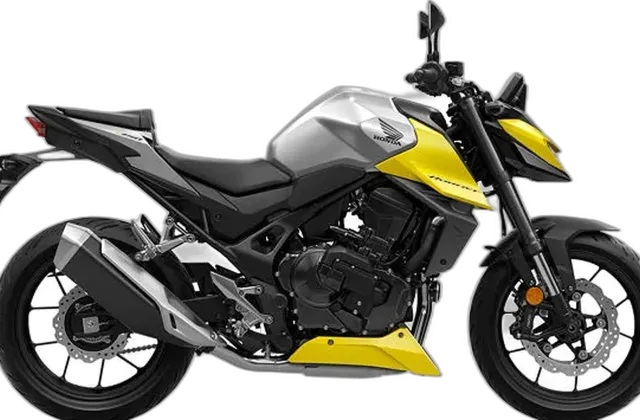
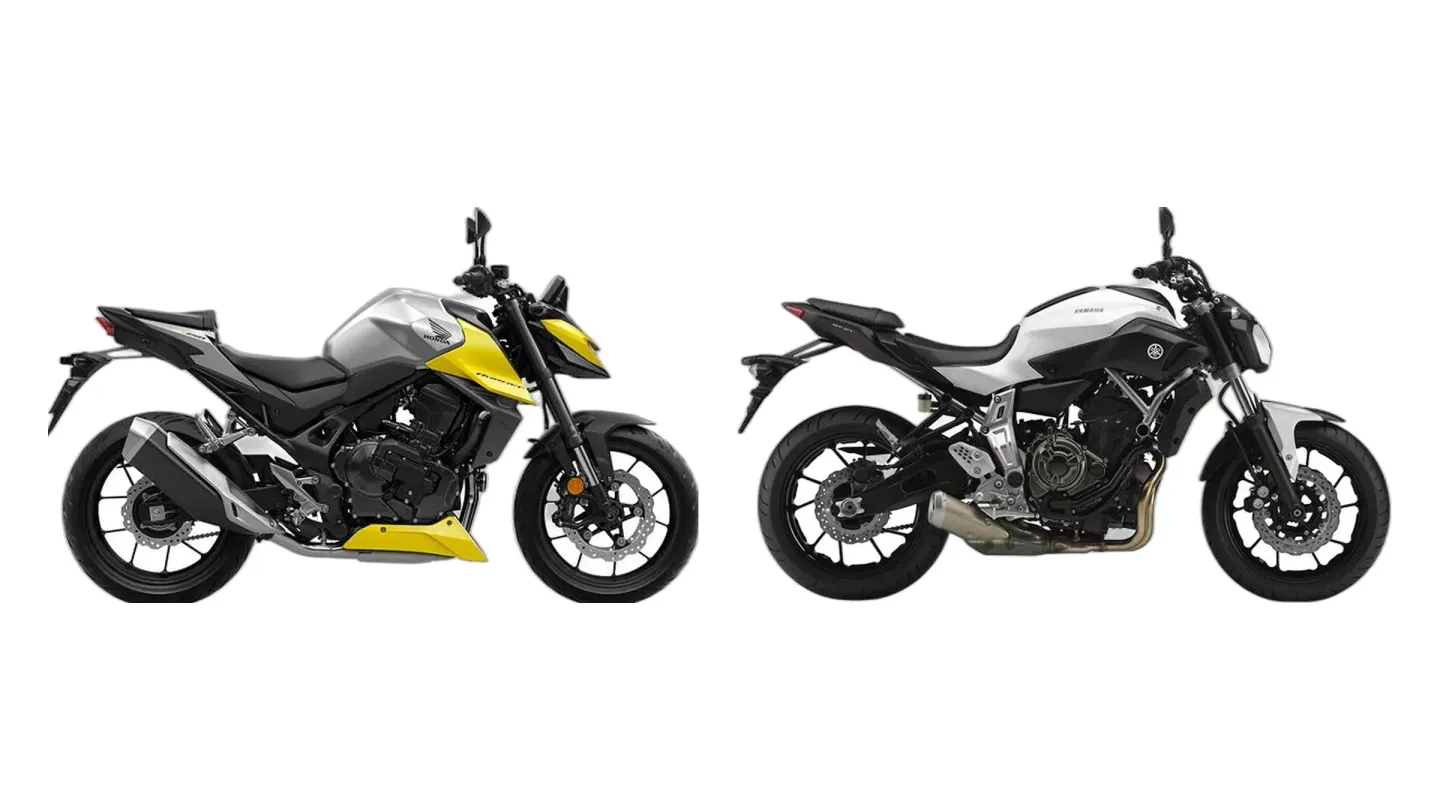
Honda CB750 Hornet (RH12) vs Yamaha MT-07 (RM04)
Honda CB750 Hornet vs Yamaha MT-07: which one's easier to live with every day.
Rolling off mid-corner, the Honda CB750 Hornet's chassis doesn't flinch as engine braking takes over. Off the line, the Yamaha MT-07's throttle lifts the front wheel.
So which one do you buy?
The CB750 Hornet has the edge if…
Traveling with luggage
By a nose: CB750 Hornet
For trips with luggage, the CB750 Hornet nudges ahead. The difference is a better passenger seat.
Daily commuting & city riding
Inches ahead: CB750 Hornet
Your daily ride leans slightly toward the CB750 Hornet. Fit and price can easily outweigh that.
A confidence-building first motorcycle
Edges it: CB750 Hornet
For a new rider, the CB750 Hornet noses ahead. How it fits you counts for more than this gap.
Sporty riding on twisty roads
Small edge: CB750 Hornet
In the twisties, the CB750 Hornet asks a bit less of you to go quickly. Call it a modest edge.
What makes each one tick
CB750 Hornet
Through the hairpins on Back of the Dragon, the Hornet changes direction off one push on the bar and doesn't fight the arc you pick. Over a bump, the suspension's stock tune copes with most pavement, and you can't change its damping. The front lever squeezes in progressively and stays predictable when you clamp it. The Hornet's brakes haul it down.
Nils rode the CB750 Hornet in Austria in 2023, and in Austria in 2024 (NastyNils Testride).
MT-07
The crossplane twin in the MT-07 thumps with a V-twin pulse and pulls hard from low revs. A twist of the throttle gets an instant answer, since torque peaks at 6,500 rpm. The bars flick it into turns almost like a supermoto, and there's no lag behind any input. This twin hasn't been tamed.
The Voice of Experience

What actually separates them
- The MT-07 has the lower wet weight: 401 lb (182 kg) vs 419 lb (190 kg).
- The CB750 Hornet makes more peak power: 92 hp (68 kW) vs 75 hp (55 kW).
- The CB750 Hornet makes more peak torque: 55 lb-ft (75 Nm) vs 50 lb-ft (68 Nm).
Which one for the way you ride
Comfortable long-distance riding
Both fall short
Long-haul comfort is a weak spot for both. If you tour, shop with that in mind.
Who each one is built for
What's good, and what you'll live with
CB750 Hornet
Strengths
- Weightless clutch, tuned slipper
- Turns in on one push
- Strong, easy front brake
- Gutsy low-end twin
- Surprising lean clearance
Trade-offs
- No damping adjustment
- Vague front-end feel
- Seat bottoms out
- Tight for taller riders
- Snatchy on-off throttle at low rpm
MT-07
Strengths
- Easy To Trust Quickly
- Cheap To Run
- Light, Friendly Controls
- Addictive CP2 engine character
- Accessible for all skill levels
Trade-offs
- Idle And Decel Cutouts
- Fragile 5th Gear
- Quick To Corrode
- Budget build quality
- Jerky throttle response at low RPM
Known problems to check before you buy
CB750 Hornet
- Soft suspension setup, limited adjustability The Showa SFF-BP USD fork is non-adjustable on the standard model; the Pro-Link rear shock offers preload only (7-step). Heavier riders and brisk-paced riders report rebound oscillation, bouncing on bigger bumps, and a setup biased toward comfort over control. Aftermarket shock upgrades (Wilbers and similar) resolve this for owners pursuing sporty pace. Honda revised the fork damping for 25YM, but the adjustability did not change.
- Jerky on-off throttle at low rpm and urban speeds The ride-by-wire throttle calibration is abrupt during transitions between closed and small-throttle openings, particularly in 1st and 2nd gear at urban speeds and at part-throttle below approximately 5,500 rpm. Multiple owners report a TPS reset procedure provides limited improvement; Honda is reported to have improved the calibration for model year 2025.
- ABS cannot be switched off, no cornering ABS The 2-channel ABS system is fixed and non-defeatable, with no IMU and therefore no cornering ABS. Reviewers report the ABS can intervene aggressively on loose surfaces. This is a spec design choice rather than a fault, but it is a documented limitation for owners using the bike on gravel or for back-track riding.
- HSTC traction-control setting resets to default on every key-on Owners and reviewers note that the bike does not retain the rider's HSTC setting across a key cycle; it returns to the default level whenever the ignition is turned off and on again. An annoyance for riders who routinely run a non-default HSTC level.
MT-07
- Intermittent engine cutout at idle and during deceleration The engine cuts out intermittently, especially when idling at traffic lights or decelerating to a stop. The ECU appears to reduce fuel supply too aggressively at idle. Problem worsens in hot weather. Stalling during downshifting is particularly hazardous. Multiple NHTSA consumer complaints filed. Reportedly improved with ECU mapping adjustments in later production.
- Battery loses charge during extended standstill Battery depletes when the bike sits for extended periods. Components draw power even when ignition is off. On models with parking light position, the ignition switch can cause parasitic draw if moisture enters. Some owners report charging system issues linked to the regulator/rectifier.
- Instrument cluster LCD flickers, goes blank, or shows partial information LCD display develops flickering, blank sections, or complete failure. Causes include loose internal ribbon cable, water ingress, or corroded connector pins. Aftermarket replacement LCD modules available (same part 2014–2020 compatible).
- Pronounced clutch rattle at idle; potential inner plate failure Pronounced rattling noise from the clutch at idle in neutral. Noise disappears when clutch lever is pulled in. In severe cases, inner clutch plates can break or shatter. Contributing factor may be worn clutch basket. More pronounced on cold starts.
- Gear indicator fails to display correct gear (especially 5th/6th) The gear indicator in the LCD display fails to show the correct gear, particularly in 5th and 6th gear. The number flashes, disappears, or displays incorrect values. Root cause: dirty contacts on the gear position sensor. Cleaning is a temporary fix; sensor replacement (~40 USD) is the permanent solution. Yamaha developed a revised sensor.
- Poor surface finishes on fasteners and coolant pipes Widespread corrosion across peripheral components: radiator coolant pipes (chrome with thin lacquer, deteriorates rapidly from road spray), allen key bolt heads, brake line fittings, disc bobbins, gear lever linkage, rear sprocket, suspension linkage fasteners, and seat lock (seizes). Screw heads across the frame show rust. Weld slag not properly cleaned on some frames.
- Side stand safety switch causes unexpected engine cutout The bike starts normally in neutral but dies immediately when shifted into gear. Caused by the kickstand safety switch failing, corroding, or the starter cutoff relay malfunctioning. The switch connector is vulnerable to moisture ingress.
- Surface rust on steel swingarm The steel swingarm develops surface rust, particularly underneath the chain guard and near chain adjusters. Rust can appear within months of purchase, even without winter riding. The paint/coating is thin and easily damaged by chain debris. Weld seams and areas under the chain slider are most affected. Yamaha has replaced some swingarms under warranty.
What they share
- Engine
- Parallel twin
- Cooling
- Liquid-cooled
- Gearbox
- 6-speed
- Final drive
- Chain
- Front tire
- 120/70-17
Where the spec sheets split
| CB750 Hornet | MT-07 | |
|---|---|---|
| Seat height | 31.3 in (795 mm) | 31.7 in (805 mm) |
| Wet weight | 419 lb (190 kg) | 401 lb (182 kg) |
| CB750 Hornet | MT-07 | |
|---|---|---|
| Displacement | 755 cc | 689 cc |
| Power | 92 hp (68 kW) | 75 hp (55 kW) |
| Peak power at | 9,500 rpm | 9,000 rpm |
| Torque | 55 lb-ft (75 Nm) | 50 lb-ft (68 Nm) |
| Peak torque at | 7,250 rpm | 6,500 rpm |
| Top speed | 127 mph (205 km/h) | 130 mph (210 km/h) |
| CB750 Hornet | MT-07 | |
|---|---|---|
| Fuel economy | 55 mpg (US) / 4.3 L/100 km | 53 mpg (US) / 4.4 L/100 km |
| Fuel capacity | 4.0 US gal (15.2 L) | 3.7 US gal (14 L) |
| CB750 Hornet | MT-07 | |
|---|---|---|
| Front brake | 296 mm | 282 mm |
| Rear tire | 160/60-17 | 180/55-17 |
| Wheelbase | 55.9 in (1420 mm) | 55.1 in (1400 mm) |
What comes fitted, what costs extra
| CB750 Hornet | MT-07 | |
|---|---|---|
| ABS | Standard | Option |
| Ride Modes | Standard | Not offered |
| Quickshifter | Option | Not offered |
| Slipper Clutch | Standard | Not offered |
| TFT Display | Standard | Not offered |
| Smartphone Connectivity | Standard | Not offered |
| LED Headlight | Standard | Not offered |
Head to head, area by area
Both bikes on the same scale, one area at a time.