By NastyNils·
Motorcycle comparison · Naked Bike
Honda CB750 Hornet (RH12) vs CB500 Hornet (MY2024)
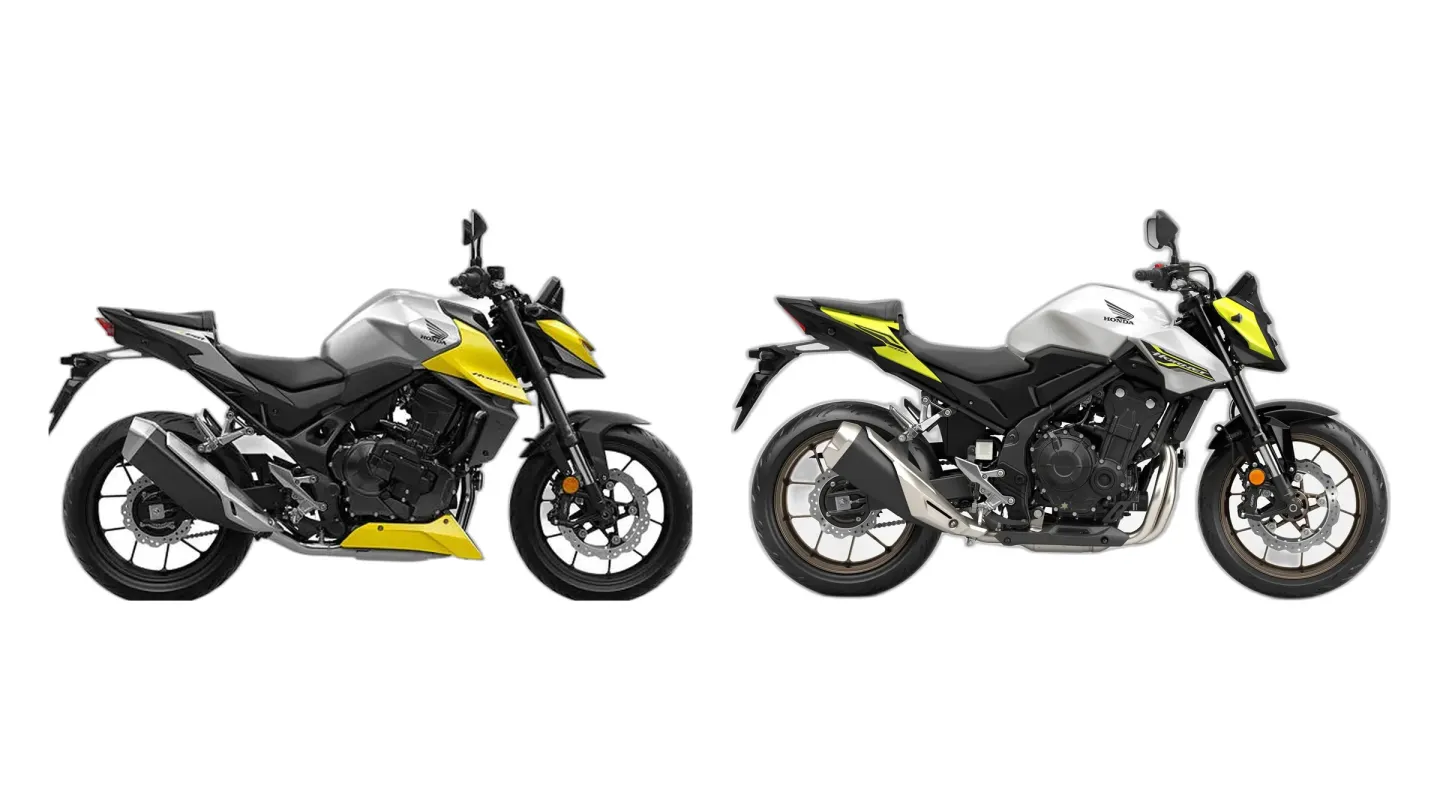
Honda CB750 Hornet vs CB500 Hornet: which one to buy, and what actually separates them.
Late on the lever at a stale yellow light, the Honda CB750 Hornet's front brake squeezes in gradually, and it won't surprise you as you clamp down. The Honda CB500 Hornet bites hard, right on demand.
So which one do you buy?
The CB750 Hornet has the edge if…
Sporty riding on twisty roads
Edges it: CB750 Hornet
On a twisty road, the CB750 Hornet edges ahead. What tips it: harder acceleration. Not by enough to settle it alone.
The CB500 Hornet has the edge if…
Traveling with luggage
Narrow edge: CB500 Hornet
Loaded for the road, the CB500 Hornet comes out a touch ahead. Put it down to more range per tank and a better reliability record. Don't read too much into a gap this narrow.
Daily commuting & city riding
A touch ahead: CB500 Hornet
The CB500 Hornet makes slightly more sense as a commuter. That comes from simpler maintenance and lower running costs. Don't read much into a gap this small.
What makes each one tick
CB750 Hornet
Through a tight run of hairpins, the CB750 Hornet turns in off a single push on the bar. There's no argument from the chassis. It holds the line you pick through the apex, and rolling off mid-corner doesn't unsettle the bike because engine braking comes in smoothly.
Nils rode the CB750 Hornet in Austria in 2023, and in Austria in 2024 (1000PS test reports).
CB500 Hornet
Through a Monday crawl in San Francisco, the CB500 Hornet swings through U-turns that don't need a death grip on the bar. Parking lots just happen. Its twin answers the throttle by climbing toward peak torque at 6,500 rpm. The same twin's out running laps by Saturday.
The Voice of Experience

What actually separates them
- The CB750 Hornet makes more peak power: 92 hp (68 kW) vs 48 hp (35 kW).
- The CB750 Hornet makes more peak torque: 55 lb-ft (75 Nm) vs 32 lb-ft (43 Nm).
- The CB750 Hornet has the larger engine: 755 cc vs 471 cc.
Which one for the way you ride
Comfortable long-distance riding
Wrong job for both
Neither of these is a mile-muncher. If big days are the plan, keep looking.
They come out level on a first bike. The better-kept used example is the smarter money.
Who each one is built for
What's good, and what you'll live with
CB750 Hornet
Strengths
- Weightless clutch, tuned slipper
- Turns in on one push
- Strong, easy front brake
- Gutsy low-end twin
- Surprising lean clearance
Trade-offs
- No damping adjustment
- Vague front-end feel
- Seat bottoms out
- Tight for taller riders
- Snatchy on-off throttle at low rpm
CB500 Hornet
Strengths
- Brakes lead the class
- Light where it counts
- Composed over rough roads
- Refined, vibration-free twin
- Built above its price
Trade-offs
- Wants revs to come alive
- Rear suspension runs short
- Soft seat, narrow bar
- Modest power for highway cruising and two-up riding
- No quickshifter option
Known problems to check before you buy
CB750 Hornet
- Soft suspension setup, limited adjustability The Showa SFF-BP USD fork is non-adjustable on the standard model; the Pro-Link rear shock offers preload only (7-step). Heavier riders and brisk-paced riders report rebound oscillation, bouncing on bigger bumps, and a setup biased toward comfort over control. Aftermarket shock upgrades (Wilbers and similar) resolve this for owners pursuing sporty pace. Honda revised the fork damping for 25YM, but the adjustability did not change.
- Jerky on-off throttle at low rpm and urban speeds The ride-by-wire throttle calibration is abrupt during transitions between closed and small-throttle openings, particularly in 1st and 2nd gear at urban speeds and at part-throttle below approximately 5,500 rpm. Multiple owners report a TPS reset procedure provides limited improvement; Honda is reported to have improved the calibration for model year 2025.
- ABS cannot be switched off, no cornering ABS The 2-channel ABS system is fixed and non-defeatable, with no IMU and therefore no cornering ABS. Reviewers report the ABS can intervene aggressively on loose surfaces. This is a spec design choice rather than a fault, but it is a documented limitation for owners using the bike on gravel or for back-track riding.
CB500 Hornet
No confirmed faults on file yet. That's not the same as fault-free.
What they share
- Engine
- Parallel twin
- Cooling
- Liquid-cooled
- Gearbox
- 6-speed
- Final drive
- Chain
- Front brake
- 296 mm
- Front tire
- 120/70-17
- Rear tire
- 160/60-17
Where the spec sheets split
| CB750 Hornet | CB500 Hornet | |
|---|---|---|
| Seat height | 31.3 in (795 mm) | 30.9 in (785 mm) |
| Wet weight | 419 lb (190 kg) | 414 lb (188 kg) |
| CB750 Hornet | CB500 Hornet | |
|---|---|---|
| Displacement | 755 cc | 471 cc |
| Power | 92 hp (68 kW) | 48 hp (35 kW) |
| Peak power at | 9,500 rpm | 8,600 rpm |
| Torque | 55 lb-ft (75 Nm) | 32 lb-ft (43 Nm) |
| Peak torque at | 7,250 rpm | 6,500 rpm |
| CB750 Hornet | CB500 Hornet | |
|---|---|---|
| Fuel economy | 55 mpg (US) / 4.3 L/100 km | 67 mpg (US) / 3.5 L/100 km |
| Fuel capacity | 4.0 US gal (15.2 L) | 4.5 US gal (17.1 L) |
| CB750 Hornet | CB500 Hornet | |
|---|---|---|
| Wheelbase | 55.9 in (1420 mm) | 55.5 in (1410 mm) |
What comes fitted, what costs extra
| CB750 Hornet | CB500 Hornet | |
|---|---|---|
| Ride Modes | Standard | Not offered |
| Quickshifter | Option | Not offered |
Head to head, area by area
Both bikes on the same scale, one area at a time.