By NastyNils·
Motorcycle comparison · Supersport
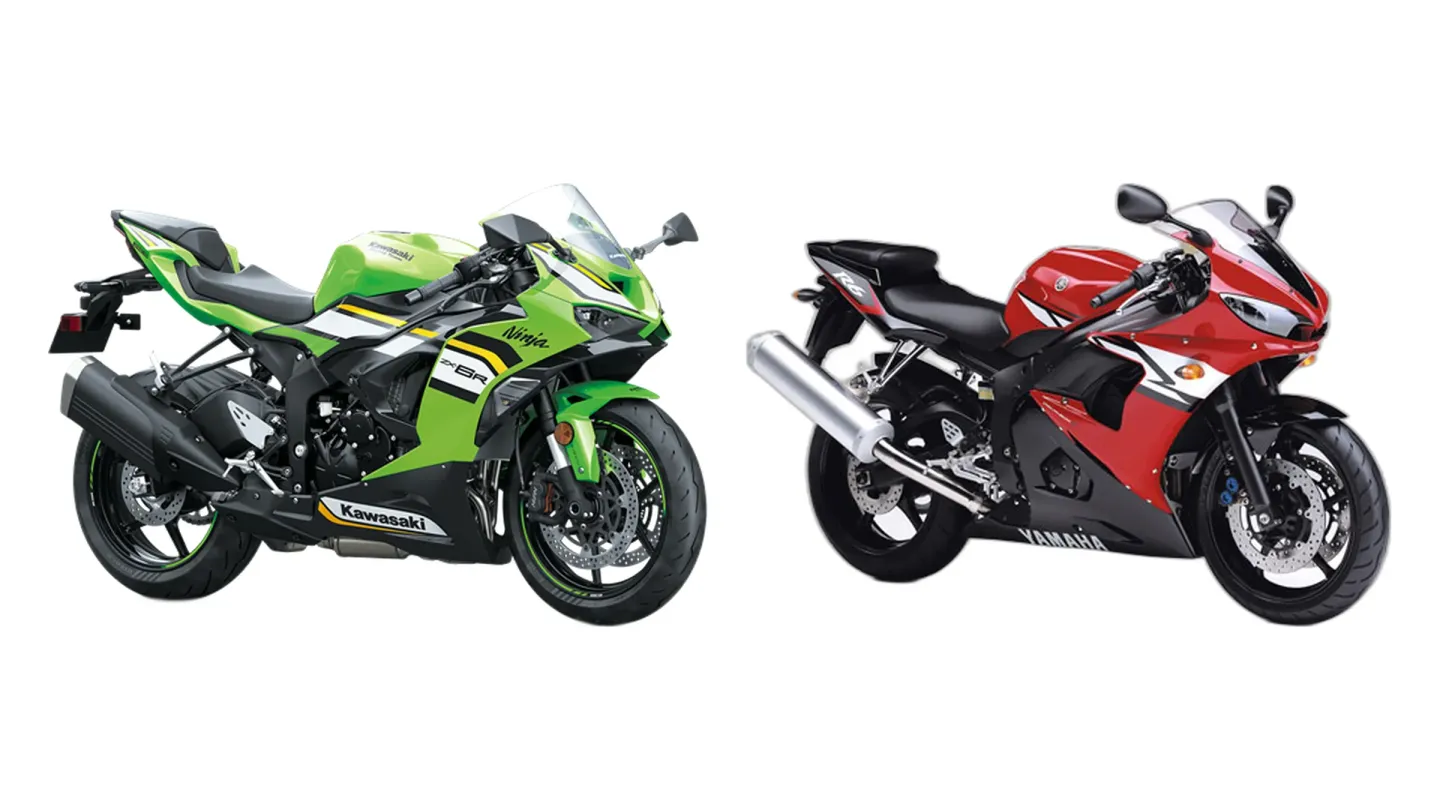
Kawasaki Ninja ZX-6R (MY2005) vs Yamaha YZF-R6 (RJ09 / 091)
Kawasaki Ninja ZX-6R vs Yamaha YZF-R6: fast is a given. What sets them apart isn't.
At the turn-in point, the Kawasaki Ninja ZX-6R shrugs off a clumsy bar input and doesn't let it wake the front. The Yamaha YZF-R6 snaps into the turn the instant you ask, and it's eager to tighten the arc. By the apex, it's already hooked up.
So which one do you buy?
The YZF-R6 has the edge if…
Racetrack use
By a nose: YZF-R6
Between the curbs, the YZF-R6 asks a bit less of you at speed. It's down to more lean clearance and more feel through the bars. It's a fine margin, nothing more.
Sporty riding on twisty roads
Edges it: YZF-R6
Through a string of corners, the YZF-R6 feels a little more eager. That comes from lighter steering. The gap is small, so ride both.
What makes each one tick
Ninja ZX-6R
Through a long, fast sweeper, the Ninja ZX-6R's chassis holds its line while you push the pace, and the bars don't fight back. There's serious stopping power at the brake lever. Most riders won't ever find the end of it. The fork swallows rough pavement whole.
Nils rode the Ninja ZX-6R in Hungary and the Czech Republic in 2004 (NastyNils Testride).
YZF-R6
The YZF-R6 tucks you into a race crouch behind a wind-tunnel fairing, and there's real weight on the bars. The soft fork doesn't fight a bump. Hard braking sinks the nose deep. The engine saves its hardest shove for redline.
The Voice of Experience

What actually separates them
- The YZF-R6 has the lower wet weight: 417 lb (189 kg) vs 432 lb (196 kg).
- The Ninja ZX-6R makes more peak power: 132 hp (97 kW) vs 125 hp (92 kW).
- The Ninja ZX-6R has the larger engine: 636 cc vs 600 cc.
Which one for the way you ride
Comfortable long-distance riding
Neither one fits
Hours in the saddle won't flatter either of these. They're happier on shorter runs.
Nothing splits them on commuting and running costs. Ride both back to back and the decision usually makes itself.
Who each one is built for
What's good, and what you'll live with
Ninja ZX-6R
From Nils' own saddle time
Strengths
- Forgiving, planted front end
- Stock Showa is genuinely sorted
- Changes line on one input
- Lap timer standard from the factory
Trade-offs
- No steering damper fitted
- Early 2005 ECU overheating
- Fuel pump can fail early
YZF-R6
What owners say
Strengths
- Class-leading top-end power
- Telepathic handling and agility
- Excellent fueling and throttle response
Trade-offs
- Unforgiving ergonomics for street use
- Suspension too soft for serious track work
Known problems to check before you buy
Ninja ZX-6R
- ECU overheating due to exhaust heat On early production models, heat from the underseat exhaust can cause the ECU to malfunction or fail, leading to engine cutouts and stalling.
- Regulator/rectifier failure Occasional charging system issues due to regulator/rectifier failure, potentially leading to battery drain or electrical faults.
YZF-R6
- Ignition coil failure (2003–2004 models) Factory ignition coils can develop internal shorts, causing misfires and poor running, especially after heat soak. Yamaha issued a service bulletin for affected 2003 models; many 2004 units exhibit similar symptoms.
- Second gear failure The transmission is prone to premature wear of the second gear engagement dogs, leading to jumping out of gear or difficult shifting. Most commonly reported on early-generation R6s including 2003–2004 models.
- Regulator/rectifier and stator failures The charging system can overheat, causing melted connectors or corrosion, leading to battery drain and eventual electrical shutdown. Often occurs without warning.
- Steering stem bearing loosening The steering stem bearing can loosen over time, creating a clunk felt through the handlebars during braking or when rocking the bike. Regular retorquing is recommended.
What they share
- Seat height
- 32.3 in (820 mm)
- Engine
- Inline-four
- Cooling
- Liquid-cooled
- Fuel capacity
- 4.5 US gal (17 L)
- Gearbox
- 6-speed
- Final drive
- Chain
- Rear tire
- 180/55-17
Where the spec sheets split
| Ninja ZX-6R | YZF-R6 | |
|---|---|---|
| Wet weight | 432 lb (196 kg) | 417 lb (189 kg) |
| Ninja ZX-6R | YZF-R6 | |
|---|---|---|
| Displacement | 636 cc | 600 cc |
| Power | 132 hp (97 kW) | 125 hp (92 kW) |
| Torque | 52 lb-ft (70 Nm) | 50 lb-ft (68 Nm) |
| Ninja ZX-6R | YZF-R6 | |
|---|---|---|
| Fork | Upside-down (USD) | Telescopic |
| Front brake | 300 mm | 298 mm |
| Front tire | 120/65-17 | 120/70-17 |
| Wheelbase | 54.9 in (1395 mm) | 54.3 in (1380 mm) |
What comes fitted, what costs extra
| Ninja ZX-6R | YZF-R6 | |
|---|---|---|
| Slipper Clutch | Standard | Not offered |
Head to head, area by area
Both bikes on the same scale, one area at a time.