By NastyNils·
Motorcycle comparison · Naked Bike
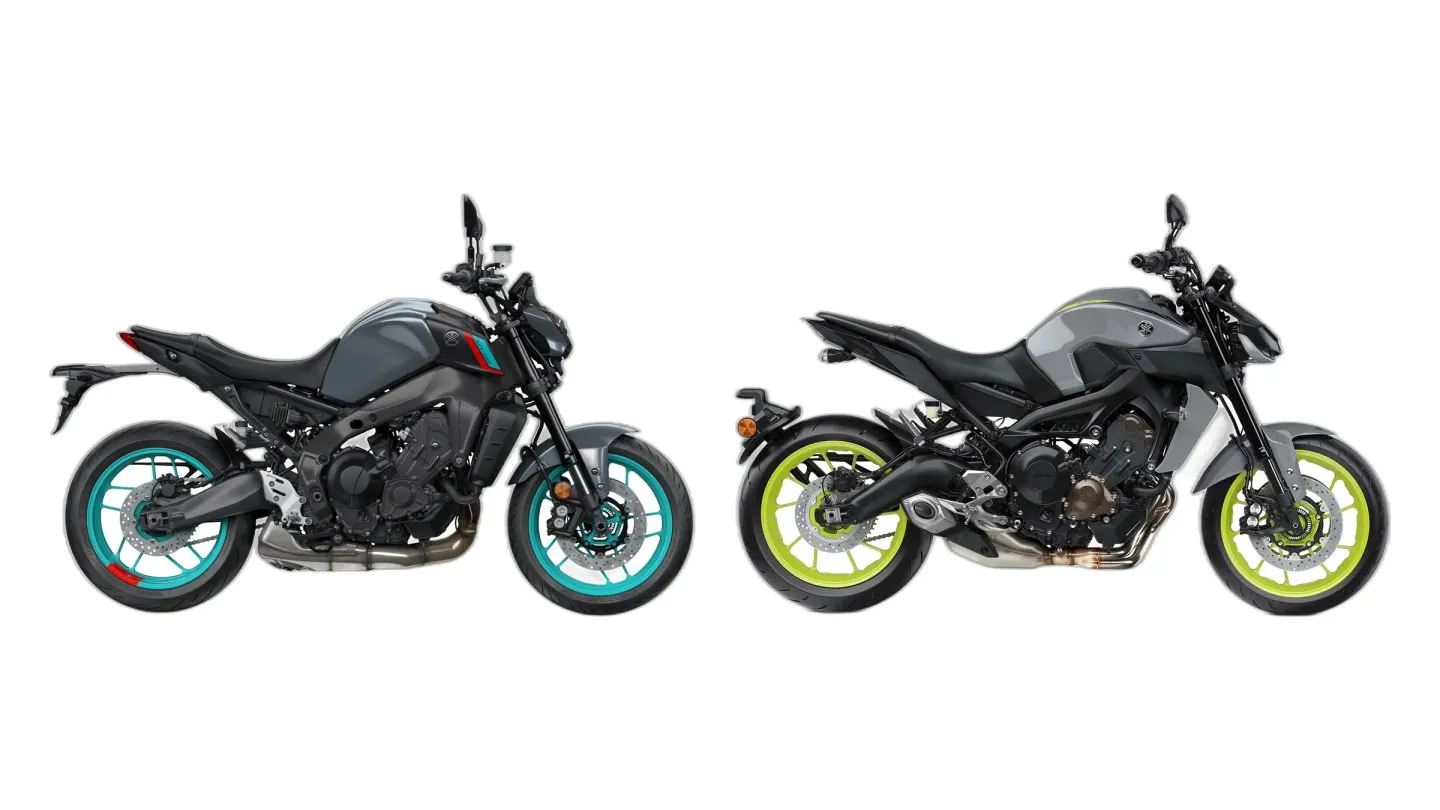
Yamaha MT-09 (RN69) vs MT-09 (RN43)
2021 Yamaha MT-09 vs 2017 Yamaha MT-09: which one's easier to live with every day.
Deep in a fast sweeper, the 2021 Yamaha MT-09 holds its line and doesn't squirm as you push harder. On the 2017 Yamaha MT-09, the wide bars and short wheelbase tip the nose in at the lightest push.
So which one do you buy?
The 2021 MT-09 has the edge if…
Daily commuting & city riding
Slight edge: 2021 MT-09
Day in, day out, the 2021 MT-09 nudges ahead in traffic. It isn't a big enough gap to plan around.
What makes each one tick
2021 MT-09
Low in the revs, the 2021 MT-09's triple pulls with a twin's punch, and up top it rushes on like a four. There's a howl from the intake. At 417 lb (189 kg), it doesn't wrestle you at walking pace through town traffic. The frame stays planted as the brake lever bites.
Nils rode the 2021 MT-09 in 2021 (NastyNils Testride).
2017 MT-09
An uneven pulse throbs through the 2017 MT-09's crossplane triple, half inline and half V-twin, as it pulls hard from low revs all the way to redline. The throttle's snatchy off idle. There's a smaller bike's quickness at corner entry as it turns in. The front snaps toward the apex.
Nils rode the 2017 MT-09 in Austria in 2017, and in 2018 (NastyNils Testride).
The Voice of Experience

What actually separates them
- The 2021 MT-09 has the lower wet weight: 417 lb (189 kg) vs 425 lb (193 kg).
- The 2021 MT-09 makes more peak torque: 69 lb-ft (93 Nm) vs 65 lb-ft (88 Nm).
- Cornering ABS: standard on the 2021 MT-09, not offered on the 2017 MT-09.
Which one for the way you ride
Comfortable long-distance riding
Not their thing
For all-day comfort, both fall short. Keep the rides short and you'll get on fine with either.
A confidence-building first motorcycle
Not built for this
Learning on either of these is the hard way. A gentler bike will make you a better rider sooner.
Call it even on twisty roads and running costs. Choose on fit, price and the one that makes you grin.
Who each one is built for
What's good, and what you'll live with
2021 MT-09
What owners say
Strengths
- CP3 engine character
- Class-leading electronics package
- Light wet weight
- Improved chassis vs. RN43
- Reliability rating from owners
Trade-offs
- ABS abrupt under hard braking
- Cosmetic build niggles
- Mirror vibration above 6,000 rpm
- Mode 4 power cap effectively unusable
- Standard seat is firm and "slippery"
2017 MT-09
What owners say
Strengths
- Exceptional CP3 engine character
- Outstanding agility and lightness
- Strong mechanical reliability
Trade-offs
- Snatchy low-RPM throttle response
- Uncomfortable stock seat
- No wind protection
- Small tank / limited range
- Handlebar vibration at highway speed
Known problems to check before you buy
2021 MT-09
- Throttle Position Sensor (TPS) wear causing unstable idle/stalling (recall 25V-248) Recall 25V248000 Worn TPS due to excessive brush sliding from improper ECU programming leads to unstable idling, throttle hesitation, and stalling. Yamaha recall (NHTSA 25V-248) requires TPS replacement and ECU reflash for affected units.
- Engine stalling due to ECU programming (recall 22V-130) Recall 22V130000 Improper ECU programming can cause engine to stall unexpectedly, particularly when clutch lever not pulled fully or at small throttle openings from idle. Affects all 2021-2022 MT-09 models; Yamaha recall issued March 2022 for ECU reflash.
2017 MT-09
- Throttle body de-synchronization causing rough idle The three throttle bodies go out of sync within a few thousand miles (a few thousand km), leading to rough idle, stalling (especially at low speeds), and poor low-RPM response. Idle Speed Control (ISC) may need resetting after synchronization. Some cases traced to Throttle Position Sensor (TPS) degradation or Acceleration Position Sensor (APS) issues.
- Quick Shifter System intermittent failure The OEM quickshifter can stop working intermittently. Common cause is an internal Alps Alpine micro-switch failure. Symptoms include QS light on but no function, intermittent ignition cut during shifts, and hard/stuck upshifts. Cold engine operation worsens symptoms. Yamaha dealers have confirmed replacing multiple faulty units under warranty.
- Front brake disc pulsation / warping Front brake discs develop pulsation felt through the lever during braking. The floating disc design may not fully prevent warping under hard or normal use. Disc replacement or aftermarket rotors are the definitive cure.
- Snatchy ride-by-wire throttle response at low RPM The electronic throttle is abrupt and jerky between 2,500–4,000 RPM, creating a push/pull sensation when rolling on from idle or cruising at low speeds. This is an ECU mapping issue inherent to the CP3 engine across all generations, though the 2017 D-Mode B setting helps. The mixture is set lean for Euro 4 compliance, and deceleration fuel cut causes jerkiness when reaccelerating. An ECU flash or tune (e.g., 2WheelDynoWorks, Woolich Racing) is the common fix.
- Seat seams leak water during rain riding Seat seams allow water to seep in during rain. The seat foam absorbs water, making it uncomfortable and slow to dry.
- Excessive handlebar vibration during sustained high-speed riding Noticeable buzzing/micro-vibration through the handlebars, particularly during sustained highway riding. Causes hand numbness within 5–10 minutes at certain RPM ranges. OEM bar-end weights are light (~1 oz (~30 g)); heavier aftermarket bar ends (~8 oz (~230 g) per side) help but don't fully eliminate. Engine mount and handlebar mount bolt torque should be checked.
- Premature corrosion on multiple components Multiple components prone to premature corrosion: bar-end Allen key holes rust quickly, rear shock spring corrodes, front disc bolts rust, exhaust headers show surface corrosion and discoloration, general bolt corrosion. Matte paint finish is very thin, scratches easily. Some bolts showed rust at less than 1,000 miles on new bikes. Pressure washing and salt exposure accelerate corrosion significantly.
What they share
- Engine
- Inline-three
- Cooling
- Liquid-cooled
- Peak power at
- 10,000 rpm
- Fuel economy
- 47 mpg (US) / 5 L/100 km
- Fuel capacity
- 3.7 US gal (14 L)
- Valve check interval
- 24,855 mi (40,000 km)
- Gearbox
- 6-speed
- Final drive
- Chain
- Front tire
- 120/70-17
- Rear tire
- 180/55-17
Where the spec sheets split
| 2021 MT-09 | 2017 MT-09 | |
|---|---|---|
| Seat height | 32.5 in (825 mm) | 32.3 in (820 mm) |
| Wet weight | 417 lb (189 kg) | 425 lb (193 kg) |
| 2021 MT-09 | 2017 MT-09 | |
|---|---|---|
| Displacement | 890 cc | 847 cc |
| Power | 119 hp (88 kW) | 115 hp (85 kW) |
| Torque | 69 lb-ft (93 Nm) | 65 lb-ft (88 Nm) |
| Peak torque at | 7,000 rpm | 8,500 rpm |
| Top speed | 143 mph (230 km/h) | 148 mph (238 km/h) |
| 2021 MT-09 | 2017 MT-09 | |
|---|---|---|
| Wheelbase | 56.3 in (1430 mm) | 56.7 in (1440 mm) |
What comes fitted, what costs extra
| 2021 MT-09 | 2017 MT-09 | |
|---|---|---|
| Cornering ABS | Standard | Not offered |
| TFT Display | Standard | Not offered |
Head to head, area by area
Both bikes on the same scale, one area at a time.