By NastyNils· ·
Motorcycle comparison · Naked Bike
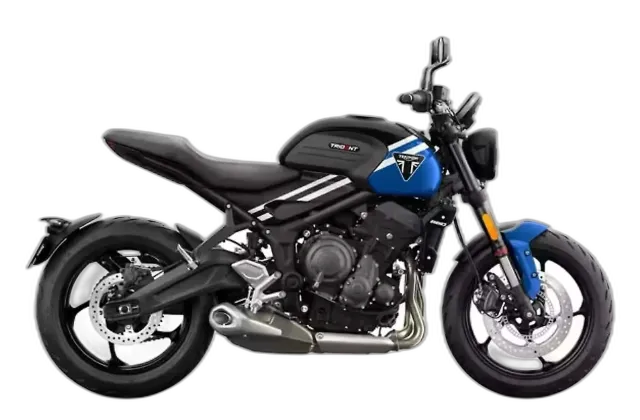
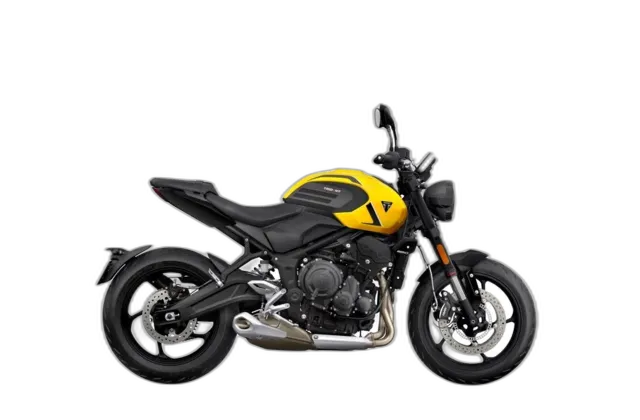
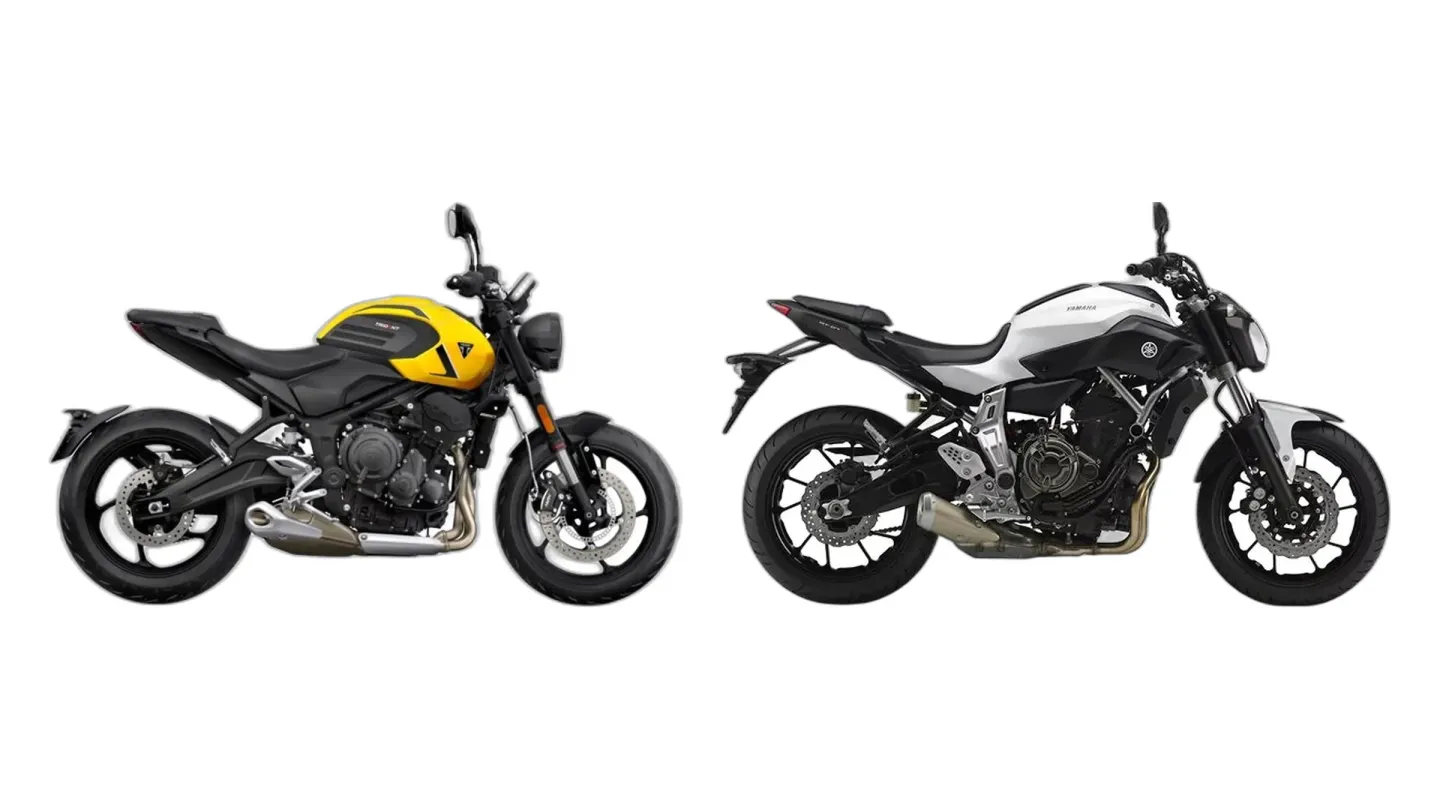
Triumph Trident 660 (MY2025) vs Yamaha MT-07 (RM04)
Triumph Trident 660 vs Yamaha MT-07: no fairing, no excuses. Here's how to choose.
Off a stoplight on a firm twist of the throttle, the Triumph Trident 660's triple builds its pull steadily and doesn't catch you out. The Yamaha MT-07's front wheel climbs on that same twist.
So which one do you buy?
The Trident 660 has the edge if…
Daily commuting & city riding
A touch ahead: Trident 660
For the ride to work, the Trident 660 noses ahead. Don't let that alone make the call.
Sporty riding on twisty roads
Edges it: Trident 660
The Trident 660 is a touch more fun when the road starts bending. Just a touch.
A confidence-building first motorcycle
Small edge: Trident 660
The Trident 660 nudges ahead as a first bike. Don't let a gap this narrow outweigh how it fits you.
The MT-07 has the edge if…
Comfortable long-distance riding
By a nose: MT-07
Deep into a long ride, the MT-07 asks slightly less of your back and shoulders. A small margin, and seat fit can overrule it.
What makes each one tick
Trident 660
There's no snatch in the Trident 660's three-cylinder, and its power stacks up evenly as the tach needle swings around. Its light chassis and low 31.7 in (805 mm) seat don't fight you in stop-and-go traffic. On San Francisco's patched pavement, the Showa suspension soaks up each bump and doesn't get flustered. Revving it out pays off.
MT-07
The MT-07's twin isn't softened for its class. You get on expecting the humble option and come away wide-eyed again. A small roll of throttle draws a V-twin thump from the crossplane engine that's got real grunt from low revs. The chassis feels light enough to flick like a supermoto, and turn-in doesn't hesitate. The bars answer every nudge.
The Voice of Experience

What actually separates them
- The MT-07 has the lower wet weight: 401 lb (182 kg) vs 419 lb (190 kg).
- The Trident 660 makes more peak power: 80 hp (60 kW) vs 75 hp (55 kW).
- The MT-07 makes more peak torque: 50 lb-ft (68 Nm) vs 47 lb-ft (64 Nm).
Which one for the way you ride
These two run dead level on running costs. Sit on both in the showroom and trust what your body says.
Who each one is built for
What's good, and what you'll live with
Trident 660
What owners say
Strengths
- Smooth and forgiving power delivery
MT-07
Strengths
- Easy To Trust Quickly
- Cheap To Run
- Light, Friendly Controls
- Addictive CP2 engine character
- Accessible for all skill levels
Trade-offs
- Idle And Decel Cutouts
- Fragile 5th Gear
- Quick To Corrode
- Budget build quality
- Jerky throttle response at low RPM
Known problems to check before you buy
Trident 660
No confirmed faults on file yet. That's not the same as fault-free.
MT-07
- Intermittent engine cutout at idle and during deceleration The engine cuts out intermittently, especially when idling at traffic lights or decelerating to a stop. The ECU appears to reduce fuel supply too aggressively at idle. Problem worsens in hot weather. Stalling during downshifting is particularly hazardous. Multiple NHTSA consumer complaints filed. Reportedly improved with ECU mapping adjustments in later production.
- Battery loses charge during extended standstill Battery depletes when the bike sits for extended periods. Components draw power even when ignition is off. On models with parking light position, the ignition switch can cause parasitic draw if moisture enters. Some owners report charging system issues linked to the regulator/rectifier.
- Instrument cluster LCD flickers, goes blank, or shows partial information LCD display develops flickering, blank sections, or complete failure. Causes include loose internal ribbon cable, water ingress, or corroded connector pins. Aftermarket replacement LCD modules available (same part 2014–2020 compatible).
- Pronounced clutch rattle at idle; potential inner plate failure Pronounced rattling noise from the clutch at idle in neutral. Noise disappears when clutch lever is pulled in. In severe cases, inner clutch plates can break or shatter. Contributing factor may be worn clutch basket. More pronounced on cold starts.
- Gear indicator fails to display correct gear (especially 5th/6th) The gear indicator in the LCD display fails to show the correct gear, particularly in 5th and 6th gear. The number flashes, disappears, or displays incorrect values. Root cause: dirty contacts on the gear position sensor. Cleaning is a temporary fix; sensor replacement (~40 USD) is the permanent solution. Yamaha developed a revised sensor.
- Poor surface finishes on fasteners and coolant pipes Widespread corrosion across peripheral components: radiator coolant pipes (chrome with thin lacquer, deteriorates rapidly from road spray), allen key bolt heads, brake line fittings, disc bobbins, gear lever linkage, rear sprocket, suspension linkage fasteners, and seat lock (seizes). Screw heads across the frame show rust. Weld slag not properly cleaned on some frames.
- Side stand safety switch causes unexpected engine cutout The bike starts normally in neutral but dies immediately when shifted into gear. Caused by the kickstand safety switch failing, corroding, or the starter cutoff relay malfunctioning. The switch connector is vulnerable to moisture ingress.
- Surface rust on steel swingarm The steel swingarm develops surface rust, particularly underneath the chain guard and near chain adjusters. Rust can appear within months of purchase, even without winter riding. The paint/coating is thin and easily damaged by chain debris. Weld seams and areas under the chain slider are most affected. Yamaha has replaced some swingarms under warranty.
What they share
- Seat height
- 31.7 in (805 mm)
- Cooling
- Liquid-cooled
- Fuel capacity
- 3.7 US gal (14 L)
- Gearbox
- 6-speed
- Final drive
- Chain
- Front tire
- 120/70-17
- Rear tire
- 180/55-17
Where the spec sheets split
| Trident 660 | MT-07 | |
|---|---|---|
| Wet weight | 419 lb (190 kg) | 401 lb (182 kg) |
| Trident 660 | MT-07 | |
|---|---|---|
| Displacement | 660 cc | 689 cc |
| Engine | Inline-three | Parallel twin |
| Power | 80 hp (60 kW) | 75 hp (55 kW) |
| Peak power at | 10,250 rpm | 9,000 rpm |
| Torque | 47 lb-ft (64 Nm) | 50 lb-ft (68 Nm) |
| Peak torque at | 6,250 rpm | 6,500 rpm |
| Trident 660 | MT-07 | |
|---|---|---|
| Fork | Upside-down (USD) | Telescopic |
| Front brake | 310 mm | 282 mm |
| Wheelbase | 55.2 in (1401 mm) | 55.1 in (1400 mm) |
What comes fitted, what costs extra
| Trident 660 | MT-07 | |
|---|---|---|
| ABS | Standard | Option |
| Traction Control | Standard | Not offered |
| Ride Modes | Standard | Not offered |
| Quickshifter | Standard | Not offered |
| Slipper Clutch | Standard | Not offered |
| TFT Display | Standard | Not offered |
| Smartphone Connectivity | Standard | Not offered |
| USB Charging Port | Option | Not offered |
| LED Headlight | Standard | Not offered |
Head to head, area by area
Both bikes on the same scale, one area at a time.