By NastyNils·
Motorcycle comparison · Naked Bike vs Adventure
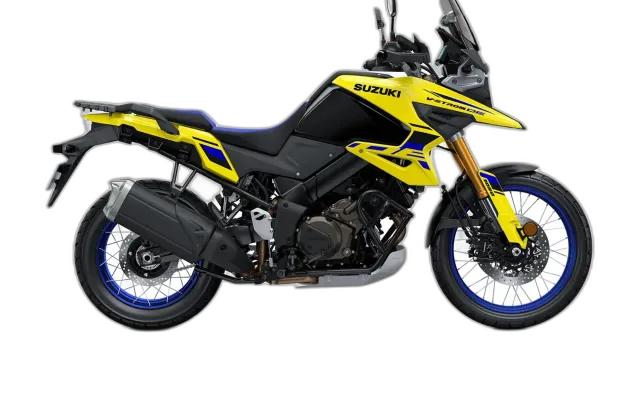
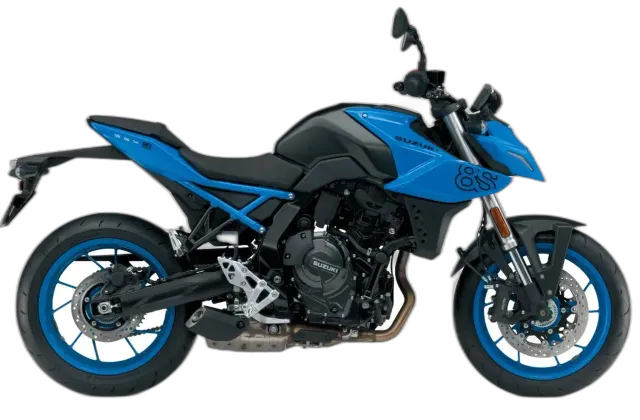
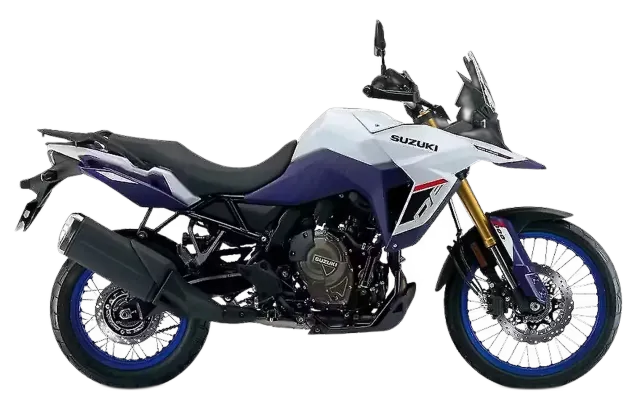
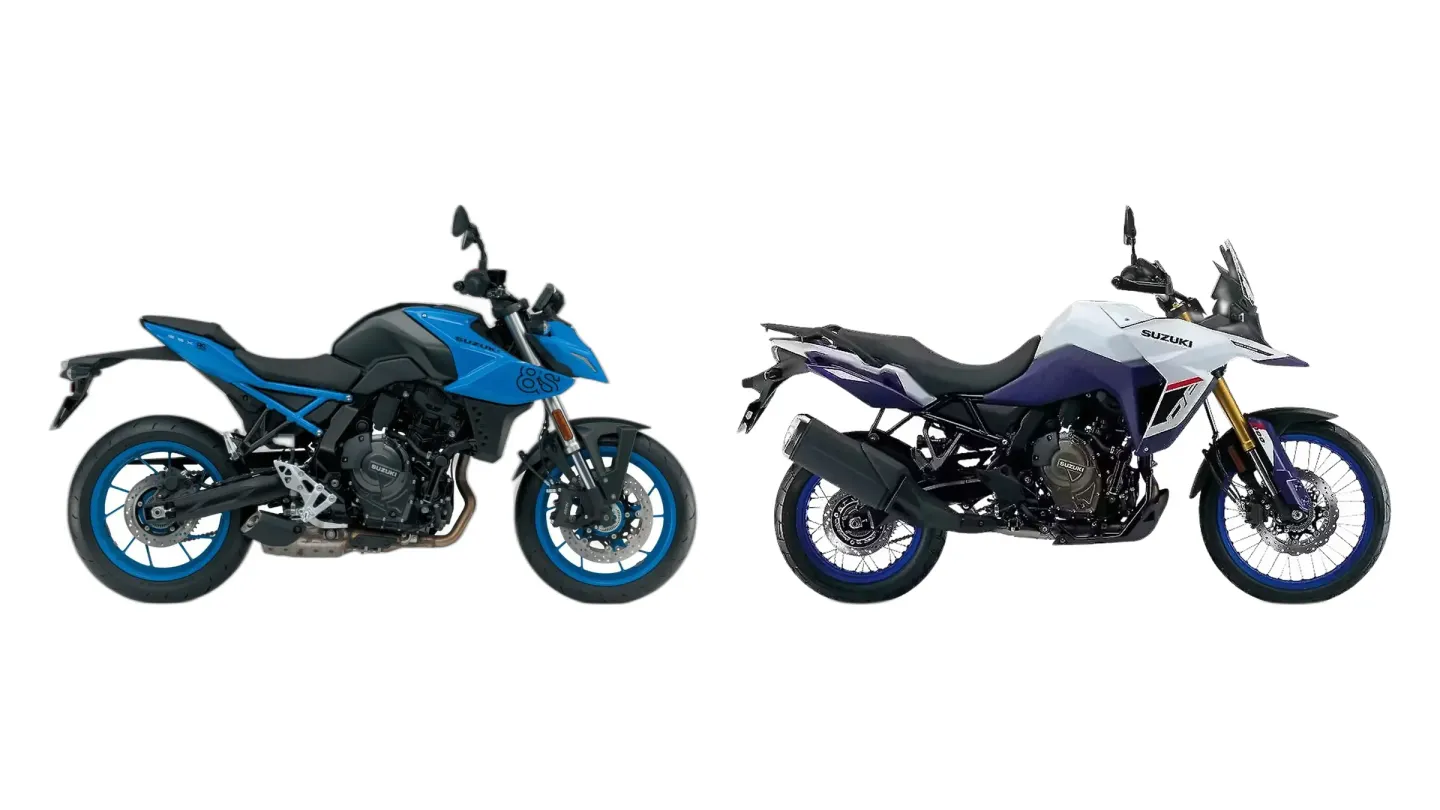
Suzuki GSX-8S (MY2023) vs V-Strom 800 DE (MY2023)
Suzuki GSX-8S vs V-Strom 800 DE: two kinds of bike, and who each one is for.
You'll tip the Suzuki GSX-8S into a tightening bend and find there's still lean left before anything scrapes. The Suzuki V-Strom 800 DE takes that arc on softer springs, and its adjusters tell you at once if a click made a difference. It settles into the bend and stays plush.
So which one do you buy?
Buy the GSX-8S if…
Daily commuting & city riding
Not close: GSX-8S
The GSX-8S suits a daily commute clearly better. In traffic, it's simply less work.
The GSX-8S has the edge if…
Sporty riding on twisty roads
Narrow edge: GSX-8S
The GSX-8S nudges ahead once the pavement starts to wiggle. Don't expect a night-and-day difference.
What makes each one tick
GSX-8S
On the GSX-8S, rolling off for a corner moves the twin from drive to engine braking without a lurch, and the chassis turns in undisturbed. On Bay Area Ridge Roads, the twin's work happens in the middle revs, well short of redline. There's more care in the seat's foam and shape than this class usually gets. Hours on, the seat's still working.
Nils rode the GSX-8S in Austria in 2023 (NastyNils Testride).
V-Strom 800 DE
Its modes split the V-Strom 800 DE's throttle into two characters. A mode is sharp and direct. B and C ease the response far enough that rain or a crawling freeway won't rattle you. A broken patch of road doesn't get past the fork and shock to the seat. On gravel, the motor never shoves.
The Voice of Experience
What actually separates them
- The GSX-8S has the lower seat: 31.9 in (810 mm) vs 33.7 in (855 mm).
- The GSX-8S has the lower wet weight: 445 lb (202 kg) vs 507 lb (230 kg).
- The V-Strom 800 DE has the larger fuel tank: 5.3 US gal (20 L) vs 3.7 US gal (14 L).
Which one for the way you ride
Comfortable long-distance riding
Not suited: GSX-8S
There's no comfort verdict for the GSX-8S here. Its job is somewhere else.
These two run dead level on running costs and a first bike. Sit on both in the showroom and trust what your body says.
Who each one is built for
What's good, and what you'll live with
GSX-8S
Strengths
- Big-bike torque down low
- Refinement above its class
- Precise, progressive front brake
- Planted in fast sweepers
- A seat you can live with
Trade-offs
- No reserves up top
- Quickshifter wants muscle
- ABS steps in early
- KYB suspension overwhelmed on rough roads
- Footpeg vibration on sustained motorway cruise
V-Strom 800 DE
Strengths
- Seat Built for Long Days
- Progressive Front Brake Feel
- 270° engine character
- Genuine off-road geometry
- Build quality and "Suzuki reliability" perception
Trade-offs
- Thirstier Than the Class
- Goes Flat Near Redline
- Short Screen for Tall Riders
- No cruise control
- Stock LED headlight beam pattern
Known problems to check before you buy
GSX-8S
- Bidirectional quickshifter clunky on downshifts and at low RPM The standard bidirectional quickshifter exhibits an awkward "clunk" on downshifts and lacks adequate auto-blip. Suzuki's manual states the quickshifter is not operable below 2,000 rpm; in practice, owners and dealers report consistent operation only above ≈3,000 rpm. At cruising RPM in higher gears, shifts can feel harsh. Manual clutch operation is markedly smoother for low-rev work.
- "A" ride-mode throttle hyper-responsive at small throttle openings In SDMS A (Active) mode, throttle response past approximately one-quarter turn is described as 1:1 / hyper-responsive, making low-speed and stop-and-go riding feel nervous. SDMS B mode is described as so progressive it feels "unenthusiastic." There is a perceived gap between A and B with no calibration in between; full-throttle behaviour is identical across modes, so the differentiation only matters at part-throttle.
- Black painted tank shows scratches and scuffs more readily than typical The black-tank colourway (and to a lesser extent the other finishes) is reported to scratch easily. Tank pads and protective films are commonly recommended.
- Persistent secondary vibration at ~5,000–5,500 rpm in footpegs, handlebars, mirrors A distinct buzz at approximately 5,000–5,500 rpm — the rev range that corresponds to highway cruising in top gear. Felt primarily through the footpegs, secondarily through the handlebars and mirrors. The same engine in the Suzuki GSX-8S is reportedly cleaner at these revs, suggesting the buzz is V-Strom-chassis-specific (mounting/frame harmonics) rather than engine-internal. Some owners report it diminishes after the first break-in.
V-Strom 800 DE
- Rear tire tread cracking and separation — Dunlop Trailmax Mixtour The Dunlop Trailmax Mixtour rear tire (150/70R17 M/C 69H, specification "B", manufactured by Sumitomo Rubber Industries) supplied as OEM equipment can develop tread cracking, deformation, and ultimately tread separation from the tire carcass. Risk: crash. Warning signs: increased rear-wheel vibration, visible tread cracking or deformation.
- Stock LED headlight produces narrow beam pattern and is aimed too low The factory dual mono-focus LED projector produces an excessively narrow, highly focused beam with poor peripheral / roadside illumination. Two contributing factors documented: (a) the projector pattern itself is narrow by design, (b) factory aim is set low and benefits from an adjustment behind the cowling. Owners report unsafe night-riding visibility at speed. Aftermarket auxiliary lights (Cyclops kits, Denali, etc.) are the de-facto fix.
- Showa fork and shock tuned soft for road comfort — bottom on hard hits The fully-adjustable Showa fork and link-type shock are tuned plush for road comfort. Heavier riders and aggressive off-road riders report fork dive under hard braking, fork bottoming on big hits, and the rear shock bottoming out on jumps and G-outs at speed. Not a defect — a tuning choice. The fully adjustable hardware allows compensation; spring re-rating and damping changes are common owner modifications. Upshift Online: "*The rear shock will bottom out when the bike is jumped or run into a G-out at speed.*"
- Hot air vented onto right leg when fan engages in slow / stationary traffic When the radiator fan engages in slow or stationary hot traffic, hot air is vented from the right side of the fairing. Riders in hot climates report uncomfortable heat on the right leg and inner thigh. Cooling-system temperatures themselves remain within nominal range — this is a vent-routing ergonomic complaint, not a cooling fault.
- Bidirectional quickshifter clunky / jerky at low RPM The Suzuki BiQS bidirectional quickshifter operates smoothly above ~4,500 rpm but is harsh, jerky, and occasionally violent on 1→2 and 2→3 upshifts at low revs. Heavy throttle modulation dependency reported. The owner's manual explicitly states the QS is not designed to operate below approximately 2,000 rpm.
- Persistent secondary vibration at ~5,000–5,500 rpm in footpegs, handlebars, mirrors A distinct buzz at approximately 5,000–5,500 rpm — the rev range that corresponds to highway cruising in top gear. Felt primarily through the footpegs, secondarily through the handlebars and mirrors. The same engine in the Suzuki GSX-8S is reportedly cleaner at these revs, suggesting the buzz is V-Strom-chassis-specific (mounting/frame harmonics) rather than engine-internal. Some owners report it diminishes after the first break-in.
- Stock 3-step adjustable windscreen produces helmet buffeting The stock manually-adjustable windscreen produces helmet buffeting for many rider heights. Both lower and taller aftermarket screens give mixed results — strongly rider-height-dependent.
What they cost used
These prices compare a 3-year-old GSX-8S with a 3-year-old V-Strom 800 DE.
- GSX-8S
- about $7,400
- V-Strom 800 DE
- about $9,000
At three years old, the Suzuki GSX-8S sits around $7,400 while the Suzuki V-Strom 800 DE runs about $9,000. That's a $1,600 gap in the GSX-8S's favor. These are US market estimates, not live listings.
What they share
- Displacement
- 776 cc
- Engine
- Parallel twin
- Cooling
- Liquid-cooled
- Peak power at
- 8,500 rpm
- Torque
- 58 lb-ft (78 Nm)
- Peak torque at
- 6,800 rpm
- Gearbox
- 6-speed
- Final drive
- Chain
- Fork
- Upside-down (USD)
- Front brake
- 310 mm
Where the spec sheets split
| GSX-8S | V-Strom 800 DE | |
|---|---|---|
| Seat height | 31.9 in (810 mm) | 33.7 in (855 mm) |
| Wet weight | 445 lb (202 kg) | 507 lb (230 kg) |
| GSX-8S | V-Strom 800 DE | |
|---|---|---|
| Power | 83 hp (61 kW) | 84 hp (62 kW) |
| GSX-8S | V-Strom 800 DE | |
|---|---|---|
| Fuel economy | 56 mpg (US) / 4.2 L/100 km | 53 mpg (US) / 4.4 L/100 km |
| Fuel capacity | 3.7 US gal (14 L) | 5.3 US gal (20 L) |
| GSX-8S | V-Strom 800 DE | |
|---|---|---|
| Front tire | 120/70-17 | 90/90-21 |
| Rear tire | 180/55-17 | 150/70-17 |
| Wheelbase | 57.7 in (1465 mm) | 61.8 in (1570 mm) |
| Ground clearance | 5.7 in (145 mm) | 8.7 in (220 mm) |
| Front travel | 5.1 in (130 mm) | 8.7 in (220 mm) |
| Rear travel | 5.1 in (130 mm) | 8.7 in (220 mm) |
What comes fitted, what costs extra
| GSX-8S | V-Strom 800 DE | |
|---|---|---|
| Front Suspension Adjustable | Not offered | Standard |
| USB Charging Port | Option | Not offered |
| Adjustable Windscreen | Not offered | Standard |
| Luggage System | Not offered | Option |
Head to head, area by area
Both bikes on the same scale, one area at a time.