·

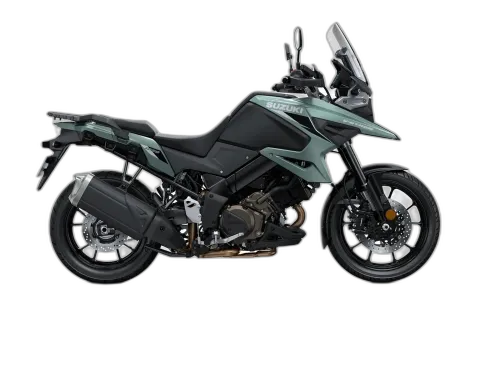
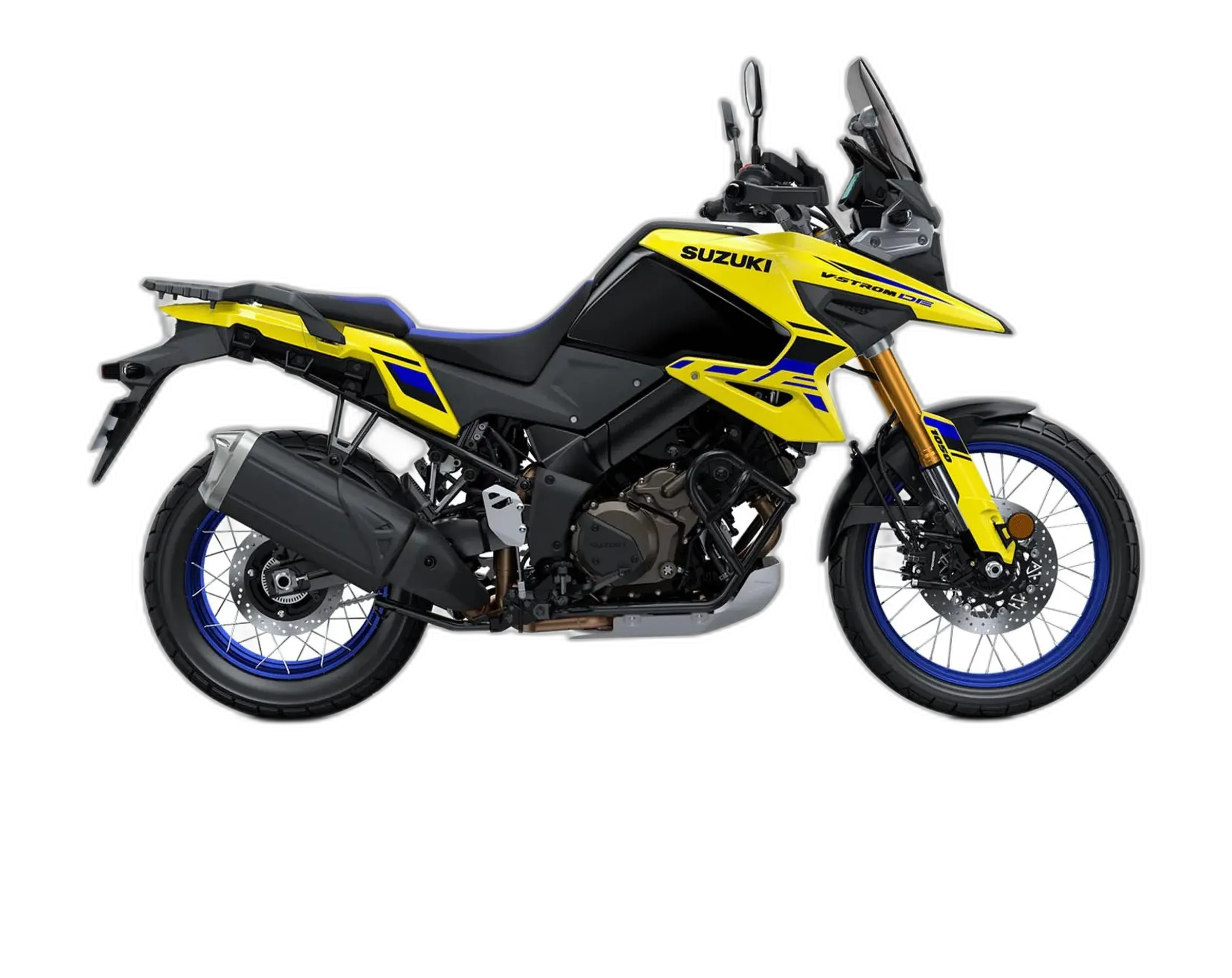
Suzuki V-Strom 1050 DE (MY2023) — Adventure
Suzuki press archive

2023 · Adventure · Buyer's Guide

V-Strom 1050 DE (MY2023)

4 / 5 NastyNils Rating · against its class

The Reliable Long-Haul Partner

The Machine's Character

The DE runs Suzuki's 90° V-twin, 1037 cc making 107 hp and 74 lb-ft, and that layout matters. Torque crests hard at 6,000 rpm and the firing pulse gives it a serious, punchy feel that reads bigger than the numbers suggest. Three ride modes tune the delivery, from direct to a softer map for rain. This is the off-road-biased branch of the 1050 family: a 21-inch front wheel, a longer wheelbase, and relaxed geometry that tracks straight and stays predictable on loose ground. It sits taller and calmer than a road-first machine, and it's built to point at the horizon.

On the road it favors stability over quick steering, holding a line without wandering once you commit. It ages the way a good tourer should. The chassis feels planted, the reliability runs deep, and the factory touring hardware means less to sort before a long trip. It's genuinely for the rider who covers distance and wants confidence in every kind of weather. The honest caveat is mass. At 556 lb wet it's a lot of machine at walking pace and in technical dirt, and the ergonomics stretch toward taller riders, so sit on it before you buy.

Hard Numbers

Spec sheets don't ride bikes, but they set the baseline.

Show full specs & equipment Hide specs & equipment
Key specifications
Power 107 hp (79 kW) @ 8,500 rpm
Torque 74 lb-ft (100 Nm) @ 6,000 rpm
Displacement 1037 cc
Engine 90° V-twin
Cooling Liquid-cooled
Gearbox 6-speed
Final drive Chain
Front brake 310 mm
Front tire 90/90-21
Rear tire 150/70-17
Wheelbase 62.8 in (1595 mm)
Ground clearance 7.5 in (190 mm)
Front travel 6.7 in (170 mm)
Rear travel 6.6 in (168 mm)
Seat height 34.6 in (880 mm)
Wet weight 556 lb (252 kg)
Fuel capacity 5.3 gal (20 L)

Equipment check

Chassis

  • Front Suspension Adjustable Standard
  • Rear Suspension Adjustable Standard
  • Cruise Control Standard

Comfort

  • Heated Grips Optional
  • Adjustable Windscreen Standard
  • Luggage System Optional

Connectivity

  • TFT Display Standard
  • USB Charging Port Standard

Drivetrain

  • Quickshifter Standard
  • Slipper Clutch Standard

Lighting

  • LED Headlight Standard

Safety

  • ABS Standard
  • Cornering ABS Standard
  • Traction Control Standard
  • Ride Modes Standard

The Voice of Experience

Portrait of NastyNils

The test ride

I ran this one through heavy rain across several Alpine passes, and the standout memory is trust. Nothing failed, nothing flinched, and by the afternoon I'd stopped managing the bike and was just riding it. The cockpit helps: few switches, an intuitive layout, and you can change a setting while moving instead of pulling over to stare at the screen. Seat and knee angle stay livable through a full day, and the suspension soaks up the miles without wearing you down. Where it shows a gap is wind coverage at the shoulders. Everywhere else the protection is good and the handguards earn their keep, but at highway speed you feel the buffeting up top. And at a full tank, wheeling it around a parking lot takes real muscle.

Rated point by point — where it earns its keep

My own 0–100 score for this bike against the class, area by area — the marker on each bar is the class average.

The brakes give me exactly what I ask for at the lever, no grabbing, no vagueness, and they hold that confidence when I'm hard on them late and already leaned into a corner. What sells it is the cornering ABS. This isn't a system that only saves you from locking the front. You can feel the calibration in how much you're willing to trust the front tire deep into a turn, and that trust is what lets you carry real speed to the apex.

What I keep coming back to is how little this bike takes out of you over a full day. The seat position and knee bend stay livable hour after hour, and the suspension quietly works the road smooth instead of grinding you down. The controls help too: not many switches, sensibly placed, so I could change a setting while rolling along without dropping my eyes to the display for long. The honest gaps are real. The riding triangle is built around a taller body, unusual for this brand, so a shorter pilot feels the reach forward to the bars, and that small stretch adds up over a long haul. Wind management is solid across the chest and hands, but it thins out at the shoulders, where the buffeting gets noticeable at highway speed. And with a brimmed tank this is a lot of weight to shuffle around a parking lot, so slow work asks for genuine muscle. Sit on one before you commit.

On the move it plants itself and stays there. This is a stable machine rather than a flickable one, but never dull with it: pick a fast corner, commit, and it settles into the arc and holds without wandering, and that composure carries straight into high-speed highway running. The traction control impressed me more than most. It gives you real adjustment, including a setting for loose ground, and when it steps in it does so cleanly instead of choking the drive out from under you. It reads like a system somebody actually rode on dirt rather than signed off in a meeting. You can also tune both ends for the load you're carrying, which matters once the bags are full. The limit is physics. On mild gravel it's happy, but the moment the ground turns technical the mass and the modest travel start writing checks the chassis won't cash. This is an adventure tourer, and that boundary is honest.

Where a lot of adventure bikes hand you a bill for the touring basics, this one shows up ready. The engine guard, handguards, accessory rails, and steel footpegs are all bolted on out of the crate, not lined up as extras you slowly buy your way toward. That makes the one gap stand out. Heated grips weren't on the bikes I rode, and on a machine built for long, all-weather days I'd want them as standard kit rather than a line on the options sheet.

The part that stuck with me is the overrun. Shut the throttle mid-corner and the bike stays composed, no lurch, no fuss at the back wheel. The slipper clutch and the electronics split the work between them, so whether I short-shifted into a downhill or grabbed a hard handful coming into a tight hairpin, the rear stayed planted underneath me. That calm on a trailing throttle is worth as much as the drive when you're stringing real corners together.

Capability here isn't a headline number, it's what the bike proves over a genuinely hard day. Run it through rough weather and long hours of demanding going and nothing gives, nothing complains, nothing asks you to nurse it home. That quiet toughness doesn't show up in a showroom. It accumulates across the miles, one uneventful hard hour after another, until the machine drops off your worry list entirely and you commit to it without a second thought. For a bike sold on going the distance, that earned confidence is the whole point.

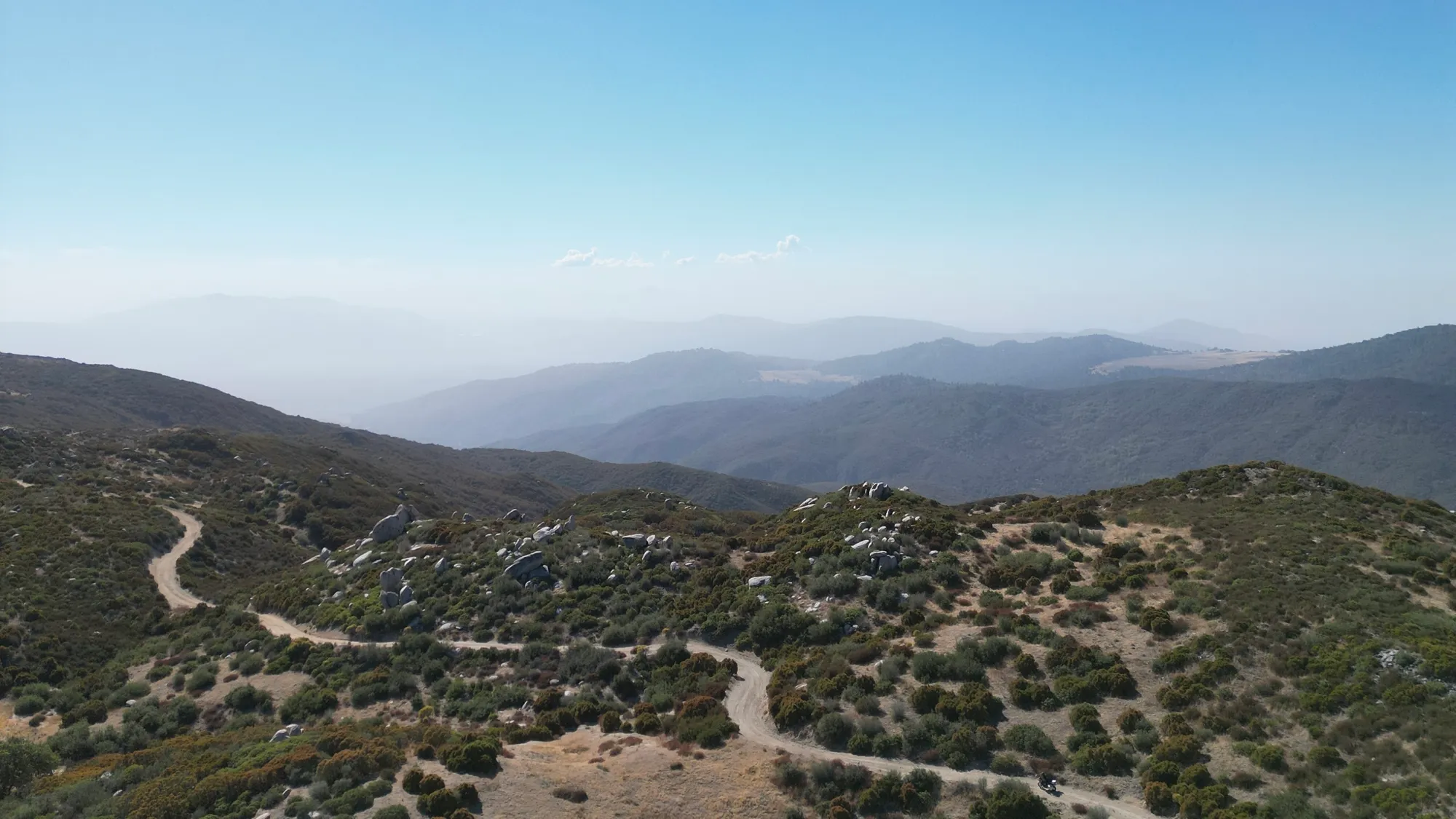
Aerial drone view of Palomar Divide Road winding through chaparral-covered mountain ridges in San Diego County. Multiple S-curve sections descend through sparse vegetation with distant valley views visible in the haze. Gravel and packed-earth surface.

The Truth on the Street

For years I've been collecting what owners tell me: in the paddock, over coffee at club nights, and in the emails and messages riders send once they've put real miles on a bike. For the V-Strom 1050 DE, the pattern is clear. Riders like the engine, the equipment that comes on the bike and the way it holds up. Their complaints are about weight in slow dirt, the seat, the tank and the dash.

An engine and platform owners trust

Riders praise the throttle response more consistently than anything else. Owners coming from parallel-twin rivals say it answers immediately, and they name the V-twin's character as what sets the DE apart from that group. Right behind that is the platform's record. The DL1050 has been around long enough to earn real faith, and owners who have covered thousands of miles report no failures. Riders who take it down forest tracks say the chassis stays settled and predictable there.

Kit you don't buy later

Owners keep coming back to how much is already fitted. They count the rider aids as a real strength: cornering ABS, five-mode traction control, rear ABS you can switch off, hill hold, ABS that adjusts for slope and load, low-rpm assist and easy start. They say the same about the armor. The aluminum bashplate, fork guards, three-piece fender and wide footpegs all come on the bike, and riders see that as money saved against rivals that sell those parts as extras.

Where owners want more

The biggest complaint is weight in tight, technical dirt. Owners say it never really goes away and is always there in the background. Shorter riders struggle with the fixed seat height and have to buy the accessory seats to change it. Touring riders say the range from the 5.3-gal (20 L) tank falls short of the best in the class. The 5-inch TFT gets good marks for its layout, but it has no Bluetooth or app connection. A smaller group of hard off-road riders say the suspension bottoms out over quick, repeated hits, though they find it fine for trails.

Known issues

  • High-beam headlight intensity exceeds federal limit (FMVSS 108)

    electrics occasional Recall

    Protective tape applied to the headlight reflector base during production elevated the reflector by approximately 0.5°, causing the upper beam intensity to exceed the 7,500 candela maximum specified in FMVSS 108. Risk: glare for oncoming traffic, impaired visibility. Affects MY2023–MY2025 V-Strom 1050, 1050 DE, and 1050 DE Adventure (plus selected GSX-S1000S models). Remedy: free dealer headlight assembly replacement.

  • Front and rear suspension bottoms on rapid successive impacts

    suspension occasional

    Press reviews and forum discussions report the rebound damping cannot keep up during rapid bump sequences off-road, leading to bottoming. The travel is reported as adequate for trails and gravel but marginal for serious off-road work. This is a tuning-and-stroke limitation typical of road-leaning adventure bikes, not a defect.

  • Downshifts below 3rd gear drop into false neutral

    drivetrain occasional

    When downshifting (clutch and quickshifter both reported), the gearbox enters neutral instead of engaging the target gear. Workaround: partial clutch release engages the gear. More pronounced at low RPM and low load; less prevalent with higher throttle input. Owners report multiple independent cases plus a dealer-confirmed pattern of "two additional customers" with the same complaint.

  • Lean cold-start fueling produces throttle hesitation until engine warm

    engine occasional

    After cold start, throttle response is hesitant and lean — owners describe a "lurching forward like catapulted by a rubber band" sensation once the engine catches up. A Suzuki technician attributed the behavior to weak spark timing below approximately 171 °F (77 °C) engine temperature; the attempted remedy was spark plug and connector replacement. The pattern overlaps with the broader emissions-driven lean-fueling map common to Euro 5 V-twins; treat as a drivability characteristic rather than a defect.

The Expert Benchmark

Where this Suzuki V-Strom 1050 DE pulls ahead of — or falls behind — its rivals on the numbers, and the typical bike in its class on character.

What kind of bike this is — character vs. the class

This bike Class average

The shape of the Suzuki V-Strom 1050 DE — numbers and character vs. the average Adventure

Head-to-head: Suzuki V-Strom 1050 DE vs. its rivals

The Long-Haul Verdict

Forget spec-sheet bragging. Here's who the V-Strom 1050 DE is actually built for.

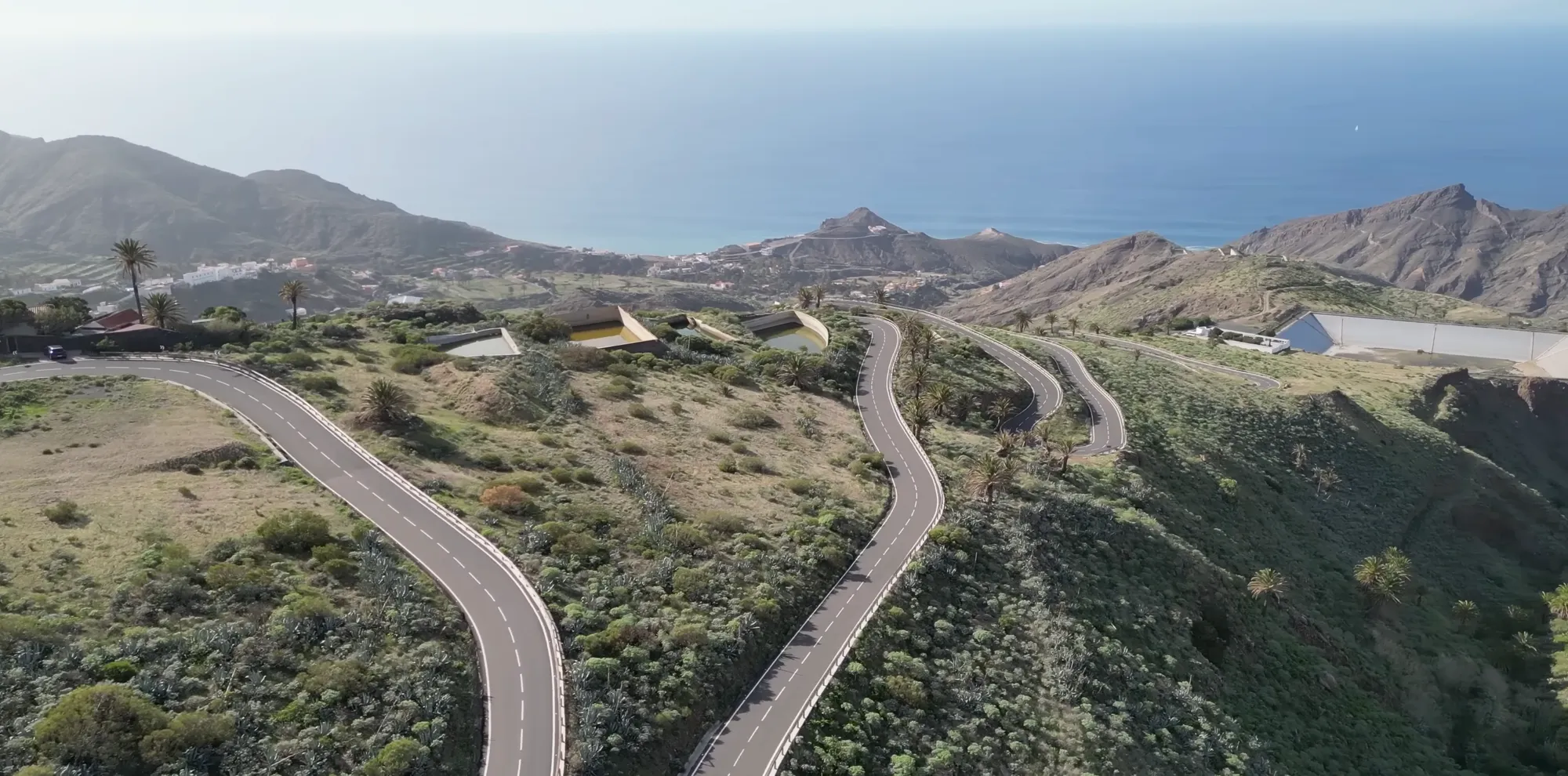
Aerial view of a winding asphalt road cutting through volcanic terrain on La Gomera, Canary Islands. The road curves through sparse green vegetation with rocky volcanic peaks visible in the background and a settled valley to the left. Clear lane markings, dry climate, partly cloudy sky.

Best touring motorcycle for long distance?

If you string together big routes, changing weather, and long days two-up or loaded, this fits. It's comfortable, weatherproof, and confident, once you accept the weight and some shoulder buffeting.

Made for Beartooth Highway · Blue Ridge Parkway · Going-to-the-Sun Road
Best motorcycle for Highway 1?

For 200 to 400-mile days linking curves, comfort, and scenery, it delivers. It leans toward stability over sharp steering, so it rewards flowing roads more than hustling through tight, technical ones.

Made for Highway 1 / Big Sur · Black Hills · Blue Ridge Parkway

Best motorcycle for BDR routes?

You want middleweight-style backcountry capability, and this is heavier than that. Easy BDR miles are no problem, but on the technical sections the mass is always with you, so plan your routes honestly.

Made for AZBDR — Arizona Backcountry Discovery Route · California BDR South · COBDR — Colorado Backcountry Discovery Route

Alternatives to the Suzuki V-Strom 1050 DE

If this one isn't quite the fit, these are the bikes worth riding back-to-back against it.

Any price note compares both bikes at the same age — the youngest age both have on the used market — against this Suzuki V-Strom 1050 DE. “cheaper/pricier” is what that bike costs second-hand, not how worn it is.