By NastyNils·
Motorcycle comparison · Naked Bike vs Cruiser
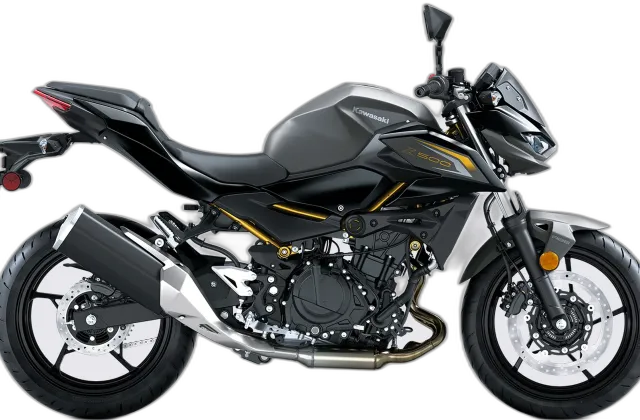
Kawasaki Z 500 (MY2024) vs Eliminator 500 (MY2024)
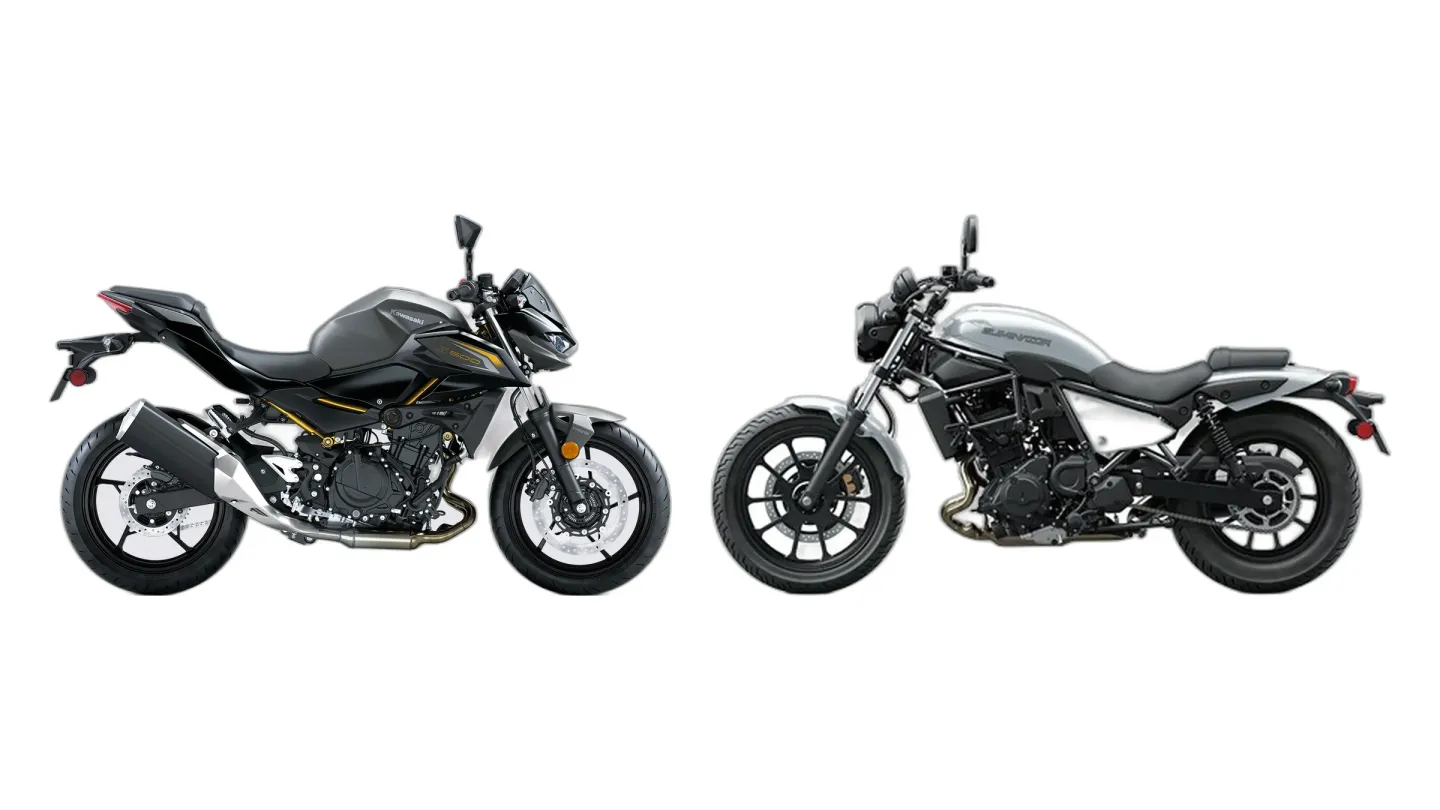
Kawasaki Z 500 vs Eliminator 500: where they split, and which one to buy.
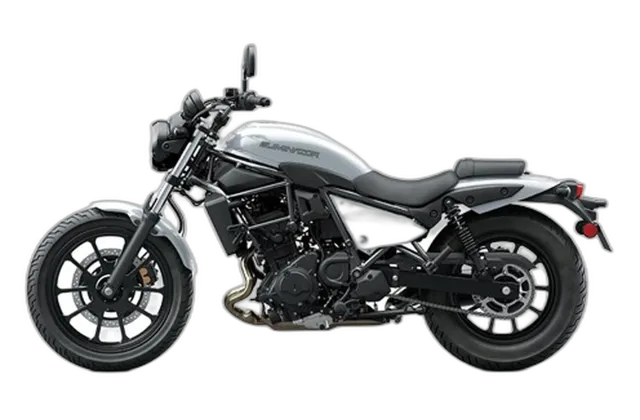
Roll up to a red light, and the Kawasaki Z 500 weighs so little that you're flat-footed without a wobble. On the Kawasaki Eliminator 500, both boots plant flat while you're sitting upright with your feet on mid-mount pegs. Its rubber-mounted bars keep your hands loose.
So which one do you buy?
Buy the Z 500 if…
Daily commuting & city riding
By a mile: Z 500
For five days a week in traffic, the Z 500 makes far more sense. That comes from a smaller footprint and lighter steering. You'll notice it by the second week.
The Z 500 has the edge if…
Sporty riding on twisty roads
Edges it: Z 500
On a winding road, the Z 500 comes out a touch ahead. Credit more feel through the bars and a sportier chassis. You wouldn't bet much on a gap like that.
A confidence-building first motorcycle
Small edge: Z 500
The Z 500 asks a little less of a rookie. That's a narrow edge, so sit on both before you decide.
What makes each one tick
Z 500
There's almost no pull at the Z 500's clutch lever, while the gearbox clicks through its gears cleanly and finds neutral without hunting. A fine buzz creeps through the pegs and seat at a steady cruise. The trellis frame drops the bike into a corner on a neutral line, and it doesn't wander once the road opens up. The bar answers the smallest nudge.
Nils rode the Z 500 in Austria in 2024 (NastyNils Testride).
Eliminator 500
Down low, the Eliminator 500's twin tugs cleanly, and there's no letup as it spins eagerly toward the redline. Its clutch takes up smoothly. A squeeze of the brake lever slows the bike through its 310 mm front brake. The low-slung chassis steers where it's pointed.
The Voice of Experience

What actually separates them
- The Eliminator 500 has the lower seat: 28.9 in (735 mm) vs 30.9 in (785 mm).
- The Z 500 has the lower wet weight: 366 lb (166 kg) vs 390 lb (177 kg).
- The Z 500 makes more peak power: 52 hp (38 kW) vs 46 hp (34 kW).
Which one for the way you ride
Comfortable long-distance riding
Not built for this
Hours in the saddle won't flatter either of these. They're happier on shorter runs.
Count running costs as a draw. The deal on the table and the condition of the bike matter more here.
Who each one is built for
What's good, and what you'll live with
Z 500
What owners say
Strengths
- Featherlight clutch + crisp 6-speed
- Neutral, agile handling
- Exceptional accessibility for shorter riders
Trade-offs
- Mid-rpm vibration buzz
- Single front disc, early ABS intervention
- Cramped knee angle for taller riders
- Rideology smartphone app reliability
Eliminator 500
What owners say
Strengths
- Comfortable upright ergonomics with low seat
- Smooth, rev-happy engine with punchy low-end
Known problems to check before you buy
Z 500
- Mid-RPM vibration buzz at sustained ~6,500 rpm cruise Pronounced high-frequency buzz transmitted through grips, pegs, and seat at sustained rpm (corresponds to cruise). Settles slightly above and below this band. Characteristic of the engine, not a failure mode. Long-distance fatigue factor.
- Rideology smartphone-app pairing and ride-logging unreliability Bluetooth pairing between the instrument panel and the Rideology smartphone app can take repeated attempts, and in some cases dealer assistance, before a connection is established. Once paired, ride logging can be incomplete, recording only a small portion of a longer ride. This is a weakness of the Kawasaki app that affects the brand's connected models in general rather than a fault unique to this bike.
Eliminator 500
- Fuel gauge inaccuracy Some owners report that the fuel gauge does not display correctly, showing incorrect levels or empty when fuel remains.
What they cost used
These prices compare a 2-year-old Z 500 with a 2-year-old Eliminator 500.
- Z 500
- about $4,800
- Eliminator 500
- about $6,100
At two years old, the Kawasaki Z 500 sits around $4,800 while the Kawasaki Eliminator 500 runs about $6,100. That's a $1,300 gap in the Z 500's favor. These are US market estimates, not live listings.
What they share
- Displacement
- 451 cc
- Engine
- Parallel twin
- Cooling
- Liquid-cooled
- Gearbox
- 6-speed
- Final drive
- Chain
- Front brake
- 310 mm
Where the spec sheets split
| Z 500 | Eliminator 500 | |
|---|---|---|
| Seat height | 30.9 in (785 mm) | 28.9 in (735 mm) |
| Wet weight | 366 lb (166 kg) | 390 lb (177 kg) |
| Z 500 | Eliminator 500 | |
|---|---|---|
| Power | 52 hp (38 kW) | 46 hp (34 kW) |
| Torque | 32 lb-ft (43 Nm) | 31 lb-ft (43 Nm) |
| Z 500 | Eliminator 500 | |
|---|---|---|
| Fuel capacity | 3.7 US gal (14 L) | 3.4 US gal (13 L) |
| Z 500 | Eliminator 500 | |
|---|---|---|
| Front tire | 110/70-17 | 130/70-18 |
| Rear tire | 150/60-17 | 150/80-16 |
What comes fitted, what costs extra
| Z 500 | Eliminator 500 | |
|---|---|---|
| TFT Display | Option | Not offered |
| USB Charging Port | Option | Not offered |
| Heated Grips | Not offered | Option |
Head to head, area by area
Both bikes on the same scale, one area at a time.