By NastyNils·
Motorcycle comparison · Naked Bike
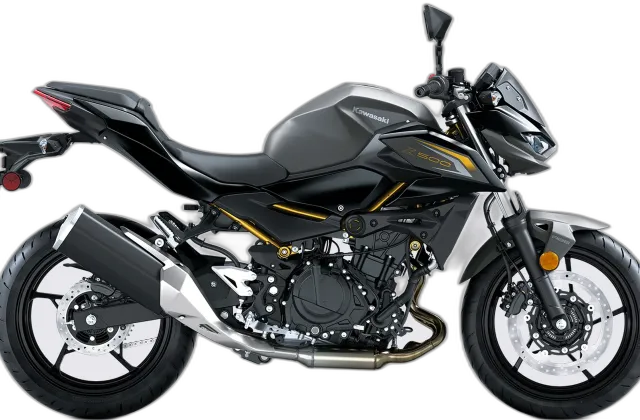
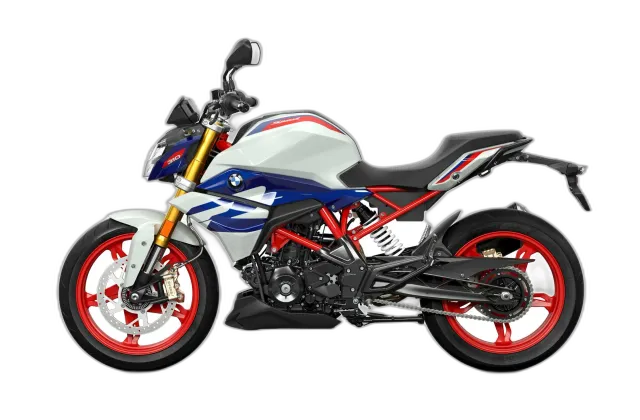
Kawasaki Z 500 (MY2024) vs BMW G 310 R (K03)
Kawasaki Z 500 vs BMW G 310 R: no fairing, no excuses. Here's how to pick.
You'll find the Kawasaki Z 500 doesn't argue at corner entry: it tips in on a neutral line and holds steady as the bend opens. The BMW G 310 R flicks over at the lightest nudge of the bars. Once it's leaned over, the chassis stays put.
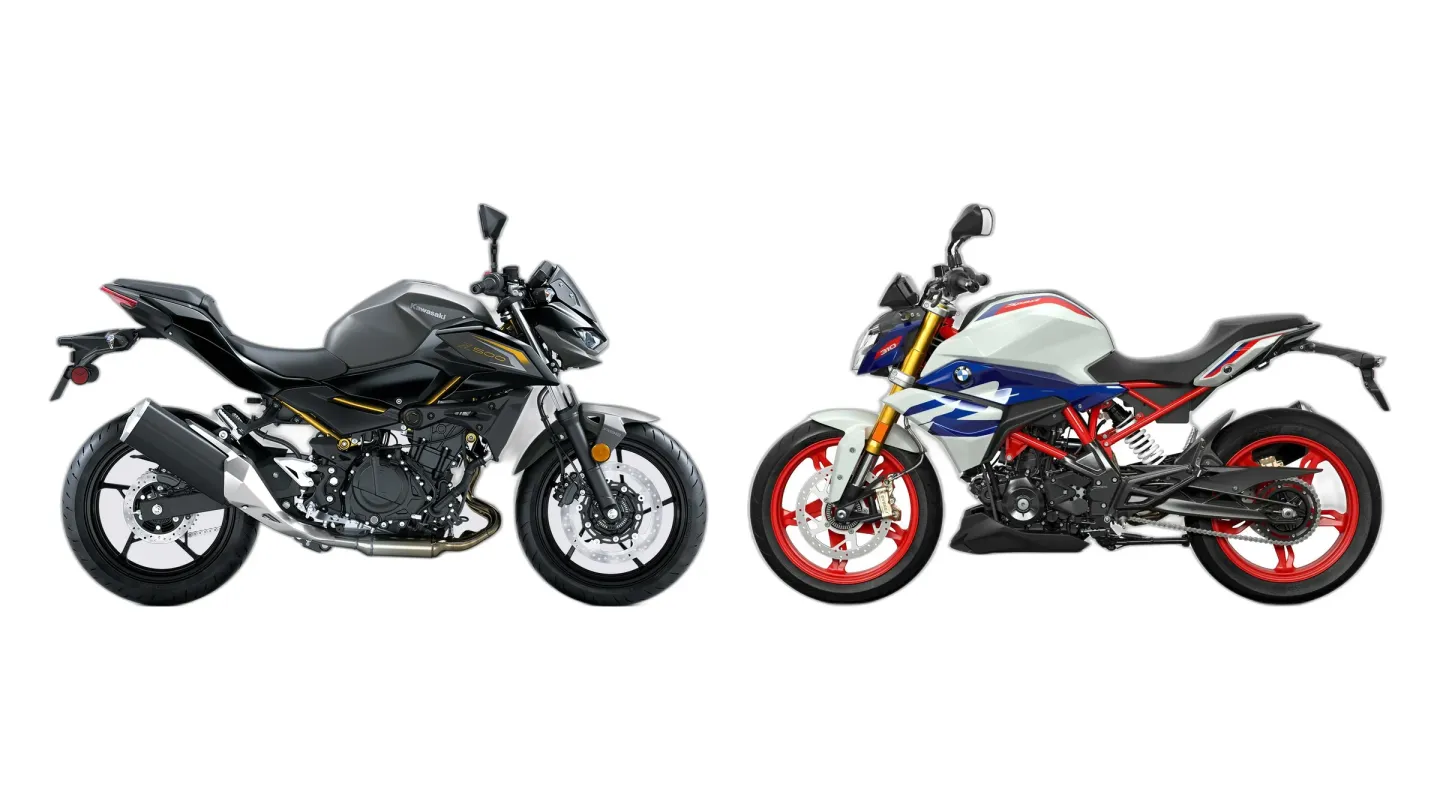
So which one do you buy?
The Z 500 has the edge if…
Daily commuting & city riding
Inches ahead: Z 500
On the way to work, the Z 500 asks a little less of you. It's down to friendlier manners. Close enough that the test ride should settle it.
Sporty riding on twisty roads
A touch ahead: Z 500
Once the road starts to bend, the Z 500 noses ahead. The reason: harder acceleration and stronger brakes. Your own skill counts for more than a gap this size.
A confidence-building first motorcycle
Small edge: Z 500
For your first season, the Z 500 makes slightly more sense. Fit and confidence at a standstill still come first.
Which one's the smarter buy
Nothing in it on value
At these used prices, neither bike comes out ahead on value. The small price gap doesn't make one the clear better buy for the money.
What makes each one tick
Z 500
In San Francisco stop-and-go, the Z 500's clutch lever takes almost no pull, and the gearbox doesn't fumble a shift. The throttle draws the twin up through the revs in one even pull. At a sustained cruise, there's a fine buzz in the grips, pegs and seat.
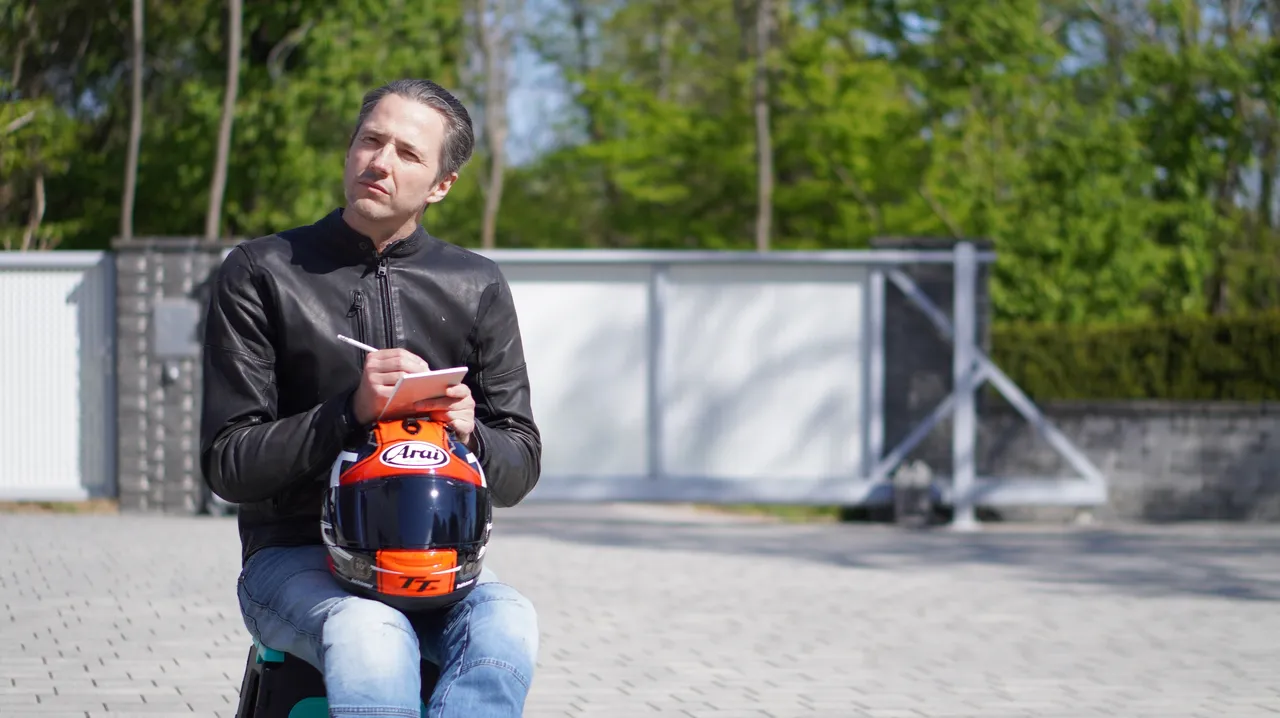
Nils rode the Z 500 in Austria in 2024 (NastyNils Testride).
G 310 R
There's almost no thud from the G 310 R's reversed single, and the counterbalancer spins it up close to electric. The brake lever works a radial Bybre caliper through braided steel lines. It's authentic BMW feel.
The Voice of Experience
What actually separates them
- The G 310 R has the lower wet weight: 349 lb (158 kg) vs 366 lb (166 kg).
- The Z 500 makes more peak power: 52 hp (38 kW) vs 34 hp (25 kW).
- The Z 500 makes more peak torque: 32 lb-ft (43 Nm) vs 21 lb-ft (28 Nm).
Which one for the way you ride
Comfortable long-distance riding
Neither is a natural fit
Neither one is built for long-haul comfort. For big miles, look at a proper tourer or sport tourer.
Traveling with luggage
Neither one fits
Saddlebags and long trips don't suit these two. They're better at day rides.
Who each one is built for
What's good, and what you'll live with
Z 500
What owners say
Strengths
- Featherlight clutch + crisp 6-speed
- Neutral, agile handling
- Exceptional accessibility for shorter riders
Trade-offs
- Mid-rpm vibration buzz
- Single front disc, early ABS intervention
- Cramped knee angle for taller riders
- Rideology smartphone app reliability
G 310 R
What owners say
Strengths
- Lightweight and nimble handling
- Premium build quality for its class
- Smooth, vibe-free single-cylinder engine
Known problems to check before you buy
Z 500
- Mid-RPM vibration buzz at sustained ~6,500 rpm cruise Pronounced high-frequency buzz transmitted through grips, pegs, and seat at sustained rpm (corresponds to cruise). Settles slightly above and below this band. Characteristic of the engine, not a failure mode. Long-distance fatigue factor.
- Rideology smartphone-app pairing and ride-logging unreliability Bluetooth pairing between the instrument panel and the Rideology smartphone app can take repeated attempts, and in some cases dealer assistance, before a connection is established. Once paired, ride logging can be incomplete, recording only a small portion of a longer ride. This is a weakness of the Kawasaki app that affects the brand's connected models in general rather than a fault unique to this bike.
G 310 R
- Brake caliper corrosion (recall 19V593) Recall 19V593000 Unanodized caliper piston bores can corrode over time, causing pistons to stick or drag, reducing braking performance. Affects 2017-2020 models.
- Catastrophic engine failure (valve or crankshaft) Some high-mileage units (30,000+ miles) have suffered from dropped valves or crankshaft bearing failure. BMW replaced several engines under warranty. Regular valve checks may help prevent valve-related failures.
- Side stand/frame mount failure (recall 18V408000) Recall 18V408000 Repeated use and loading can damage the side stand or frame, potentially causing the bike to fall over while stationary. Affected 2017-2018 models.
What they cost used
These prices compare a 2-year-old Z 500 with a 2-year-old G 310 R.
- Z 500
- about $4,800
- G 310 R
- about $4,400
What they share
- Seat height
- 30.9 in (785 mm)
- Cooling
- Liquid-cooled
- Peak torque at
- 7,500 rpm
- Gearbox
- 6-speed
- Final drive
- Chain
- Front tire
- 110/70-17
- Rear tire
- 150/60-17
Where the spec sheets split
| Z 500 | G 310 R | |
|---|---|---|
| Wet weight | 366 lb (166 kg) | 349 lb (158 kg) |
| Z 500 | G 310 R | |
|---|---|---|
| Displacement | 451 cc | 313 cc |
| Engine | Parallel twin | Single-cylinder |
| Power | 52 hp (38 kW) | 34 hp (25 kW) |
| Peak power at | 10,000 rpm | 9,500 rpm |
| Torque | 32 lb-ft (43 Nm) | 21 lb-ft (28 Nm) |
| Top speed | 112 mph (180 km/h) | 89 mph (143 km/h) |
| Z 500 | G 310 R | |
|---|---|---|
| Fuel economy | 62 mpg (US) / 3.8 L/100 km | 67 mpg (US) / 3.5 L/100 km |
| Fuel capacity | 3.7 US gal (14 L) | 2.9 US gal (11 L) |
| Z 500 | G 310 R | |
|---|---|---|
| Front brake | 310 mm | 300 mm |
| Wheelbase | 54.1 in (1375 mm) | 54.0 in (1372 mm) |
What comes fitted, what costs extra
| Z 500 | G 310 R | |
|---|---|---|
| Slipper Clutch | Standard | Not offered |
| TFT Display | Option | Not offered |
| Smartphone Connectivity | Standard | Not offered |
| USB Charging Port | Option | Not offered |
| LED Headlight | Standard | Not offered |
Head to head, area by area
Both bikes on the same scale, one area at a time.