By NastyNils·
Motorcycle comparison · Naked Bike
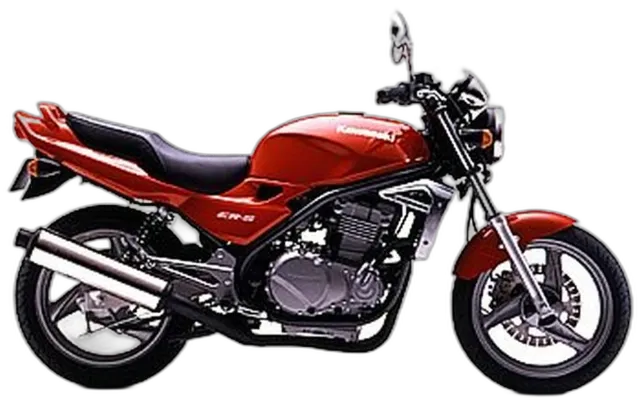
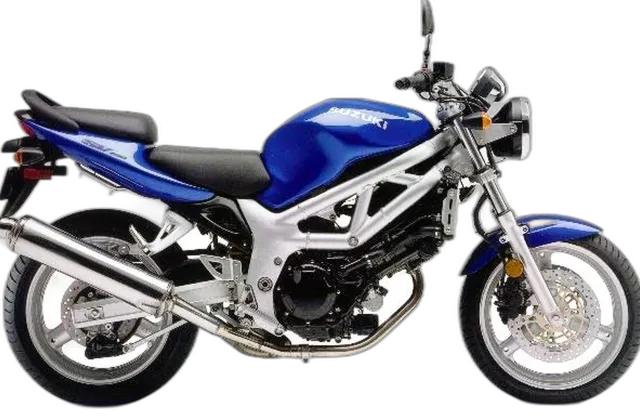
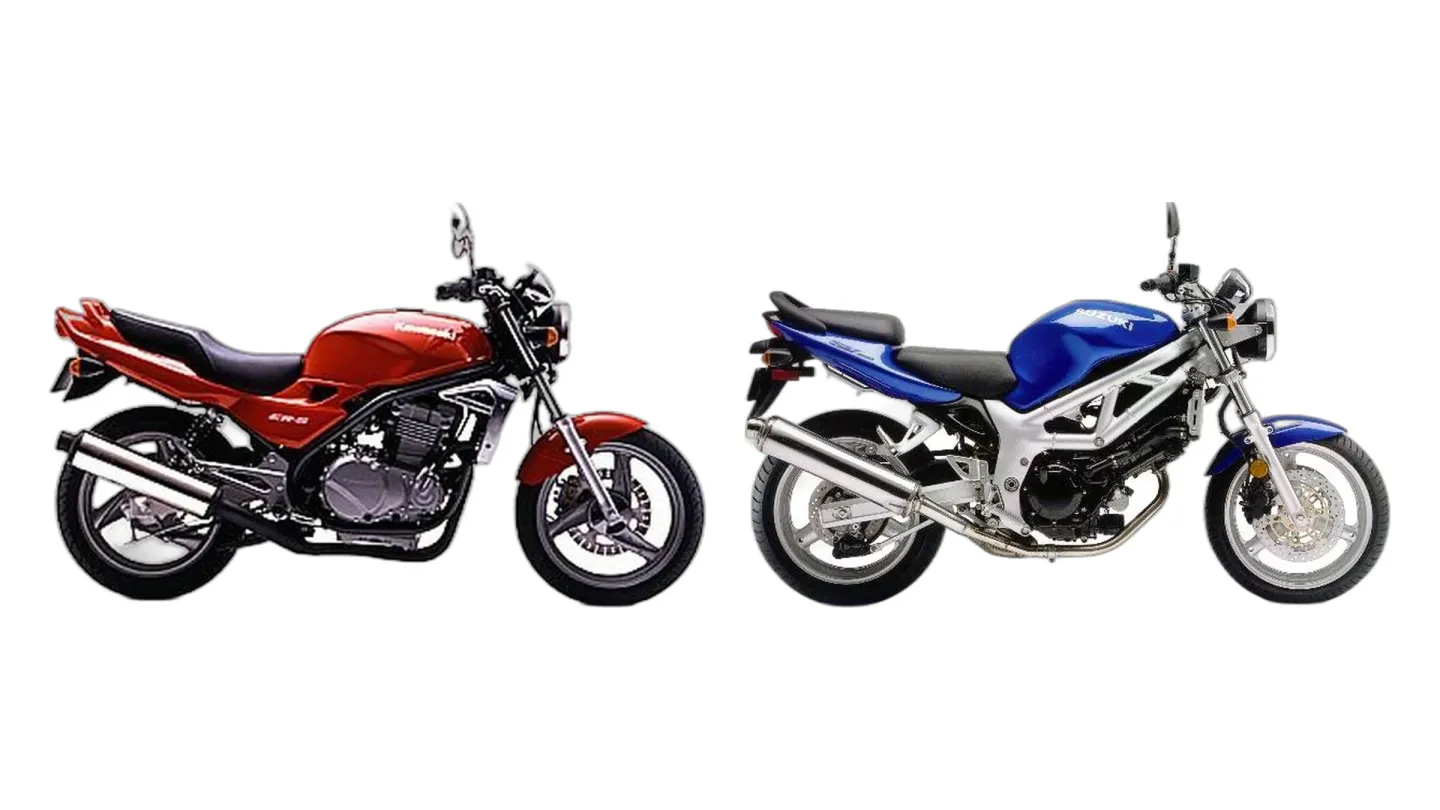
Kawasaki ER-5 (ER5-MY2005) vs Suzuki SV650 (MY1999)
Kawasaki ER-5 vs Suzuki SV650: no fairing, no excuses. Here's how to pick.
Roll on the Kawasaki ER-5's throttle and its twin sips fuel and won't quit as the miles pile up. The Suzuki SV650's V-twin doesn't hang back there: it pulls cleanly from low revs. It's still climbing when the top end rushes in.
So which one do you buy?
The SV650 has the edge if…
Sporty riding on twisty roads
Edges it: SV650
On a winding road, the SV650 comes out a touch ahead. Most of that is harder acceleration and stronger brakes. You wouldn't bet much on a gap like that.
What makes each one tick
ER-5
There's nothing on the ER-5 that's there for show, and its engine has just enough modest shove to get it away from each stoplight without fuss. Out of town, the engine's strained. The single front disc and rear drum want a hard pull at the brake lever, where there's little feel and only adequate stopping as the bike slows. Its low seat keeps both boots close to the pavement.
SV650
The SV650's V-twin spins up with an eagerness no budget engine has a right to, and it's smooth the whole way. At 408 lb (185 kg), the bike feels light over broken pavement, where there's plush give in its springs. Hard riding outruns the damping. On corner entry, the front turns in and stays put.
The Voice of Experience

What actually separates them
- The SV650 has the lower wet weight: 408 lb (185 kg) vs 432 lb (196 kg).
- The SV650 makes more peak power: 71 hp (52 kW) vs 50 hp (37 kW).
- The SV650 makes more peak torque: 46 lb-ft (62 Nm) vs 33 lb-ft (45 Nm).
Which one for the way you ride
Comfortable long-distance riding
Both miss here
For all-day comfort, both fall short. Keep the rides short and you'll get on fine with either.
Traveling with luggage
Look elsewhere
Neither is a natural luggage carrier, so a trip with bags means a compromise either way.
Nothing splits them on commuting and a first bike. Ride both back to back and the decision usually makes itself.
Who each one is built for
What's good, and what you'll live with
ER-5
What owners say
Strengths
- Proven, long-lasting engine
- Rock-bottom running costs
- Superb fuel economy
Trade-offs
- Corrosion-prone build quality
- Weak and wooden brakes
- Recurring electrical gremlins
SV650
What owners say
Strengths
- Charismatic V-twin engine
- Sweet, neutral handling
- Exceptional value for money
Trade-offs
- Soft, budget suspension
Known problems to check before you buy
ER-5
- Regulator/rectifier and charging system failure The reg/rec can overheat and fail, often taking the tachometer and CDI unit with it. Symptoms include flickering lights, a dead battery, and an erratic tacho.
- Rear drum brake warping The rear drum can wear unevenly and eventually warp, leading to a pulsing brake pedal.
- Corrosion of frame, fasteners, and exhaust The thin paint and poor-quality plating cause widespread rust on the frame, swingarm, and fasteners. Exhaust headers and collector box also rot through prematurely.
SV650
- Clutch cover gasket leak The clutch cover gasket can seep oil over time.
What they share
- Seat height
- 31.5 in (800 mm)
- Cooling
- Liquid-cooled
- Peak torque at
- 7,200 rpm
- Gearbox
- 6-speed
- Final drive
- Chain
- Fork
- Telescopic
- Wheelbase
- 56.3 in (1430 mm)
Where the spec sheets split
| ER-5 | SV650 | |
|---|---|---|
| Wet weight | 432 lb (196 kg) | 408 lb (185 kg) |
| ER-5 | SV650 | |
|---|---|---|
| Displacement | 499 cc | 645 cc |
| Engine | Parallel twin | 90° V-twin |
| Power | 50 hp (37 kW) | 71 hp (52 kW) |
| Peak power at | 9,000 rpm | 8,500 rpm |
| Torque | 33 lb-ft (45 Nm) | 46 lb-ft (62 Nm) |
| Top speed | 111 mph (178 km/h) | 123 mph (198 km/h) |
| ER-5 | SV650 | |
|---|---|---|
| Fuel economy | 47 mpg (US) / 5 L/100 km | 33 mpg (US) / 7.1 L/100 km |
| Fuel capacity | 4.5 US gal (17 L) | 4.2 US gal (16 L) |
| ER-5 | SV650 | |
|---|---|---|
| Front brake | 280 mm | 290 mm |
| Front tire | 110/70-17 | 120/60-17 |
| Rear tire | 130/70-17 | 160/60-17 |
Head to head, area by area
Both bikes on the same scale, one area at a time.