By NastyNils·
Motorcycle comparison · Naked Bike
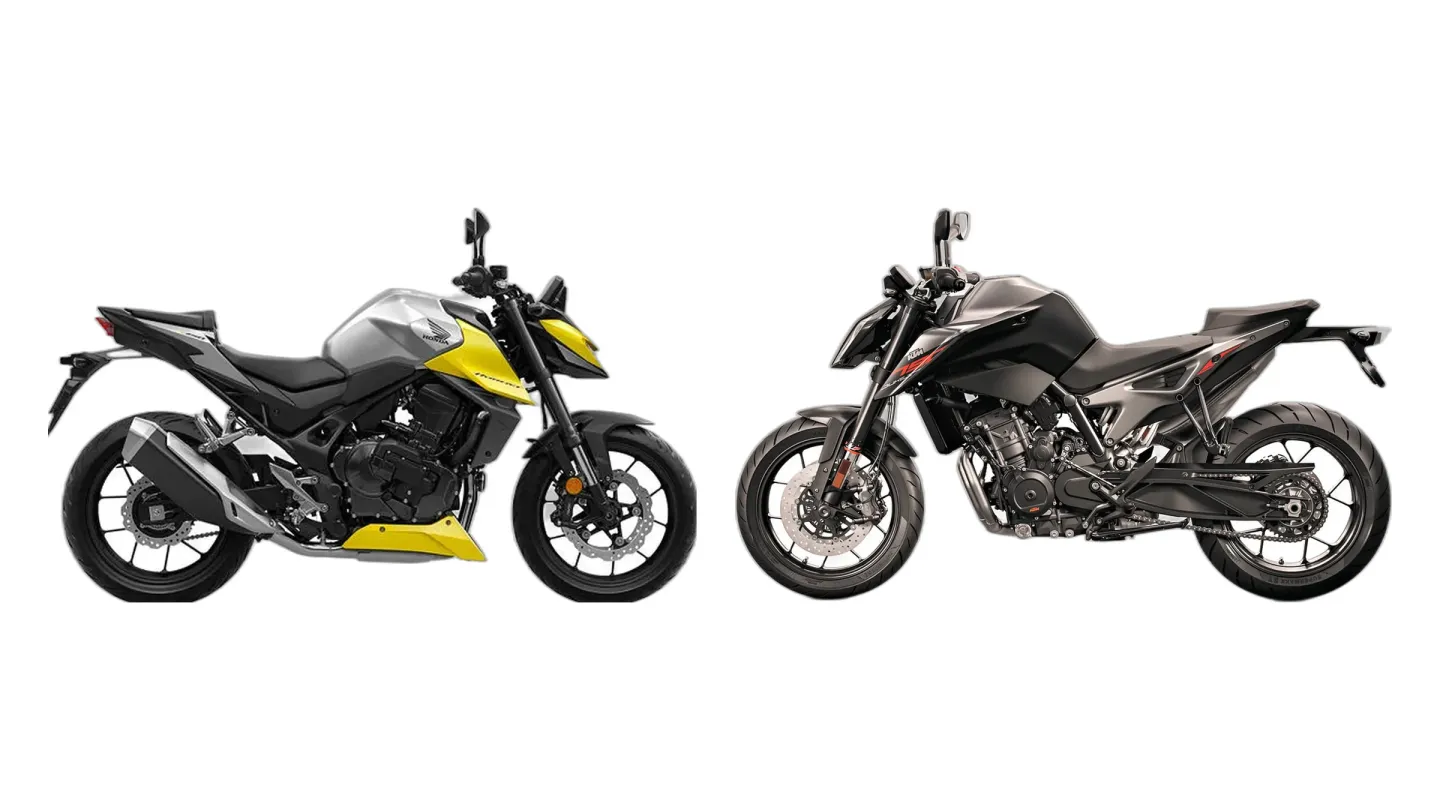
Honda CB750 Hornet (RH12) vs KTM 790 Duke (MY2018)
Honda CB750 Hornet vs KTM 790 Duke: no fairing, no excuses. Here's how to pick.
Tip the Honda CB750 Hornet into a corner and it won't fight you. The KTM 790 Duke flicks in quick and slices a tight line. Hustled hard, it starts to squirm.
So which one do you buy?
The CB750 Hornet has the edge if…
Traveling with luggage
By a nose: CB750 Hornet
The CB750 Hornet feels a little more at home with bags on. Put it down to a better reliability record and a better passenger seat. It's a fine margin, so test both loaded if you can.
Daily commuting & city riding
Nose ahead: CB750 Hornet
Day in, day out, the CB750 Hornet nudges ahead in traffic. What tips it: lower running costs. It isn't a big enough gap to plan around.
What makes each one tick
CB750 Hornet
Underway, the CB750 Hornet feels compact, with a bar that swaps direction through esses and hairpins for almost no effort. The chassis doesn't flinch when the throttle closes mid-bend, because the engine braking comes in smooth. The fork sends back little feel from the front tire under braking toward an apex, just when you'd want it most. Uneven crank pulses leave you grinning.
Nils rode the CB750 Hornet in Austria in 2023, and in Austria in 2024 (NastyNils Testride).
790 Duke
There's a V-twin edge to the 790 Duke's exhaust note, and the parallel twin pulls strong through the middle of the revs. Cornering ABS backs up the brake lever on the way into a bend, where sharp geometry keeps the bike precise. The frame earned that Scalpel nickname.
Nils rode the 790 Duke in Hungary in 2019 (NastyNils Testride).
The Voice of Experience

What actually separates them
- The CB750 Hornet has the lower seat: 31.3 in (795 mm) vs 32.5 in (825 mm).
- The 790 Duke makes more peak power: 105 hp (77 kW) vs 92 hp (68 kW).
- The 790 Duke makes more peak torque: 64 lb-ft (87 Nm) vs 55 lb-ft (75 Nm).
Which one for the way you ride
Comfortable long-distance riding
Neither one fits
Big miles aren't where either one shines. You'll be watching for the next rest stop.
A confidence-building first motorcycle
No verdict: 790 Duke
The 790 Duke isn't a first bike. Learn on something gentler and come back to it later.
These two run dead level on twisty roads. Sit on both in the showroom and trust what your body says.
Who each one is built for
What's good, and what you'll live with
CB750 Hornet
From Nils' own saddle time
Strengths
- Front brake is easy to modulate and stops hard
- Lean angle clearance surprises you
- Solid and composed at highway speed
Trade-offs
- Fork gives up little front-end information
- Menu logic takes getting used to
- No USB port in the cockpit
- Overall proportions feel compact for taller riders
- Seat bottoms out on long days
790 Duke
What owners say
Strengths
- Punchy, characterful parallel-twin engine
- Razor-sharp handling and agility
Trade-offs
- Non-adjustable suspension limits fine-tuning
Known problems to check before you buy
CB750 Hornet
- Soft suspension setup, limited adjustability The Showa SFF-BP USD fork is non-adjustable on the standard model; the Pro-Link rear shock offers preload only (7-step). Heavier riders and brisk-paced riders report rebound oscillation, bouncing on bigger bumps, and a setup biased toward comfort over control. Aftermarket shock upgrades (Wilbers and similar) resolve this for owners pursuing sporty pace. Honda revised the fork damping for 25YM, but the adjustability did not change.
- Jerky on-off throttle at low rpm and urban speeds The ride-by-wire throttle calibration is abrupt during transitions between closed and small-throttle openings, particularly in 1st and 2nd gear at urban speeds and at part-throttle below approximately 5,500 rpm. Multiple owners report a TPS reset procedure provides limited improvement; Honda is reported to have improved the calibration for model year 2025.
- ABS cannot be switched off, no cornering ABS The 2-channel ABS system is fixed and non-defeatable, with no IMU and therefore no cornering ABS. Reviewers report the ABS can intervene aggressively on loose surfaces. This is a spec design choice rather than a fault, but it is a documented limitation for owners using the bike on gravel or for back-track riding.
- HSTC traction-control setting resets to default on every key-on Owners and reviewers note that the bike does not retain the rider's HSTC setting across a key cycle; it returns to the default level whenever the ignition is turned off and on again. An annoyance for riders who routinely run a non-default HSTC level.
790 Duke
- Premature camshaft wear The LC8c engine can suffer from soft cam lobes, leading to excessive wear and potential engine damage. Typically noticed at 12,000–19,000 mi (20,000–30,000 km) during valve checks.
- Coolant hose leaks The round radiator hoses do not seal well against the oval thermostat housing, causing coolant leaks. Common on 2018-2020 models.
- Immobilizer malfunction In cold weather or with a weak battery, the immobilizer may trigger a warning on the dash and prevent starting.
- Thermostat housing leak The factory plastic thermostat housing lacks a dedicated gasket and is prone to thermal warping, causing coolant to weep from the mating surface.
- Valve cover gasket leak The valve cover gasket can leak oil from the half-moon seals due to insufficient factory sealant. The leak often appears after moderate mileage and may eventually affect early production bikes.
What they share
- Engine
- Parallel twin
- Cooling
- Liquid-cooled
- Gearbox
- 6-speed
- Final drive
- Chain
- Front tire
- 120/70-17
Where the spec sheets split
| CB750 Hornet | 790 Duke | |
|---|---|---|
| Seat height | 31.3 in (795 mm) | 32.5 in (825 mm) |
| Wet weight | 419 lb (190 kg) | 417 lb (189 kg) |
| CB750 Hornet | 790 Duke | |
|---|---|---|
| Displacement | 755 cc | 799 cc |
| Power | 92 hp (68 kW) | 105 hp (77 kW) |
| Peak power at | 9,500 rpm | 9,000 rpm |
| Torque | 55 lb-ft (75 Nm) | 64 lb-ft (87 Nm) |
| Peak torque at | 7,250 rpm | 8,000 rpm |
| CB750 Hornet | 790 Duke | |
|---|---|---|
| Fuel economy | 55 mpg (US) / 4.3 L/100 km | 53 mpg (US) / 4.4 L/100 km |
| Fuel capacity | 4.0 US gal (15.2 L) | 3.7 US gal (14 L) |
| CB750 Hornet | 790 Duke | |
|---|---|---|
| Rear tire | 160/60-17 | 180/55-17 |
What comes fitted, what costs extra
| CB750 Hornet | 790 Duke | |
|---|---|---|
| Cornering ABS | Not offered | Standard |
| Quickshifter | Option | Standard |
| Smartphone Connectivity | Standard | Option |
| USB Charging Port | Not offered | Option |
Head to head, area by area
Both bikes on the same scale, one area at a time.