By NastyNils·
Motorcycle comparison · Naked Bike
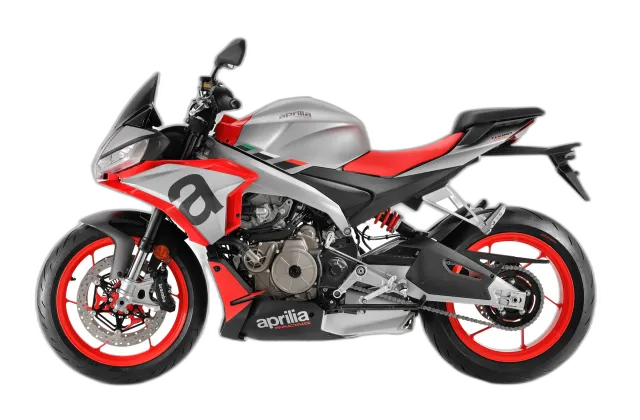
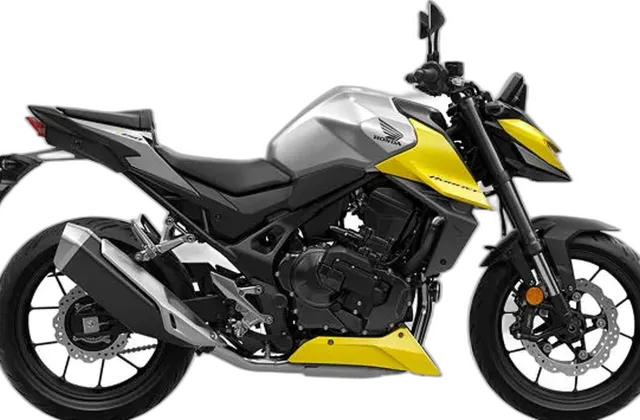
Aprilia Tuono 660 (MY2021) vs Honda CB750 Hornet (RH12)
Aprilia Tuono 660 vs Honda CB750 Hornet: which one's easier to live with every day.
Crack open the Aprilia Tuono 660's throttle and you'll hear its off-beat twin growl like a V-twin. The Honda CB750 Hornet's engine braking won't upset it mid-bend.
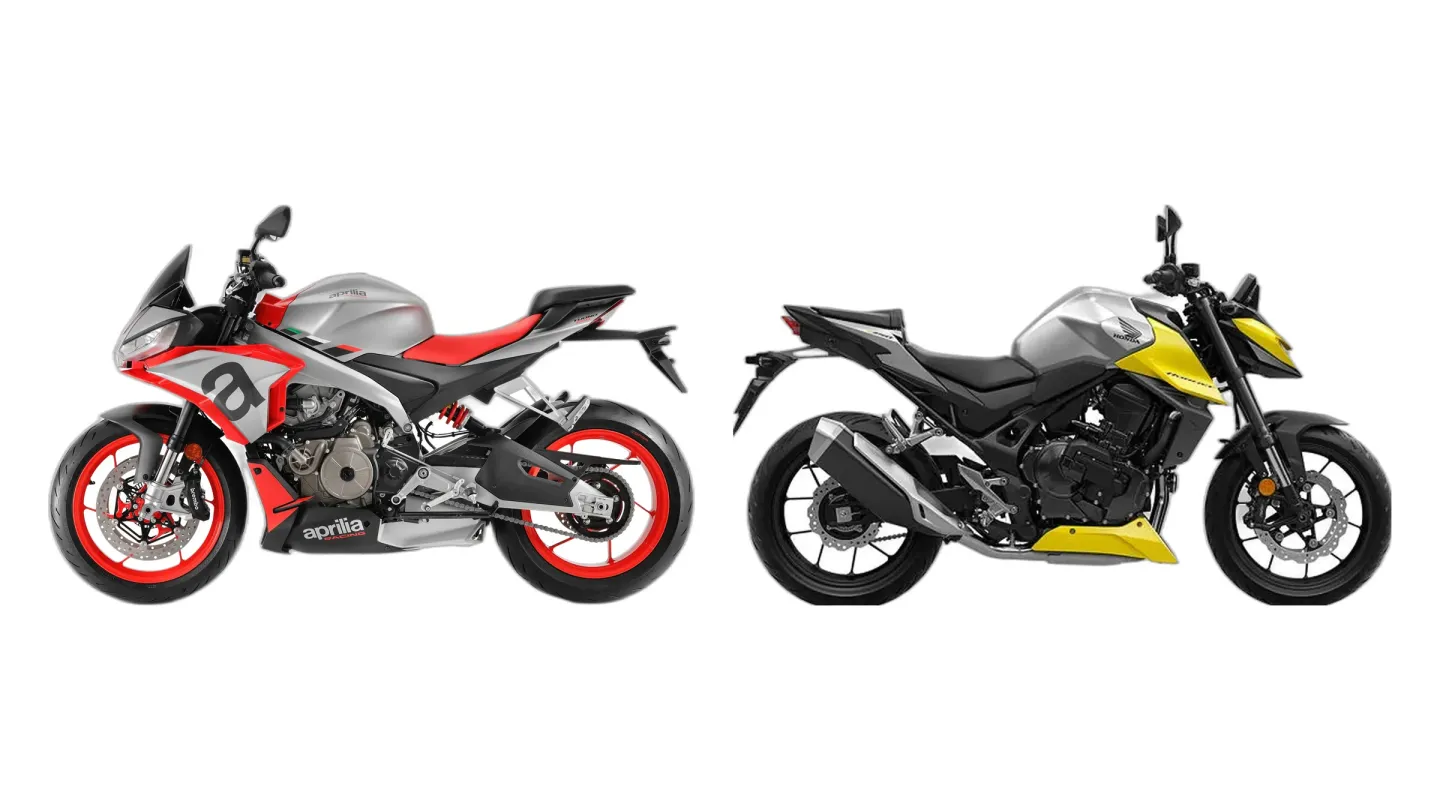
So which one do you buy?
The Tuono 660 has the edge if…
Daily commuting & city riding
Small edge: Tuono 660
For the Monday-to-Friday grind, the Tuono 660 pulls a nose in front. Your own commute could easily flip it.
Sporty riding on twisty roads
Edges it: Tuono 660
In the twisties, the Tuono 660 asks a bit less of you to go quickly. Call it a modest edge.
The CB750 Hornet has the edge if…
A confidence-building first motorcycle
Nose ahead: CB750 Hornet
The CB750 Hornet is slightly friendlier for a newer rider. Slightly.
Which one's the smarter buy
Value pick: CB750 Hornet
The CB750 Hornet is the better buy at these used prices. You get more for the money, mainly through reliability.
What makes each one tick
Tuono 660
On Bay Area Ridge Roads, the Tuono swings from one curve into the next with a nudge at the bar that's barely there. Corner entry doesn't need coaxing. The nose tucks toward the apex the instant you ask.
Nils rode the Tuono 660 in 2021, and in Austria in 2023 (NastyNils Testride).
CB750 Hornet
Tight hairpins don't ask much of the Hornet, which goes where you point it after one push and holds the line without fighting back. Over a broken patch, the stock suspension tune copes on most roads. The front lever's progressive from the first squeeze, and it trails into a turn precisely. Its front brake clamps down hard.
Nils rode the CB750 Hornet in Austria in 2023, and in Austria in 2024 (NastyNils Testride).
The Voice of Experience

What actually separates them
- The CB750 Hornet has the lower seat: 31.3 in (795 mm) vs 32.3 in (820 mm).
- The Tuono 660 has the lower wet weight: 403 lb (183 kg) vs 419 lb (190 kg).
- The CB750 Hornet makes more peak torque: 55 lb-ft (75 Nm) vs 49 lb-ft (67 Nm).
Which one for the way you ride
Comfortable long-distance riding
Not their thing
Neither one is built for long-haul comfort. For big miles, look at a proper tourer or sport tourer.
Count running costs as a draw. The deal on the table and the condition of the bike matter more here.
Who each one is built for
What's good, and what you'll live with
Tuono 660
What owners say
Strengths
- Light, agile handling
- Refined 270° parallel-twin character
Trade-offs
- Buzzy vibrations around 5,000–6,000 rpm
- Soft, underdamped stock suspension (Standard model)
- Parts availability and dealer density
CB750 Hornet
Strengths
- Weightless clutch, tuned slipper
- Turns in on one push
- Strong, easy front brake
- Gutsy low-end twin
- Surprising lean clearance
Trade-offs
- No damping adjustment
- Vague front-end feel
- Seat bottoms out
- Tight for taller riders
- Snatchy on-off throttle at low rpm
Known problems to check before you buy
Tuono 660
- Loose shift lever (early units) and quickshifter false-neutral / "sticky" engagement Two distinct symptoms reported: (a) on early MY2021 units, the shift lever could come loose from the splined shaft within the first ~100 miles and require dealer replacement; (b) the bidirectional quickshifter occasionally produces a false-neutral on upshifts in upper gears at low or partial throttle, or "sticky" cuts during shifts. Rough gear changes at low rpm and partial throttle, smoothing above 5,000 rpm, have also been reported. The loose-lever issue is widely reported on MY2021 and largely resolved on MY2022+ production.
- Snatchy ride-by-wire fueling on throttle transitions Closed-throttle to roll-on transitions exhibit a touchy, jerky character widely reported in launch-year reviews. Cold-weather behavior below approximately 54°F (12 °C) ambient adds occasional hesitation or misfires until the engine warms. The character is most pronounced in the more aggressive ride modes. Reports diminish in MY2022+ coverage relative to MY2021.
- Water-pump mechanical seal weep at low mileage Coolant or engine oil drip from the water-pump weep hole, sometimes presenting as early as 150–250 miles. Recurring early-ownership theme on Aprilia owner forums. The coolant-side variant sometimes self-clears as the seal beds in; the oil-side variant requires teardown of the flywheel cover and seal replacement, normally completed under warranty.
- Aprilia MIA module pairing failures and dashboard firmware quirks When the optional Aprilia MIA Multimedia Platform (PMP 3.0) module is fitted, owners report Bluetooth pairing failures, the phone icon remaining greyed out, inaccessible submenus, and music interruption when paired comms are active. Several owners report a fix only after a dealer-side dashboard firmware update via the Piaggio PADS diagnostic tool.
- Cosmetic finish and fastener corrosion complaints Recurring small complaints across reviews and forums: matte/satin tank paint is thin and scratch-prone; visible fasteners surface-corrode in year-round use; belly-pan plastic feels rough relative to price tier; decals work loose over time; minor rear-brake squeak reported. None are structural problems and all are cosmetic in nature, but they are widely cited as detracting from the bike's premium positioning.
CB750 Hornet
- Soft suspension setup, limited adjustability The Showa SFF-BP USD fork is non-adjustable on the standard model; the Pro-Link rear shock offers preload only (7-step). Heavier riders and brisk-paced riders report rebound oscillation, bouncing on bigger bumps, and a setup biased toward comfort over control. Aftermarket shock upgrades (Wilbers and similar) resolve this for owners pursuing sporty pace. Honda revised the fork damping for 25YM, but the adjustability did not change.
- Jerky on-off throttle at low rpm and urban speeds The ride-by-wire throttle calibration is abrupt during transitions between closed and small-throttle openings, particularly in 1st and 2nd gear at urban speeds and at part-throttle below approximately 5,500 rpm. Multiple owners report a TPS reset procedure provides limited improvement; Honda is reported to have improved the calibration for model year 2025.
- ABS cannot be switched off, no cornering ABS The 2-channel ABS system is fixed and non-defeatable, with no IMU and therefore no cornering ABS. Reviewers report the ABS can intervene aggressively on loose surfaces. This is a spec design choice rather than a fault, but it is a documented limitation for owners using the bike on gravel or for back-track riding.
What they cost used
These prices compare a 3-year-old Tuono 660 with a 3-year-old CB750 Hornet.
- Tuono 660
- about $9,500
- CB750 Hornet
- about $6,100
At three years old, the Aprilia Tuono 660 sits around $9,500 while the Honda CB750 Hornet lands near $6,100. That's a $3,400 gap in the Hornet's favor. These are US market estimates, not live listings.
What they share
- Engine
- Parallel twin
- Cooling
- Liquid-cooled
- Gearbox
- 6-speed
- Final drive
- Chain
- Front tire
- 120/70-17
Where the spec sheets split
| Tuono 660 | CB750 Hornet | |
|---|---|---|
| Seat height | 32.3 in (820 mm) | 31.3 in (795 mm) |
| Wet weight | 403 lb (183 kg) | 419 lb (190 kg) |
| Tuono 660 | CB750 Hornet | |
|---|---|---|
| Displacement | 659 cc | 755 cc |
| Power | 95 hp (70 kW) | 92 hp (68 kW) |
| Peak power at | 10,500 rpm | 9,500 rpm |
| Torque | 49 lb-ft (67 Nm) | 55 lb-ft (75 Nm) |
| Peak torque at | 8,500 rpm | 7,250 rpm |
| Top speed | 134 mph (215 km/h) | 127 mph (205 km/h) |
| Tuono 660 | CB750 Hornet | |
|---|---|---|
| Fuel economy | 48 mpg (US) / 4.9 L/100 km | 55 mpg (US) / 4.3 L/100 km |
| Fuel capacity | 4.0 US gal (15 L) | 4.0 US gal (15.2 L) |
| Tuono 660 | CB750 Hornet | |
|---|---|---|
| Rear tire | 180/55-17 | 160/60-17 |
| Wheelbase | 53.9 in (1370 mm) | 55.9 in (1420 mm) |
What comes fitted, what costs extra
| Tuono 660 | CB750 Hornet | |
|---|---|---|
| Manually Adjustable Front Suspension | Standard | Not offered |
| Smartphone Connectivity | Option | Standard |
| USB Charging Port | Option | Not offered |
Head to head, area by area
Both bikes on the same scale, one area at a time.