By NastyNils·
Motorcycle comparison · Hyper Naked
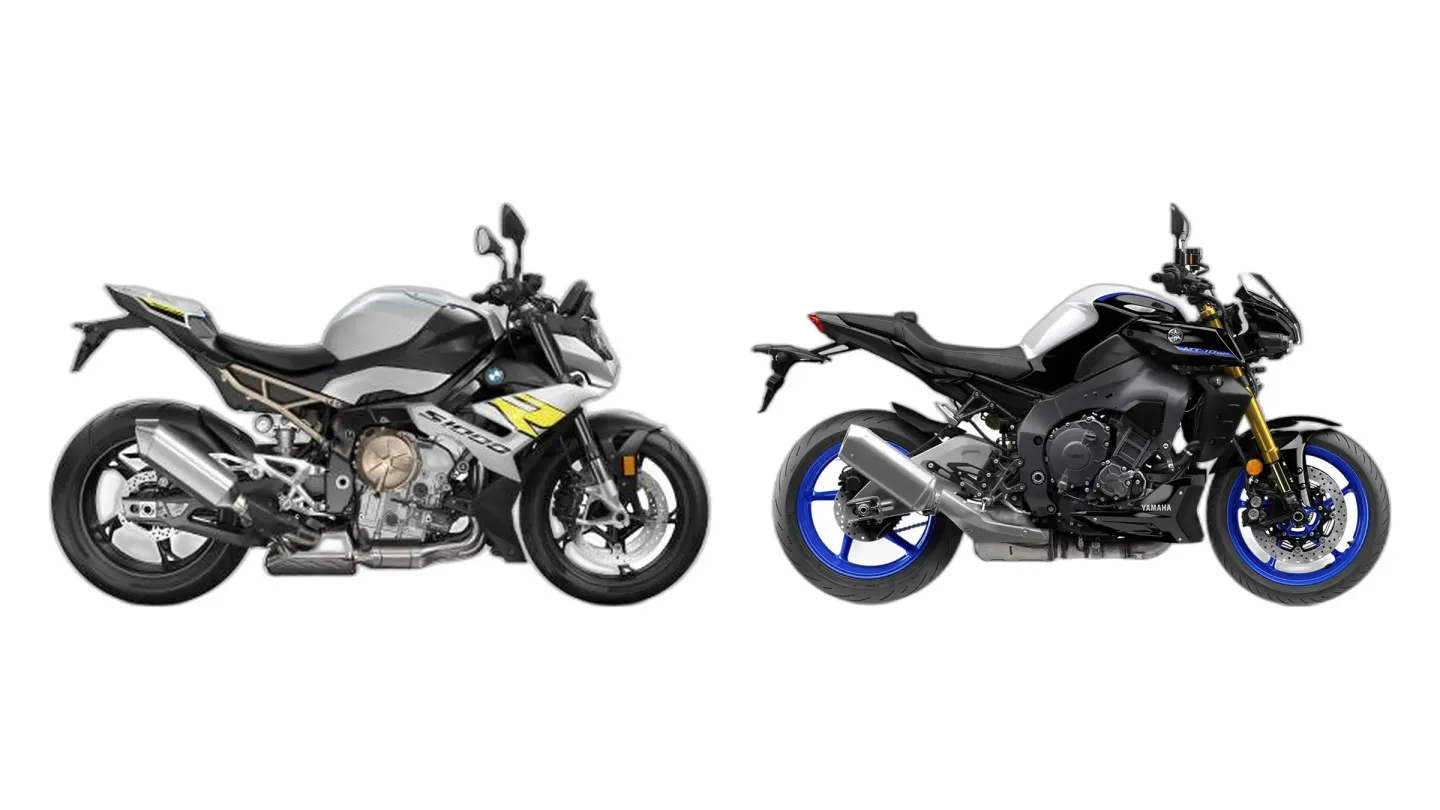
BMW S 1000 R (K63) vs Yamaha MT-10 (RN78-SP)
BMW S 1000 R vs Yamaha MT-10: which one's easier to live with every day.
Roll the throttle open on the BMW S 1000 R and its light frame doesn't fight the power you're asking for. On the Yamaha MT-10, the throttle picks up cleanly from closed, with no stumble or surge. The rear stays settled as you roll on mid-corner.
So which one do you buy?
Which one's the smarter buy
Nothing in it on value
At these used prices, neither bike is the clear better buy for the money.
What makes each one tick
S 1000 R
Every nudge at the wide bar gets a straight answer from the S 1000 R, and there's nothing to guess at as the pace climbs. Hauling on the brake lever piles weight onto the front tire, which stays pinned and won't flutter or hunt. Cranked into a tight radius with some gas on, the chassis holds its line. Fork and shock move as one.
Nils rode the S 1000 R in Hungary in 2021, and in Austria and Spain in 2025 (NastyNils Testride).
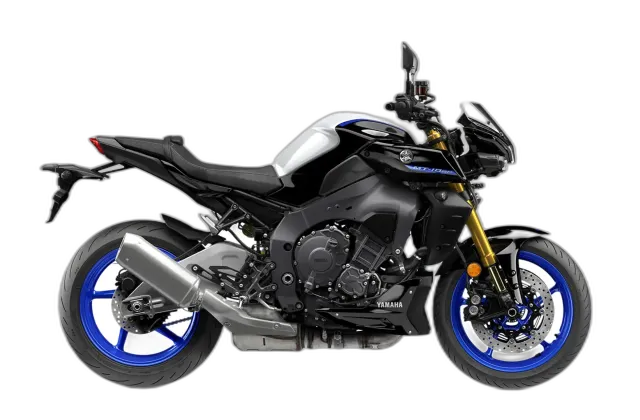
MT-10
Through the fast sweepers and tight switchbacks of the Angeles Crest Highway, the MT-10 holds the exact line you've chosen. On a circuit, the upright seat sits you tall and mutes what the front tire's telling you. Each downshift at corner entry gets a matched blip as you trail the brakes, and there's no clunk to upset the chassis. The front hooks into the turn.
Nils rode the MT-10 in Slovakia in 2023 (NastyNils Testride).
The Voice of Experience
What actually separates them
- The S 1000 R has the lower wet weight: 439 lb (199 kg) vs 472 lb (214 kg).
- Launch Control: option on the S 1000 R, not offered on the MT-10.
- Electronic Suspension: standard on the MT-10, option on the S 1000 R.
Which one for the way you ride
Comfortable long-distance riding
Wrong job for both
Hours in the saddle won't flatter either of these. They're happier on shorter runs.
For track days, character, commuting, and twisty roads, you won't find daylight between them. Let the test ride settle it.
Who each one is built for
What's good, and what you'll live with
S 1000 R
Strengths
- Torque Long Before The Top End
- A Fork That Never Stops Talking
- Lighter Than 439 lb Feels
- An Engine Built To Outlast You
- Low weight for the power class
Trade-offs
- Base Spec Is A Different Bike
- Early Builds And ABS Units
- DDC Softens Over Big Miles
- Rear Tires Are A Line Item
- Hayes brake calipers: poor modulation and bite
MT-10
Strengths
- Öhlins Range You Can Feel
- Holds Your Line Exactly
- Quickshifter Nails Every Downshift
- Öhlins ERS transforms chassis composure
- Sharper, more legible TFT dashboard
Trade-offs
- Soft Front Brake Lever
- Fades Against The Wildest
- No USB, No Phone Link
- Limited wind protection at sustained high speeds
- High price premium over base RN78
Known problems to check before you buy
S 1000 R
- Premature failure of individual coil-on-plug units (pencil-type) One or more ignition coils fail; symptoms: misfires, cylinder dropout, rough running, check-engine warning. Typically one coil fails first, then others follow. Recommended community solution: replace all 4 ignition coils simultaneously. Special tool (BMW 12 3 621) and airbox removal required.
- Coolant loss via the weep hole of the combined oil/water pump The combined oil/water pump can develop a leak; coolant exits via the weep hole at the rear of the oil pan. Two seals: if the first fails, coolant leaks externally; if the second fails, coolant mixes with oil (critical). Some owners report recurrence after warranty repair.
- Cascading error messages: ABS, TC, engine management, crash sensor simultaneously Simultaneous illumination of multiple warnings: "ABS Pro Failure", "TC Failure", "Adaptive Headlight Failure", "Crash Sensor Failure", "Electrical system critical". Often traceable to loose or corroded battery terminals. CAN bus communication errors cascade across all systems.
- Strong vibrations above 5,500–6,000 rpm The inline four-cylinder without a balance shaft generates noticeable vibrations at bar ends, mirrors, and footpegs. Mirrors become blurry at highway speeds. Numbness in hands on longer rides. Considered a design characteristic (weight saving from the absence of a balance shaft), not a defect. Community remedies: heavy bar-end weights (HVMP), Rizoma Stealth mirrors, foam pellets in clip-ons.
- Jerky throttle response below 3,000 rpm (ride-by-wire) Jerky, unharmonious response from the ride-by-wire system at low rpm and constant part-throttle operation. Particularly pronounced in Dynamic/Race mode. Cause: lean mapping for Euro 5 compliance. Community remedies: BoosterPlug/Red-Chip module, Rain/Road mode in city traffic, ECU remap.
- Quickshifter (Shift Assistant Pro) intermittently non-functional Quickshifter stops working on upshifts from 2nd to 3rd gear and above, while 1st to 2nd works. Causes include pinched or damaged 4-wire cable, incorrect chain tension, and software error. Community solution: quickshifter reset, inspect chain tension, and check cable for damage.
- "DDC!" error message and failure of electronic suspension control "DDC!" error message on the display, suspension settings no longer adjustable. Causes: battery terminal issues, CAN bus errors, connector issues at fork/shock. Affects only vehicles with the optional DDC suspension.
- Engine stalling when pulling the clutch, at traffic lights, or when shifting Rough idle and engine stalling, particularly on MY2021–2022. Cause: Euro 5 lean-mixture strategy in ECU mapping. BMW released a software update in January 2022 that resolved the problem for many owners.
- Failure of the combination switch (start/stop/kill switch) due to heat/UV The PCB-based combination switches (introduced from the BMW S 1000 platform in 2009) can develop hairline cracks in the circuit traces due to thermal expansion. Symptoms: motorcycle will not start, intermittent electrical failures. Occurs particularly after parking in direct sunlight. A cross-platform BMW issue since 2009.
MT-10
No confirmed faults on file yet. That's not the same as fault-free.
What they cost used
These prices compare a 4-year-old S 1000 R with a 4-year-old MT-10.
- S 1000 R
- about $14,900
- MT-10
- about $14,500
What they share
- Engine
- Inline-four
- Cooling
- Liquid-cooled
- Gearbox
- 6-speed
- Final drive
- Chain
- Fork
- Upside-down (USD)
- Front brake
- 320 mm
- Front tire
- 120/70-17
- Rear tire
- 190/55-17
Where the spec sheets split
| S 1000 R | MT-10 | |
|---|---|---|
| Seat height | 32.7 in (830 mm) | 32.9 in (835 mm) |
| Wet weight | 439 lb (199 kg) | 472 lb (214 kg) |
| S 1000 R | MT-10 | |
|---|---|---|
| Displacement | 999 cc | 998 cc |
| Power | 165 hp (121 kW) | 166 hp (122 kW) |
| Peak power at | 11,000 rpm | 11,500 rpm |
| Torque | 84 lb-ft (114 Nm) | 83 lb-ft (112 Nm) |
| Peak torque at | 9,250 rpm | 9,000 rpm |
| S 1000 R | MT-10 | |
|---|---|---|
| Fuel economy | 38 mpg (US) / 6.17 L/100 km | 34 mpg (US) / 7 L/100 km |
| Fuel capacity | 4.4 US gal (16.5 L) | 4.5 US gal (17 L) |
| S 1000 R | MT-10 | |
|---|---|---|
| Wheelbase | 57.1 in (1450 mm) | 55.3 in (1405 mm) |
What comes fitted, what costs extra
| S 1000 R | MT-10 | |
|---|---|---|
| Launch Control | Option | Not offered |
| Electronic Suspension | Option | Standard |
| Cruise Control | Option | Standard |
| Smartphone Connectivity | Standard | Not offered |
| USB Charging Port | Option | Not offered |
Head to head, area by area
Both bikes on the same scale, one area at a time.