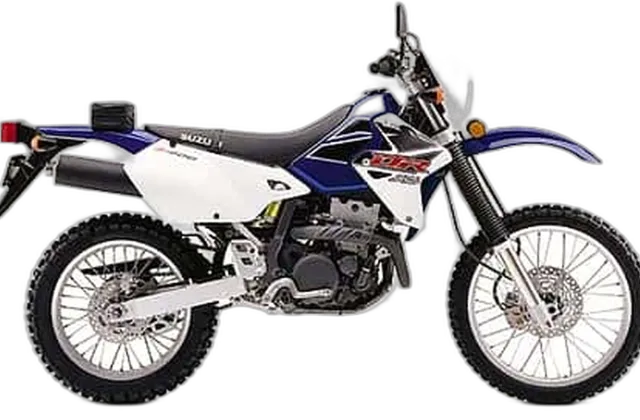
By NastyNils·
Motorcycle comparison · Enduro
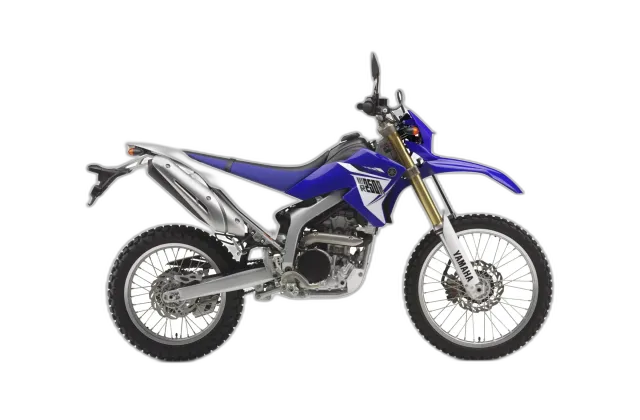
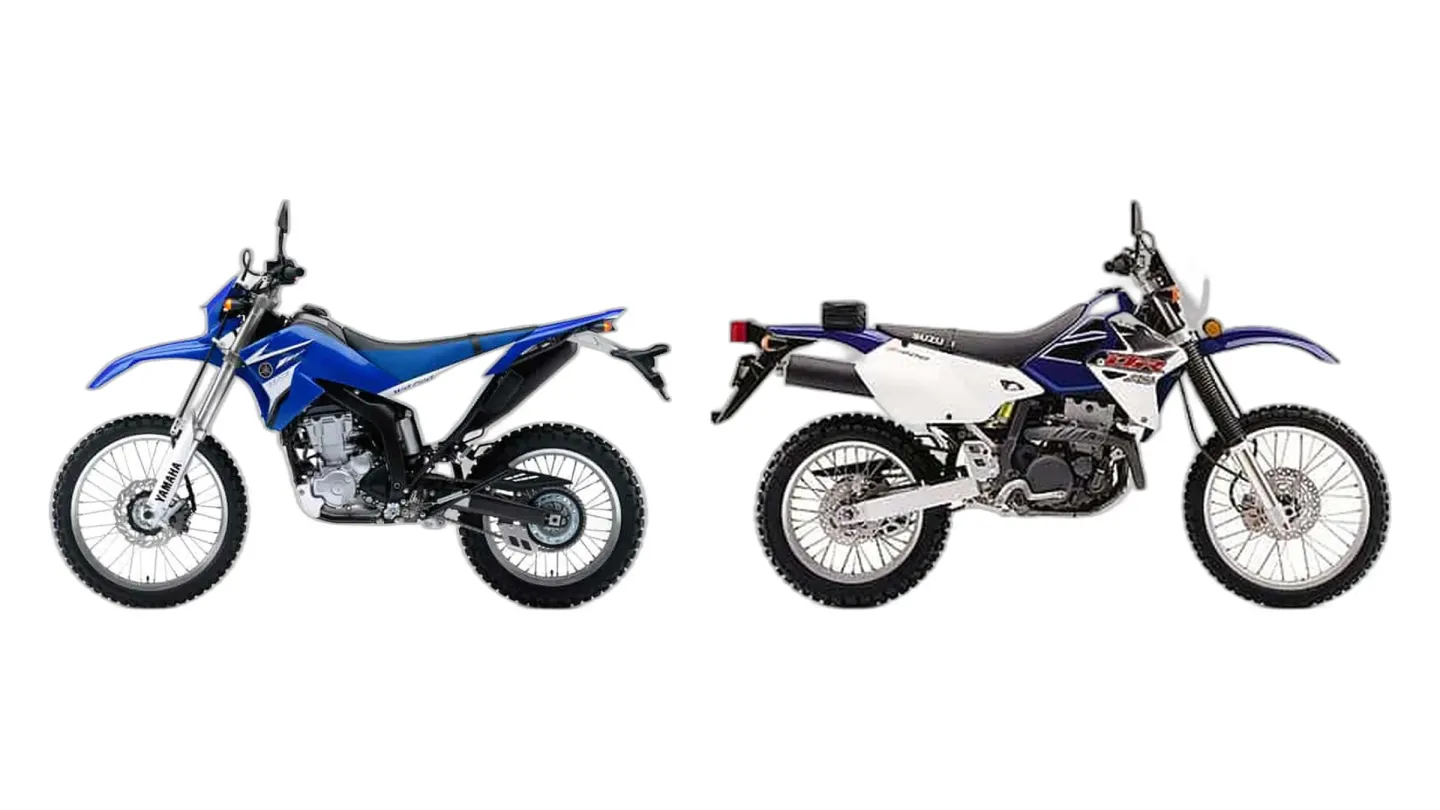
Yamaha WR 250R (MY2008) vs Suzuki DR-Z 400 S (MY2000)
Yamaha WR 250R vs Suzuki DR-Z 400 S: which one to buy for the riding you do.
You'll find the Yamaha WR 250R's fuel-injected engine stays quiet and almost buzz-free as you roll on the throttle. On the Suzuki DR-Z 400 S, the carb's response to the throttle drifts with altitude and temperature, and it won't come right without rejetting. After long storage, it often balks at the starter.
So which one do you buy?
The WR 250R has the edge if…
Sporty riding on twisty roads
Edges it: WR 250R
Through a string of corners, the WR 250R feels a little more eager. Most of that is better suspension. The gap is small, so ride both.
Real off-road capability
Small edge: WR 250R
Where the gravel starts, the WR 250R pulls a nose ahead. Thank more suspension adjustment for that. Don't build a dirt plan on a gap that thin.
The DR-Z 400 S has the edge if…
A confidence-building first motorcycle
Slight edge: DR-Z 400 S
The DR-Z 400 S asks a little less of a rookie. That's a narrow edge, so sit on both before you decide.
Which one's the smarter buy
No clear winner on value
The lower sticker price on the DR-Z 400 S doesn't settle which one is the better buy. Neither is the clear better buy for the money.
What makes each one tick
WR 250R
A compact steel frame gives the WR 250R an enduro bike's appetite for trail, yet it's street-legal. On Kane Creek, its 295 lb (134 kg) wet weight lets a nudge at the bar drop the front into a turn. It doesn't push wide. The bars track straight at highway pace.
DR-Z 400 S
Grunt, not glamour, drives the DR-Z 400 S. Its old-school chassis has barely changed in a quarter-century, and it'll still slip through singletrack like an enduro bike and stay docile on the commute. There's tractable pull that pays off when picking a dirt line, not when chasing top speed. The single thrums and hooks up.
Nils rode the DR-Z 400 S in Austria in 2005, and in Austria in 2007 (1000PS test reports).
The Voice of Experience

What actually separates them
- The WR 250R has the lower wet weight: 295 lb (134 kg) vs 317 lb (144 kg).
- The DR-Z 400 S makes more peak power: 40 hp (29 kW) vs 31 hp (23 kW).
- The DR-Z 400 S makes more peak torque: 29 lb-ft (39 Nm) vs 18 lb-ft (24 Nm).
Which one for the way you ride
Nothing splits them on commuting and running costs. Ride both back to back and the decision usually makes itself.
Who each one is built for
What's good, and what you'll live with
WR 250R
What owners say
Strengths
- Smooth and quiet engine
DR-Z 400 S
What owners say
Strengths
- Bulletproof reliability and ease of maintenance
- Endlessly customisable and well‑supported aftermarket
Trade-offs
- Carburettor demands more fettling than fuel injection
Known problems to check before you buy
WR 250R
- Stator coil failure (NHTSA Recall 15V-410) Recall 15V410000 Insufficient heat resistance in the stator coil insulation can lead to short-circuiting and engine stalling. Affected units need stator replacement.
- Clutch push lever oil seal failure (2014-2016, NHTSA Recall 16V-800) Recall 16V800000 Factory Modification Campaign: incorrect assembly process may cause the clutch push lever oil seal to crack, leading to oil leaks that could reach the rear tire.
- Fuel pump failure on early 2008 models Some early builds experienced fuel pump failures, causing stalling or no-start conditions. Dealer replacement under warranty was common.
DR-Z 400 S
- Automatic cam chain tensioner (ACCT) can fail The stock automatic cam chain tensioner on early production models is prone to over-extending or sticking, allowing the cam chain to jump timing and potentially cause catastrophic engine damage.
What they cost used
Both bikes priced used at the same age: 9 years old.
- WR 250R
- about $5,000
- DR-Z 400 S
- about $3,600
At nine years old, the Yamaha WR 250R sits around $5,000 while the Suzuki DR-Z 400 S lands near $3,600. That's a $1,400 gap in the Suzuki's favor. These are estimates from earlier market records, not live listings.
What they share
- Engine
- Single-cylinder
- Cooling
- Liquid-cooled
- Final drive
- Chain
- Front tire
- 80/100-21
- Ground clearance
- 11.8 in (300 mm)
Where the spec sheets split
| WR 250R | DR-Z 400 S | |
|---|---|---|
| Seat height | 36.6 in (930 mm) | 36.8 in (935 mm) |
| Wet weight | 295 lb (134 kg) | 317 lb (144 kg) |
| WR 250R | DR-Z 400 S | |
|---|---|---|
| Displacement | 250 cc | 398 cc |
| Power | 31 hp (23 kW) | 40 hp (29 kW) |
| Torque | 18 lb-ft (24 Nm) | 29 lb-ft (39 Nm) |
| Top speed | 87 mph (140 km/h) | 94 mph (151 km/h) |
| WR 250R | DR-Z 400 S | |
|---|---|---|
| Fuel capacity | 2.0 US gal (7.6 L) | 2.6 US gal (10 L) |
| WR 250R | DR-Z 400 S | |
|---|---|---|
| Gearbox | 6-speed | 5-speed |
| Fork | Upside-down (USD) | Telescopic |
| Rear tire | 120/80-18 | 120/90-18 |
| Front travel | 10.6 in (269 mm) | 11.3 in (287 mm) |
| Rear travel | 10.6 in (269 mm) | 11.6 in (295 mm) |
What comes fitted, what costs extra
| WR 250R | DR-Z 400 S | |
|---|---|---|
| Manually Adjustable Front Suspension | Standard | Not offered |
| Manually Adjustable Rear Suspension | Standard | Not offered |
Head to head, area by area
Both bikes on the same scale, one area at a time.