By NastyNils·
Motorcycle comparison · Adventure
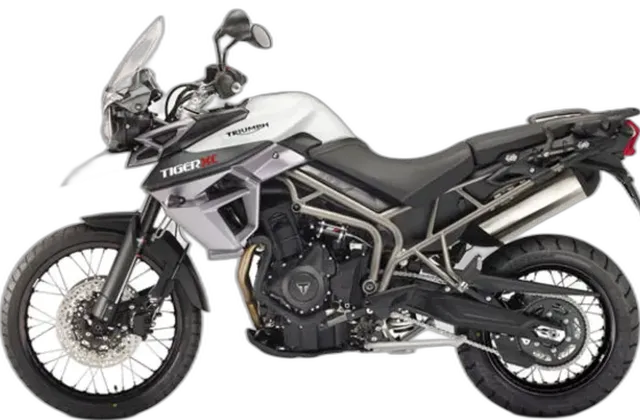
Triumph Tiger 800 XCx (MY2015) vs BMW F 800 GS Adventure (K75)
You'll feel the Triumph Tiger 800 XCx's triple pull hard each time you open the throttle, and it's smooth as silk all the way to the top. The BMW F 800 GS Adventure sips fuel at every twist.
So which one do you buy?
The Tiger 800 XCx has the edge if…
Daily commuting & city riding
Narrow edge: Tiger 800 XCx
On the way to work, the Tiger 800 XCx asks a little less of you. Put it down to friendlier manners. Close enough that the test ride should settle it.
Comfortable long-distance riding
Nose ahead: Tiger 800 XCx
Hour after hour, the Tiger 800 XCx feels a little kinder to you. It's a close-run thing, though.
Real off-road capability
Small edge: Tiger 800 XCx
The Tiger 800 XCx nudges ahead where the road turns to gravel. Close enough that a test ride on dirt is worth it.
Which one's the smarter buy
No clear winner on value
Neither bike is the clear better buy at these used prices. The Tiger 800 XCx costs less, but that doesn't make it the smarter spend.
What makes each one tick
Tiger 800 XCx
Weekday commute or weekend detour, the Tiger 800 XCx's key is the one you'll grab, since the daily grind and real fun share its seat. From low rpm, the engine answers each roll of the grip with a strong shove that never turns rough. Paper figures undersell this motor. The engine's still eager at day's end.
Nils rode the Tiger 800 XCx in Austria in 2015 (NastyNils Testride).
F 800 GS Adventure
Off the asphalt, the F 800 GS Adventure lets you stay standing on the footpegs through long trail sections, and you won't go hunting for an easy patch to sit down. Corner entry on gravel stays calm, since the front grips predictably and the bike doesn't punish a sloppy line. The gravel turnoff stops being a question.
Nils rode the F 800 GS Adventure in 2021 (NastyNils Testride).
The Voice of Experience

What actually separates them
- The Tiger 800 XCx has the lower seat: 33.1 in (840 mm) vs 35.0 in (890 mm).
- The Tiger 800 XCx has the lower wet weight: 487 lb (221 kg) vs 505 lb (229 kg).
- The Tiger 800 XCx makes more peak power: 94 hp (70 kW) vs 86 hp (63 kW).
Which one for the way you ride
Look at twisty roads and running costs and you'll find two bikes doing the same job equally well. Fit is what breaks the tie.
Who each one is built for
What's good, and what you'll live with
Tiger 800 XCx
Strengths
- Kit List Gets It Right
- Better Than Its Spec Sheet
- Strong and Smooth Together
- Carries Gear, Goes Far
- High build quality and reliability
Trade-offs
- Off-Road Looks, Road Character
- It Can Refuse to Start
- Rattle From the Rear End
- Coolant Clamps Can Seep
- Suspension undersprung for heavier riders
F 800 GS Adventure
Strengths
- Turns Off-Road Without Hesitation
- Built To Be Ridden Standing
- Forgiving On Rough Ground
- Friendly, torque‑rich engine
- Light, manageable off‑road performance
Trade-offs
- Strained At High Freeway Pace
- Heavy, Dated Throttle Action
- Sparse Electronics Package
- Soft Suspension, Fixed Front Fork
Known problems to check before you buy
Tiger 800 XCx
No confirmed faults on file yet. That's not the same as fault-free.
F 800 GS Adventure
- Wheel bearing failure Front and rear wheel bearings can fail early, especially on bikes used off‑road. Symptoms include grinding, play, and noise. Inspect at every tyre change.
- Steering head bearing failure Bearings wear prematurely, leading to a notchy feel, instability, and resistance to steering input. Regular servicing and early replacement (often with tapered rollers) recommended.
- Corroded fasteners and engine paint Fairing bolts, footpeg mounts, and engine casing paint are susceptible to surface corrosion, particularly on bikes used in winter or stored outdoors.
What they cost used
These prices compare an 8-year-old Tiger 800 XCx with an 8-year-old F 800 GS Adventure.
- Tiger 800 XCx
- about $7,200
- F 800 GS Adventure
- about $8,000
At eight years old, the Triumph Tiger 800 XCx sits around $7,200 while the BMW F 800 GS Adventure runs about $8,000. That leaves the Triumph cheaper by roughly $800. These are US market estimates, not live listings.
What they share
- Cooling
- Liquid-cooled
- Top speed
- 124 mph (200 km/h)
- Gearbox
- 6-speed
- Final drive
- Chain
- Fork
- Upside-down (USD)
- Front tire
- 90/90-21
- Rear tire
- 150/70-17
- Rear travel
- 8.5 in (215 mm)
Where the spec sheets split
| Tiger 800 XCx | F 800 GS Adventure | |
|---|---|---|
| Seat height | 33.1 in (840 mm) | 35.0 in (890 mm) |
| Wet weight | 487 lb (221 kg) | 505 lb (229 kg) |
| Tiger 800 XCx | F 800 GS Adventure | |
|---|---|---|
| Displacement | 799 cc | 798 cc |
| Engine | Inline-three | Parallel twin |
| Power | 94 hp (70 kW) | 86 hp (63 kW) |
| Peak power at | 9,250 rpm | 7,500 rpm |
| Torque | 58 lb-ft (79 Nm) | 61 lb-ft (83 Nm) |
| Peak torque at | 7,850 rpm | 5,750 rpm |
| Tiger 800 XCx | F 800 GS Adventure | |
|---|---|---|
| Fuel economy | 54 mpg (US) / 4.35 L/100 km | 50 mpg (US) / 4.7 L/100 km |
| Fuel capacity | 5.0 US gal (19 L) | 6.3 US gal (24 L) |
| Tiger 800 XCx | F 800 GS Adventure | |
|---|---|---|
| Front brake | 308 mm | 300 mm |
| Wheelbase | 60.8 in (1545 mm) | 62.0 in (1575 mm) |
| Ground clearance | 8.7 in (220 mm) | 9.3 in (235 mm) |
| Front travel | 8.7 in (220 mm) | 9.1 in (230 mm) |
What comes fitted, what costs extra
| Tiger 800 XCx | F 800 GS Adventure | |
|---|---|---|
| Traction Control | Standard | Option |
| Ride Modes | Standard | Option (from 2017) |
| Front Suspension Adjustable | Standard | Not offered |
| Cruise Control | Standard | Not offered |
| Adjustable Seat Height | Standard | Not offered |
| Luggage System | Option | Not offered |
Head to head, area by area
Both bikes on the same scale, one area at a time.