By NastyNils·
Motorcycle comparison · Adventure
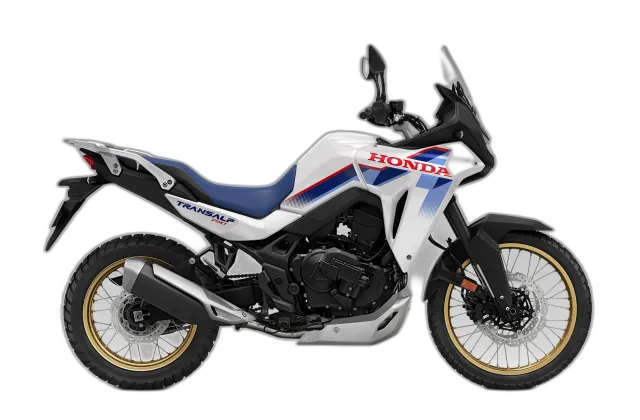
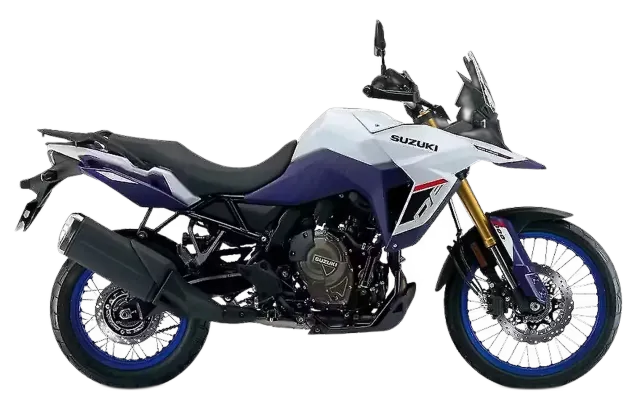
Honda XL750 Transalp (RD16-3-E_Clutch) vs Suzuki V-Strom 800 DE (MY2023)
Honda XL750 Transalp vs Suzuki V-Strom 800 DE: long days, loaded bags, one choice to make.
Roll the throttle open on the Honda XL750 Transalp and it's surging out of the midrange, still eager as the revs climb. On the Suzuki V-Strom 800 DE, the throttle bites in A mode, but it's soft enough for rain in B or C.
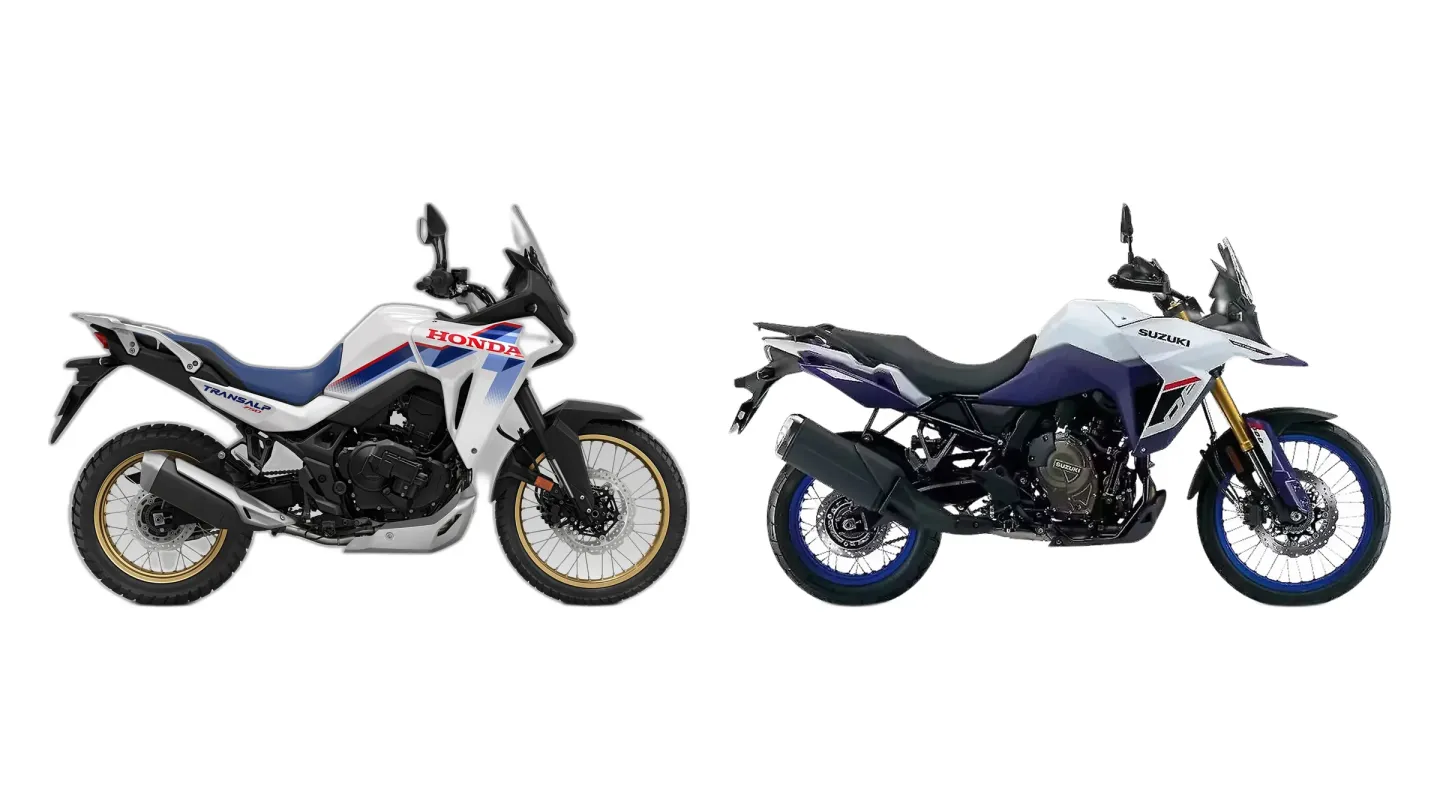
So which one do you buy?
The XL750 Transalp has the edge if…
Daily commuting & city riding
Small edge: XL750 Transalp
The XL750 Transalp makes slightly more sense as a commuter. Put it down to friendlier manners. Don't read much into a gap this small.
The V-Strom 800 DE has the edge if…
Real off-road capability
By a nose: V-Strom 800 DE
Once the asphalt stops, the V-Strom 800 DE noses ahead. That comes from more suspension adjustment and more low-end pull. Tires and your own skill can easily cancel that out.
Keeping running costs low
A touch ahead: V-Strom 800 DE
On running costs, the V-Strom 800 DE edges it. Not by enough to bank on.
Sporty riding on twisty roads
Narrow edge: V-Strom 800 DE
The V-Strom 800 DE nudges ahead once the pavement starts to wiggle. Most of that is better suspension. Don't expect a night-and-day difference.
What makes each one tick
XL750 Transalp
On the Transalp, the clutch lever can hang there untouched while the E-Clutch handles every shift, up or down, and you'll barely feel the gear swap. There's no stall to fear when you're standing on the pegs on a gravel track. The front wheel picks through rock.
V-Strom 800 DE
Off the gas, there's no lurch from the V-Strom's motor, just engine braking that settles the bike cleanly on loose dirt or a slow, rocky section. Bumps sink into the plush suspension. When you set the adjusters for luggage or a harder pace, you'll feel the change on the next mile. The switchgear lands right where your thumb reaches.
The Voice of Experience
What actually separates them
- The XL750 Transalp has the lower wet weight: 459 lb (208 kg) vs 507 lb (230 kg).
- The XL750 Transalp makes more peak power: 92 hp (68 kW) vs 84 hp (62 kW).
- The V-Strom 800 DE has the larger fuel tank: 5.3 US gal (20 L) vs 4.5 US gal (16.9 L).
Which one for the way you ride
There's no real gap on long days. Sit on both and let fit and price decide.
Who each one is built for
What's good, and what you'll live with
XL750 Transalp
What owners say
Strengths
- All-day comfort and practicality
- Brilliant E-Clutch system
- Composed, improved suspension
- Engaging parallel-twin engine
- Surprisingly capable off-road
V-Strom 800 DE
Strengths
- Seat Built for Long Days
- Progressive Front Brake Feel
- 270° engine character
- Genuine off-road geometry
- Build quality and "Suzuki reliability" perception
Trade-offs
- Thirstier Than the Class
- Goes Flat Near Redline
- Short Screen for Tall Riders
- No cruise control
- Stock LED headlight beam pattern
Known problems to check before you buy
XL750 Transalp
No confirmed faults on file yet. That's not the same as fault-free.
V-Strom 800 DE
- Rear tire tread cracking and separation — Dunlop Trailmax Mixtour The Dunlop Trailmax Mixtour rear tire (150/70R17 M/C 69H, specification "B", manufactured by Sumitomo Rubber Industries) supplied as OEM equipment can develop tread cracking, deformation, and ultimately tread separation from the tire carcass. Risk: crash. Warning signs: increased rear-wheel vibration, visible tread cracking or deformation.
- Stock LED headlight produces narrow beam pattern and is aimed too low The factory dual mono-focus LED projector produces an excessively narrow, highly focused beam with poor peripheral / roadside illumination. Two contributing factors documented: (a) the projector pattern itself is narrow by design, (b) factory aim is set low and benefits from an adjustment behind the cowling. Owners report unsafe night-riding visibility at speed. Aftermarket auxiliary lights (Cyclops kits, Denali, etc.) are the de-facto fix.
- Showa fork and shock tuned soft for road comfort — bottom on hard hits The fully-adjustable Showa fork and link-type shock are tuned plush for road comfort. Heavier riders and aggressive off-road riders report fork dive under hard braking, fork bottoming on big hits, and the rear shock bottoming out on jumps and G-outs at speed. Not a defect — a tuning choice. The fully adjustable hardware allows compensation; spring re-rating and damping changes are common owner modifications. Upshift Online: "*The rear shock will bottom out when the bike is jumped or run into a G-out at speed.*"
- Hot air vented onto right leg when fan engages in slow / stationary traffic When the radiator fan engages in slow or stationary hot traffic, hot air is vented from the right side of the fairing. Riders in hot climates report uncomfortable heat on the right leg and inner thigh. Cooling-system temperatures themselves remain within nominal range — this is a vent-routing ergonomic complaint, not a cooling fault.
- Bidirectional quickshifter clunky / jerky at low RPM The Suzuki BiQS bidirectional quickshifter operates smoothly above ~4,500 rpm but is harsh, jerky, and occasionally violent on 1→2 and 2→3 upshifts at low revs. Heavy throttle modulation dependency reported. The owner's manual explicitly states the QS is not designed to operate below approximately 2,000 rpm.
- Stock 3-step adjustable windscreen produces helmet buffeting The stock manually-adjustable windscreen produces helmet buffeting for many rider heights. Both lower and taller aftermarket screens give mixed results — strongly rider-height-dependent.
What they share
- Engine
- Parallel twin
- Cooling
- Liquid-cooled
- Gearbox
- 6-speed
- Final drive
- Chain
- Fork
- Upside-down (USD)
- Front brake
- 310 mm
- Front tire
- 90/90-21
Where the spec sheets split
| XL750 Transalp | V-Strom 800 DE | |
|---|---|---|
| Seat height | 33.5 in (850 mm) | 33.7 in (855 mm) |
| Wet weight | 459 lb (208 kg) | 507 lb (230 kg) |
| XL750 Transalp | V-Strom 800 DE | |
|---|---|---|
| Displacement | 755 cc | 776 cc |
| Power | 92 hp (68 kW) | 84 hp (62 kW) |
| Peak power at | 9,500 rpm | 8,500 rpm |
| Torque | 55 lb-ft (75 Nm) | 58 lb-ft (78 Nm) |
| Peak torque at | 7,250 rpm | 6,800 rpm |
| XL750 Transalp | V-Strom 800 DE | |
|---|---|---|
| Fuel capacity | 4.5 US gal (16.9 L) | 5.3 US gal (20 L) |
| XL750 Transalp | V-Strom 800 DE | |
|---|---|---|
| Rear tire | 150/70-18 | 150/70-17 |
| Wheelbase | 61.4 in (1560 mm) | 61.8 in (1570 mm) |
| Ground clearance | 8.3 in (210 mm) | 8.7 in (220 mm) |
| Front travel | 7.9 in (200 mm) | 8.7 in (220 mm) |
| Rear travel | 7.5 in (190 mm) | 8.7 in (220 mm) |
What comes fitted, what costs extra
| XL750 Transalp | V-Strom 800 DE | |
|---|---|---|
| Smartphone Connectivity | Standard | Not offered |
| Navigation | Standard | Not offered |
| USB Charging Port | Standard | Not offered |
Head to head, area by area
Both bikes on the same scale, one area at a time.