
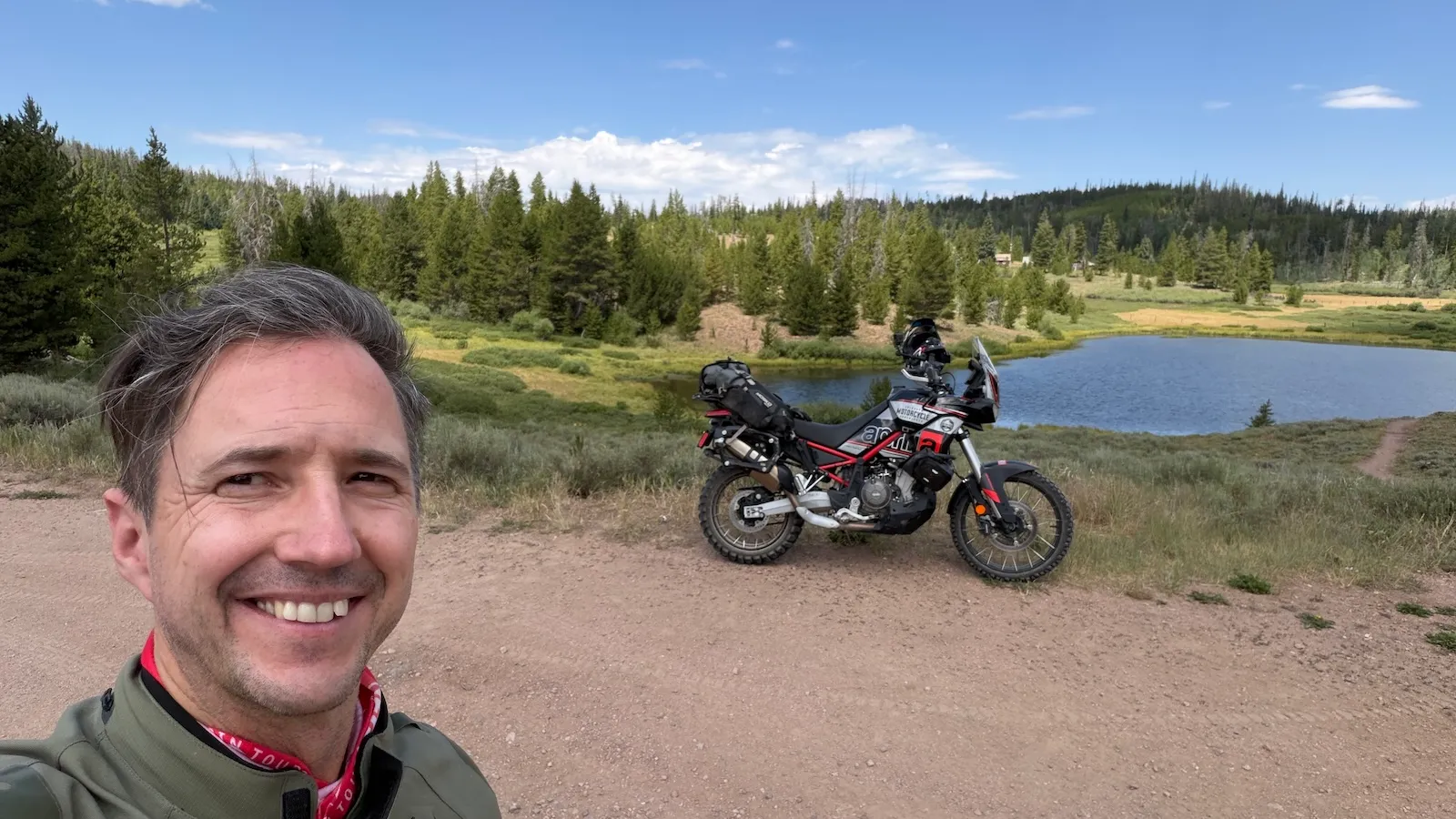
Some motorcycles have you in the first corner. Others leave you cold for three days and then turn you completely around in a single afternoon. This is the story of the second kind, and it happened to me in Colorado.
Days One Through Three: Neither Here Nor There
I’ll say it up front, because honesty demands it: for the first two or three days I genuinely thought this was not a bike I’d fall for.
The engine is linear, but it wants revs. There’s no punchy point in the rev range where it grabs you. It was simply too little power for me, neither one thing nor the other. If you come off strong twins it feels tame at first, and on those early stages I caught myself already drafting the verdict in my head.
It is only 659 cc, after all, even if 80 horsepower reads fine on paper. On the connecting stages, where you’re just covering ground, you notice.
The Day Everything Turned
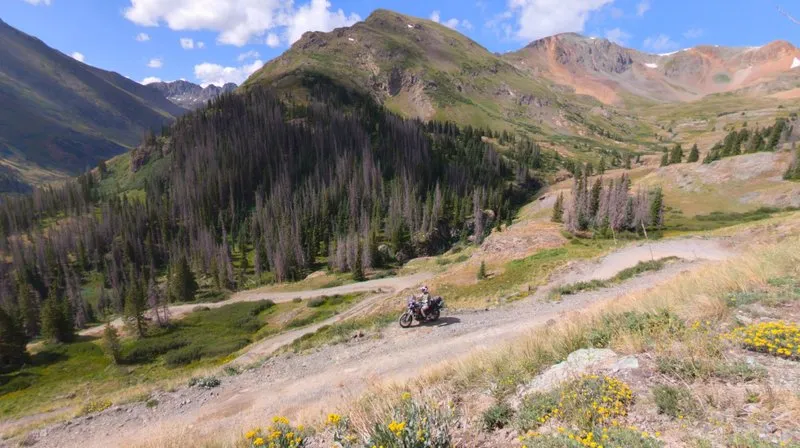
And then came the Alpine Loop. Sixty-five miles of unpaved road between Lake City, Silverton and Ouray, four passes above 12,600 feet, all of it above the treeline, which out here sits at around 11,500.
At some point you’re standing on the pegs at Cinnamon Pass near 12,640 feet, loose rock under the tires, exposed switchbacks, and it is simply effortless to steer this motorcycle.
That’s the sentence this whole thing turns on. Not acceleration, not the spec sheet. The ease with which you place a 200-kilo adventure bike across loose rock, like you’re having a conversation with it. That’s when it got me.
Why the Surprise Ran So Deep
Looking back, I understand why it took so long. This is an adventure bike you only learn to appreciate once the terrain gets difficult.
The characteristics that annoyed me in the first days are exactly the ones that work up there. A linear engine with no pothole in its power curve is dull on a back road and precisely meterable on loose ground. Suspension that isn’t tuned for sportiness forgives your mistakes at the end of a long day. The bike wasn’t waiting for me. I needed three days to start asking the right questions.
There’s something else I’d underrated: you can ride this thing standing up indefinitely without getting tired. The standing ergonomics are genuinely well done. On a route that has you in loose terrain for hours every day, that isn’t a comfort detail, it’s the reason you’re still sharp in the evening.
What Changes at 12,600 Feet
Some of it isn’t the bike at all, it’s where you are. Above the treeline the landscape stops offering you reference points. No trees, no windbreak, no village in the valley to measure yourself against. There’s rock, sky, and the line in front of you.
That does something to how you ride. You stop looking for the next landmark and start reading the ground directly. And a motorcycle that lets you do that, that doesn’t demand attention for itself, suddenly becomes an advantage rather than a disappointment.
The four passes on that loop sit at 12,800, about 12,930, roughly 12,640 and 12,700 feet. You climb all of them in one day, and by the third one you’ve stopped thinking about power delivery entirely. You’re thinking about traction, about lines, about how much light is left. That shift in attention is where the bike won me over, and I don’t think it could have happened on a road.
The Scene I Won’t Forget
Part of the truth about that day is the moment we turned around.
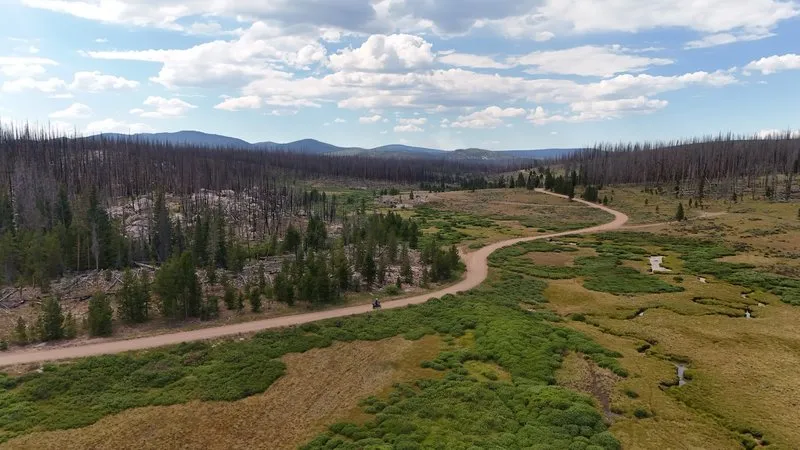
In Taylor Park a water crossing sat in front of us, and the surface was a mixture I won’t describe politely. We were on 50/50 tires, the usual adventure compromise, and they’re not stars in the wet. One of us had to take the hit. Clemens rode it, I turned back and went around.
That belongs in this story, because a change of mind is worth nothing if you only tell the good parts. The Tuareg convinced me that day. And in the same place it showed me where its limit sits, and where mine does.
The Highest Espresso of My Life
The day had a second scene, and it probably explains better than any riding description why this stuck.
Up at Cinnamon Pass an American stood there with a portable espresso machine, grinding fresh beans. At that altitude water boils at about 189 degrees Fahrenheit instead of 212, so he’d adjusted his grind and his dose to make the espresso taste right anyway. Why do you speak German, I asked him. Because I lived in Heidelberg for two years.
It was the highest coffee of my life, and I was standing next to a motorcycle I hadn’t particularly liked that morning and didn’t want to hand back that evening.
Why I’m Telling It This Way Round
I could have written this differently. I could have skipped the first three days, opened at Cinnamon Pass, and let you believe I recognized the bike’s qualities immediately. Most reviews are written that way, not out of dishonesty but because a clean verdict reads better than a messy one.
The problem is that the messy version is the useful one. If you’re considering a bike in this class, the thing you most need to know isn’t that somebody eventually liked it. It’s that it takes a specific kind of terrain to show what it’s for, and that on the wrong roads, for the first few days, you will wonder whether you made a mistake.
That’s not a flaw you can read out of a spec sheet, and it’s not something a weekend test ride will surface. It only appears when you’re far enough in that turning back isn’t an option, and by then you’ve either understood the machine or you’re stuck with it. I got lucky. This one turned out to be worth the wait.
What’s Left of the Surprise
Clemo later called the Alpine Loop the most awe-inspiring part of the whole tour, and I wouldn’t argue. For me it’s also the day my verdict flipped.
The weaknesses didn’t disappear because of it. Loaded two-up I’d reach for more displacement, the punch simply isn’t there. Up high the throttle response goes doughy. And the gear lever is a real weak spot if you go down on the left.
But whether a motorcycle works its way into your affection apparently isn’t decided on paper, and not in the first three days. It’s decided on the afternoon when things get difficult and the machine is suddenly lighter than the terrain.
What I’d Tell Somebody Standing in the Showroom
If you’re looking at a bike in this class and wondering whether the numbers are enough, here’s the honest framing.
Ask yourself what percentage of your riding will actually be difficult. Not gravel roads you could take a car down, but ground where you’re standing, picking lines, and working. If that number is small, a bike like this will feel underwhelming most of the time, and you’d be happier with something that entertains you on tarmac.
If that number is large, the calculation flips completely. Everything that reads as a shortcoming on paper, modest displacement, a power curve without drama, suspension that isn’t stiff, turns into an advantage the moment the surface gets loose and the day gets long. Nobody in a showroom can demonstrate that to you, which is exactly why it’s worth reading about from somebody who spent eight days finding out.
And one last thing, which applies whatever you end up buying: give the bike more terrain than you think it needs before you judge it. My verdict after three days and my verdict after eight were opposite, and only one of them was worth anything.
If You Want to Feel That Yourself
The route is the Colorado Backcountry Discovery Route, and the Alpine Loop is its heart. Remember there’s no fuel between Lake City, Silverton and Ouray, and that an 18-liter tank isn’t luxury out here, it’s a precondition.
Both our Aprilia Tuareg 660s, model year 2024, came from Colorado Motorcycle Adventures in Golden near Denver, complete with the programmed GPS route and the full logistics. Whatever you ride, give it more than three days before you decide. Mine needed exactly that long, and then it needed one afternoon.