
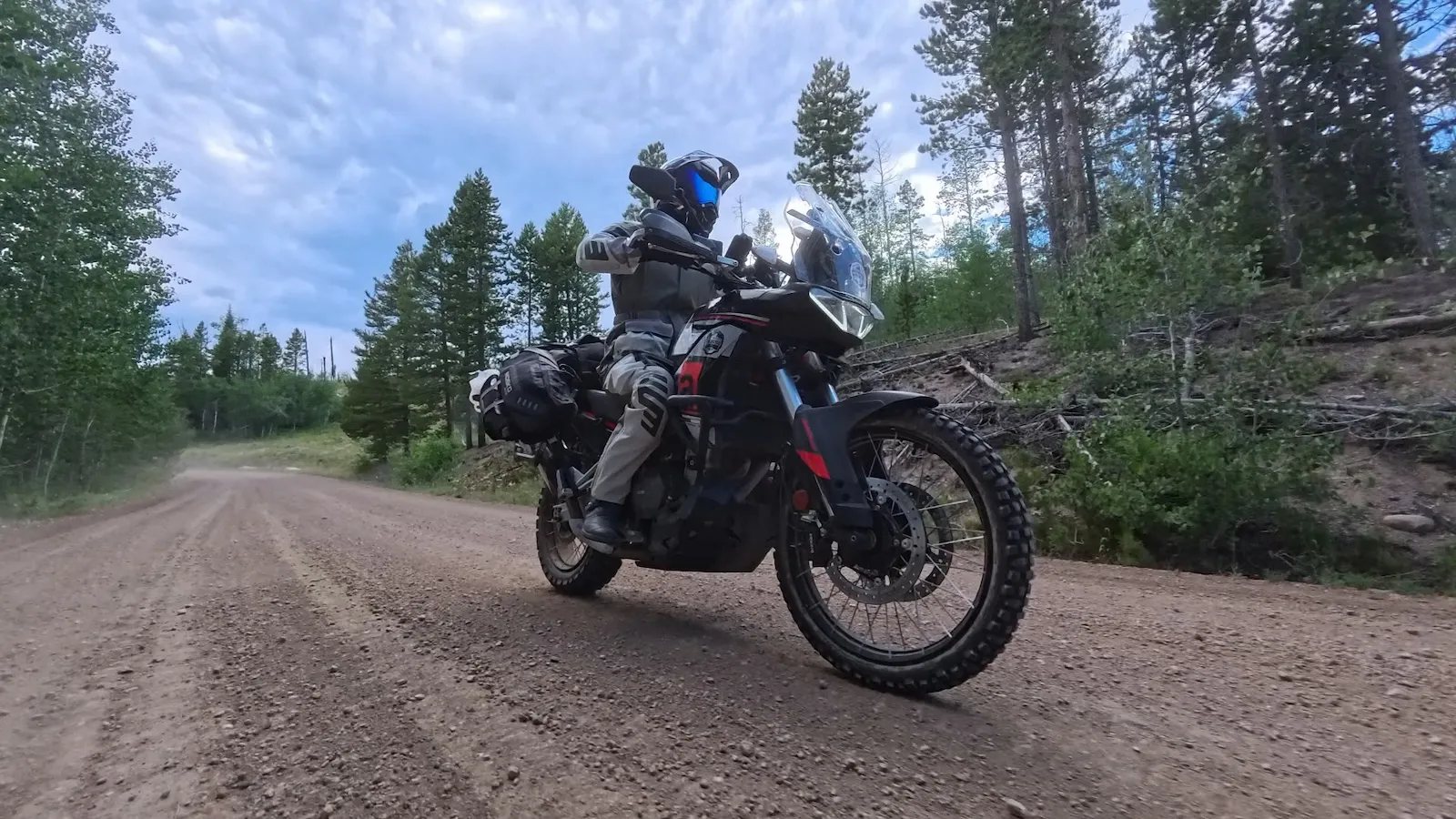
This isn’t a test and it isn’t a buying recommendation. It’s an attempt to distill a list out of 1,060 miles on the Colorado Backcountry Discovery Route: how do you recognize a good adventure bike before you’ve spent eight days in the dirt with it? The Aprilia Tuareg 660 we rode serves as the example, with its strengths and explicitly with its weaknesses.
1. Range Decides Where You Can Even Go
The first criterion is mundane and still gets underestimated. One day we rode 120 miles without seeing a single gas station. On the Alpine Loop there’s no fuel at all between Lake City, Silverton and Ouray.
An 18-liter tank covers that. On a hard enduro it would have been a problem. And the workaround is clumsy: a local we met gets 150 to 175 miles out of his bike and straps on fuel bags for the long legs.
The point: range isn’t a comfort feature. It determines which routes exist for you at all.
2. Versatility Beats Specialization
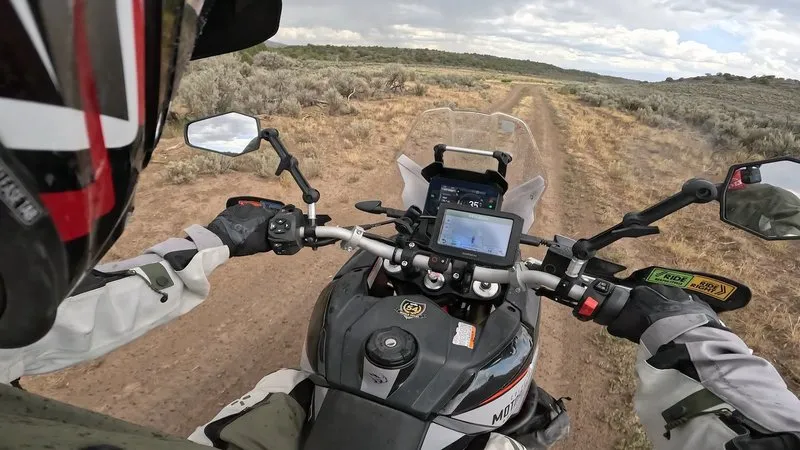
The criterion that pays off most on a trip like this: you want to cover distance the way a bigger adventure bike does, and the moment technical sections arrive you want the machine to feel agile and fun.
On the COBDR you switch between those two things ten times a day. A machine that only does one of them turns half your route into work. That’s why displacement giants and hard enduros both fail here, just at opposite ends.
3. Standing Ergonomics, Not Seated Ones
The criterion that never appears in a brochure. On a route that has you in loose terrain for hours every day, you stand a lot. What matters is whether you get tired doing it.
Done right means: your knees find purchase, the bar sits without contorting you, and you grow together with the bike. On our example that worked for eight days, and the seat was comfortable on top of it. Both at once is rare.
When you test ride an adventure bike, stand up. Ten minutes on the pegs tells you more about the next 1,000 miles than an hour of back roads.
4. Load Reserve: Where Displacement Counts
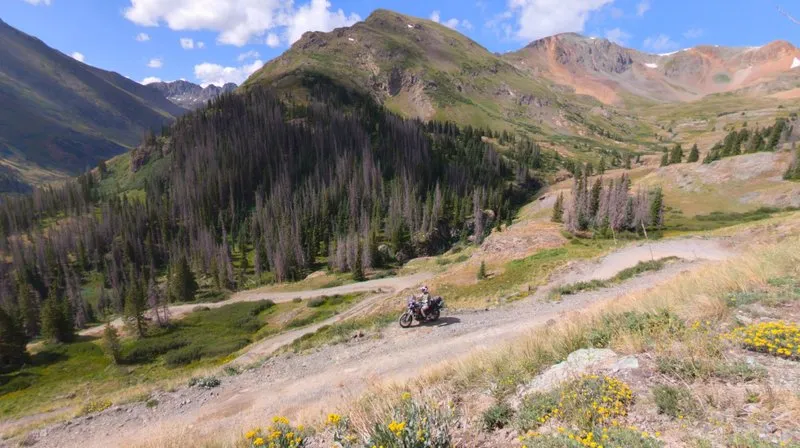
Here’s the honest weakness of our example. It’s 80 horsepower, but it’s only 659 cc. If you ride two-up and heavily loaded, the punch isn’t there, and I’d reach for more displacement.
That isn’t a design flaw, it’s a design decision. For one rider with travel luggage this class is excellent. For two people plus luggage over Alpine or Rocky Mountain passes you need reserve a 660 doesn’t have.
5. A Chassis You Can Match to Your Load
The single most valuable two-minute job of the entire trip: if you’re riding loaded, set the preload. In technical terrain with full luggage that’s the difference between control and fighting the bike.
So the criterion isn’t whether the fork is the most expensive one. It’s whether you can adapt the suspension to your load without a workshop. As an aside: Clemo and I didn’t agree about the fork on our test bike. He didn’t like the front end, I thought it was perfectly fine. Which is exactly why this section states a criterion and not a verdict.
6. Off-Road Control: What the Electronics Must Permit
A modern criterion I’d underrated before this trip. What matters isn’t how many modes a machine has, it’s whether it permits the right thing in the dirt.
Concretely: in off-road mode the ABS should regulate the front wheel only, so you can lock the rear. On loose ground that’s technique, not a mistake. And the setting has to survive a key cycle, or you’ll be hunting for it every morning.
Engine character belongs here too. A linear engine with no pothole in its power curve is easier to meter, and the traction control has to step in less often.
7. Altitude Capability, If You’re Going High
A special criterion for high-altitude travel, rarely needed in Europe and immediately relevant in Colorado.
From about 11,500 to 12,000 feet the throttle response goes noticeably doughy. That’s physics: pressure falls, and at around 12,000 feet roughly 40 percent less oxygen arrives. The question is how well a machine copes and whether higher revs bring it back into its working window. Ours did. But it’s a criterion you can never check on a test ride at sea level.
8. Durability, and the Details That Hurt Late
Two observations that belong together. Our bikes had 21,000 miles of hard rental service behind them, and they’d taken it remarkably well. Hats off.
At the same time, time gnaws at the switchgear. Vibration and constant dust make the indicator switch fiddly. And the most annoying one structurally: go down on the left and the gear lever breaks. Off-road, you do go down occasionally.
Stated as a criterion: look at how a machine ages, and how vulnerable its bolt-on parts are in a harmless tip-over. That decides your riding day more than any spec sheet.
9. Wind Protection and the Climate Around You
The least conspicuous criterion, and it only starts counting on day three. In the heat the area around your knees near the engine gets noticeably warm. At 99 degrees in the valley that stops being a detail.
The same applies in reverse on cold descents. A screen that doesn’t beat you up at highway speed on the connecting stage, and doesn’t get in your way while standing, is a compromise not every machine pulls off.
10. The One Nobody Lists: Field Repairability
Strictly speaking that’s a tenth criterion, and it only occurs to you once you’re a long way out. On the COBDR, a 745-mile route through the Rockies, you’re without cell coverage for long stretches and hours from the nearest workshop.
So the question isn’t only whether a machine holds up. It’s what you can fix yourself. Can you reach the air filter without stripping half the bodywork? Will a wheel come out with the onboard tools? Does the brake lever sit where a tip-over won’t snap it instantly?
No spec sheet answers those, and nobody asks them at a rental counter either. But they decide whether a breakdown stays an annoyance or ends your riding day.
What You Should Actually Check on a Test Ride
Since most of these criteria can’t be checked in a showroom, here’s the short version for your dealer appointment. Get on the pegs and ride ten minutes standing. Load the bike if you can, and adjust the preload yourself, purely to see whether you can reach it at all. Cycle through the modes and check whether the off-road setting survives switching the bike off.
Everything else, altitude behavior, durability past 21,000 miles, switchgear wear, you can only get from people who’ve ridden it. That’s exactly what this article is for.
The Criterion I’d Weight Differently Now
One thing shifted for me over eight days, and it’s worth saying plainly. Before the trip I’d have put engine performance in the top three. After it, I’d put fatigue management there instead.
Everything that keeps you fresh, standing ergonomics, a seat that doesn’t punish you, a screen that doesn’t buffet, suspension matched to your load, compounds across a week. Everything that costs you energy compounds too, and it compounds faster at altitude. On day one you don’t notice a bike that makes you work. On day five it’s the only thing you notice.
That reframes the whole list. Range and load reserve decide where you can go. Ergonomics and chassis decide how well you’re still riding when you get there.
What This Means for Your Shortlist
If I had to weight the nine, range, standing ergonomics and load reserve would sit at the top, because they act across the entire trip. Electronics and altitude capability matter, but they won’t rescue you if the basics are wrong.
And if you want the trip rather than the shopping: our bikes, the loaded GPS tracks and the local logistics came from Colorado Motorcycle Adventures in Golden, near Denver. Whatever you end up riding, that part of the equation matters as much as the machine.