
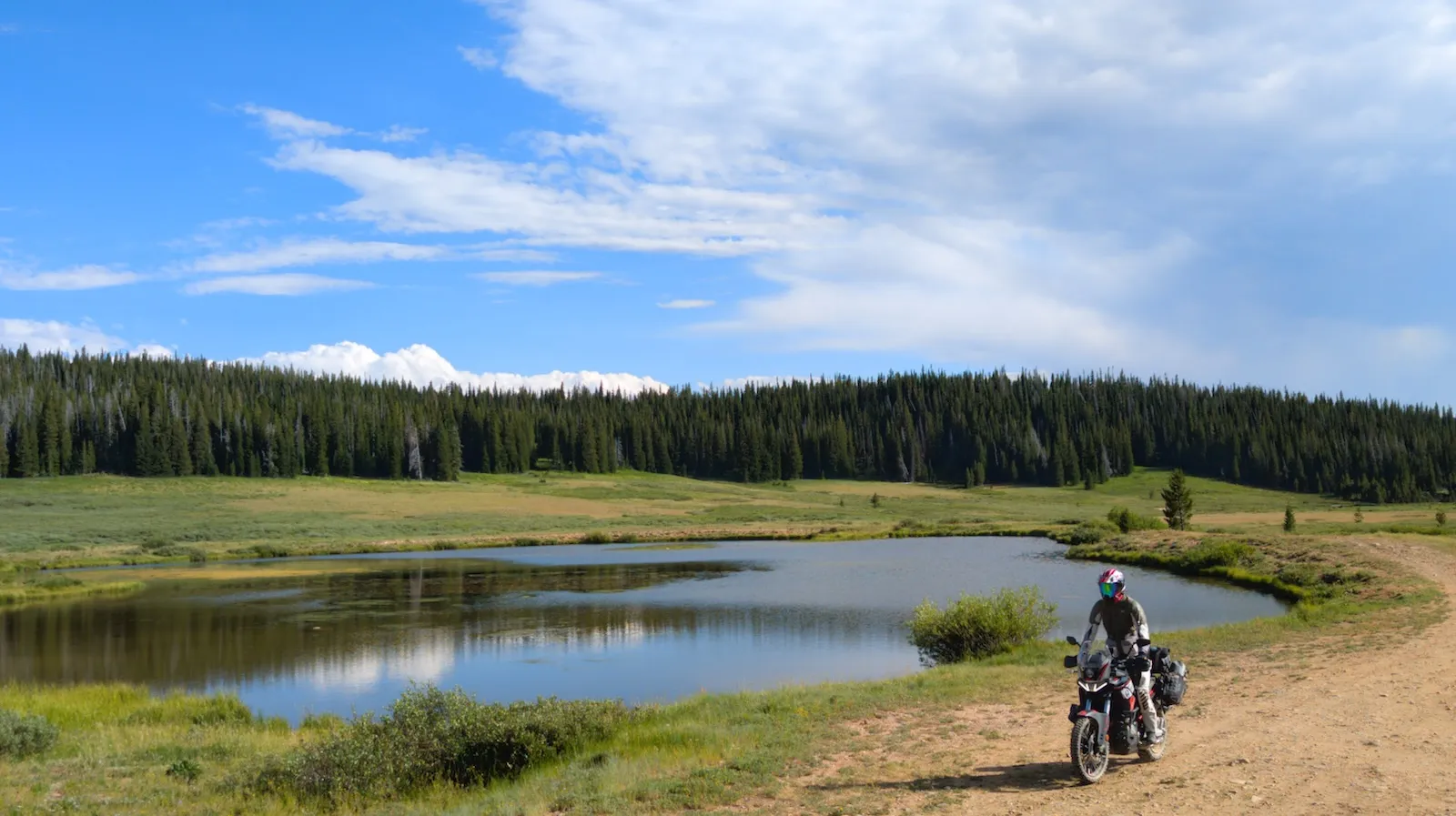
Most packing lists online are wish lists. This one is the opposite. It came out of 1,060 miles on the Colorado Backcountry Discovery Route in July 2026, including everything I carried and didn’t need, plus the two small things I’ll never leave home without again. The thread running through it isn’t gear. It’s a compromise.
Why Colorado Writes the List for You
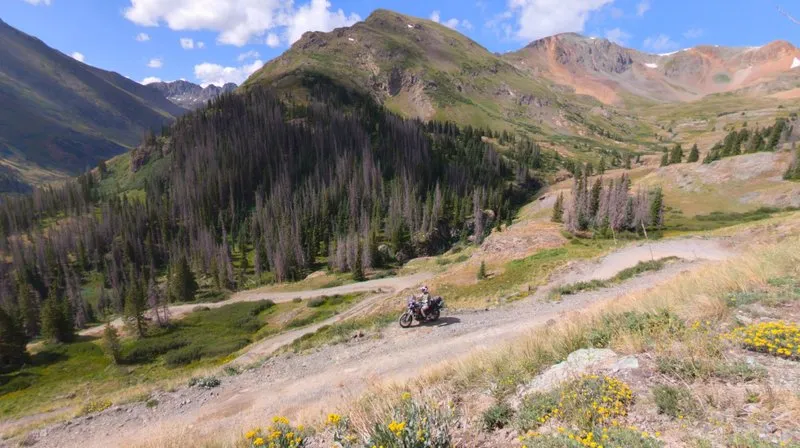
The reason you pack differently here than for a trip through the Alps is written on the thermometer. In a single day we had 99 degrees down in the valley and low 40s up top once the rain started. That isn’t an outlier, that’s how this trip is built.
Then there’s the altitude itself. At around 12,000 feet a breath delivers roughly 40 percent less oxygen than it does at sea level. The percentage of oxygen in the air doesn’t change, it stays around 21 percent, but the air pressure drops, so less of it arrives with every breath. At California Pass, near 12,930 feet, you feel it immediately: you step off the bike and you’re winded before you believe it. If you haven’t done any altitude training, you will underestimate this.
And then there’s the unpredictability. Phil from Colorado Motorcycle Adventures warned us that at altitude the temperature can fall 30 degrees Fahrenheit when it rains, very cold and very fast. A local up at Crooked Creek Pass put it shorter: in Colorado it can snow anytime, even in August. The official season runs July through September, but snow on the high passes is never off the table.
The Principle: Compromise, Not Armor
Before a single item goes in the bag, there’s a decision to make. If you wrap yourself up like a knight, you end up with a safety disadvantage on long distances, because you’re in pain. Somebody who spends the last two hours of the day thinking about where it pinches is riding less attentively than somebody wearing one layer less.
This isn’t an invitation to ride unprotected. The BDR tracks are a long way from a hard enduro trip in terms of difficulty, and that’s exactly why your kit can be travel-grade instead of race-grade. I always try to land on a good compromise between protection and comfort. On this trip that turned out to be the right call.
Layering, and Why Three Pieces Are Enough
My system for that temperature spread is simple and it worked every single day: a wind vest, a warm merino shirt, and a rain jacket to throw over the top when it turns. Three pieces you can swap standing beside the bike without unstrapping the luggage roll.
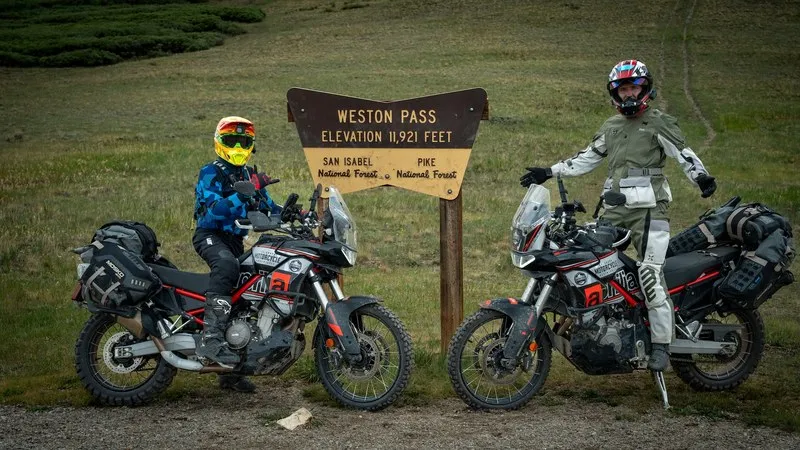
The outer shell was a two-layer ripstop adventure suit. What matters here are the big adjustable vents, because they cover both extremes: off-road heat down in the valley and cold descents off the passes. It’s AA-rated, with level 2 armor at shoulder, elbow, back, knee and hip.
On my head I deliberately ran a closed enduro helmet with a visor rather than the goggle setup. The trade-off is honest: warmer and dustier in the dirt, but a clear win in rain and on highway sections. It meets ECE 22.06, the fog-free VAS-A Max Vision visor earned its keep on every wet descent, and the flat side panels take an intercom mount cleanly.
The Two Small Things Nobody Puts on the List
These are the two tips this article really exists for.
First: barefoot shoes for camp. You can roll them up, they take almost no space, and they’re still comfortable to wear. After ten hours in enduro boots you want something else on your feet, and the alternative, a pair of trainers, eats half your luggage volume.
Second: a padded cycling short as a base layer. The kind you’d wear road cycling, with the gel insert. If you’re riding 1,200 miles across several days, it’s genuinely pleasant. The catch belongs in the same sentence: you sweat like a horse in it. But your backside stays fresh, and on day five that’s the difference between riding and enduring.
I’m naming both as categories, not brands. I won’t tell you which one to buy, because I haven’t ridden the alternatives and I’d be making it up.
Tools, and the One Repair You Have to Own
There are two things you should be able to handle without help out here: fixing a flat, and improvising your way past a torn clutch or brake line. Anything beyond that is the workshop’s problem anyway on a rental bike. So my tool roll was deliberately thin: the onboard kit, tire levers, a patch kit, a small pump, zip ties and duct tape.
The one thing I always add is a spare pair of gloves. Wet gloves on a cold descent aren’t a comfort problem, they’re a control problem. Once your fingers go numb you modulate the brake and clutch worse, and loose gravel is the last place you want that.
Safety and Communication
Out here help is far away, and there’s no cell coverage across long stretches. So I carried a satellite communicator with an SOS function, a US charger, and a banal but seriously meant emergency ration: cashews, M&Ms, water. Not survival fantasy. Just the knowledge that a flat tire at 11,800 feet with a thunderstorm building turns into a long wait very quickly.
The single most valuable piece of kit for two riders, though, was the mesh intercom. Not for music. Because you can call out ruts, cattle on the road and oncoming traffic before the other person rides into them, and because you can sort out navigation when your GPS scales don’t match. On gravel, talking is a safety feature.
And here’s one piece of advice I’ll pass straight on, because we got it on the road: don’t ride alone. Two people needed a full hour to get one loaded adventure bike back on its wheels. Solo, it doesn’t happen.
Range Is a Packing Question
The point that’s easiest to forget while packing. One day we covered 120 miles without seeing a single gas station. On the Alpine Loop there is simply no fuel between Lake City, Silverton and Ouray.
The Aprilia Tuareg 660 carries 18 liters, and that was enough for those distances. On a hard enduro it would have been a problem. I’m deliberately not giving you a maximum range figure, because it depends on your throttle hand, the altitude and how much you’ve loaded. Work backwards instead: where’s the next reliable fuel stop, and how much reserve do you want if a wildfire closes the road.
What I’d Pack Differently Next Time
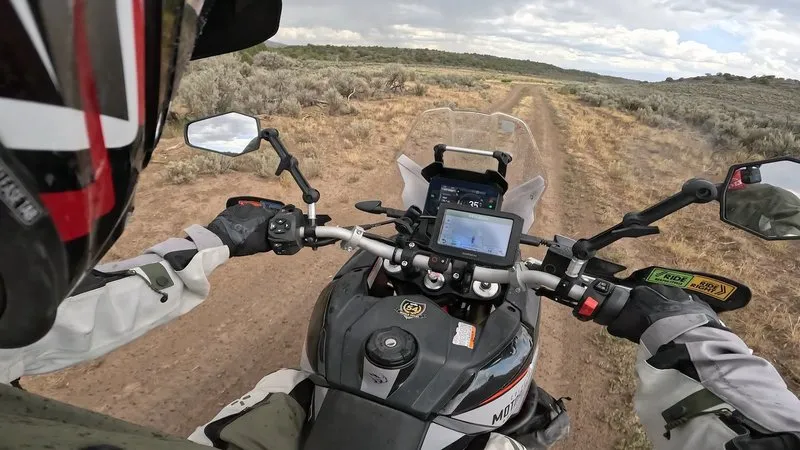
Two things I’m noting for the next high-altitude trip. First, a thin genuinely windproof glove overlayer, because the rain jacket was always within reach up on the pass but my hands stayed the weak point every single time. Second, less electronics. I carried chargers for devices I switched on twice in eight days, and every one of them wanted space and a cable.
And one lesson that isn’t gear at all: pack so you can reach your rain layer while seated. If getting to it means unstrapping the luggage roll, you’ll put it on too late, every time. On this route that decides more days than the brand name on your jacket does.
The Honest Short List
What comes along: a ventilated suit with proper armor, a merino layer, a wind vest, a rain jacket, a closed helmet, satellite SOS, an intercom, an emergency ration, barefoot shoes, and a padded base layer.
What stays home: the full carbon-brace-and-motocross-jersey armor kit, a second pair of heavy shoes, and anything you’re only carrying because it appeared on a packing list on the internet. On this route, every kilo you don’t have to lift over 12,900 feet pays you back.
If you want the logistics side of the trip rather than the kit side, Colorado Motorcycle Adventures in Golden supplied our bikes, the loaded GPS tracks and the local knowledge that made a self-guided run possible in the first place.