
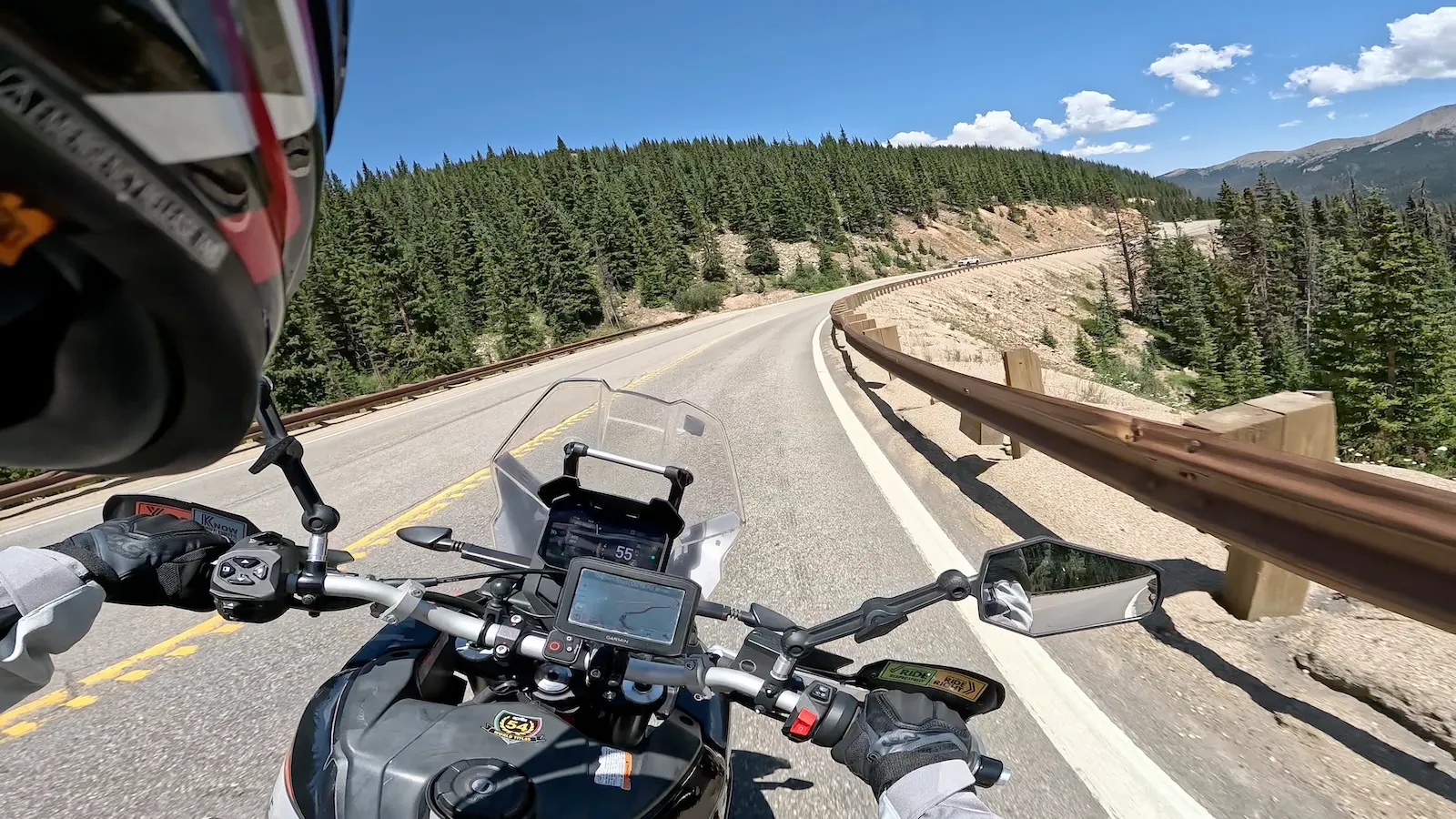
Rider aids usually get judged from a brochure. Ours worked for eight days on real ground: paved passes above 12,000 feet, loose high-country gravel, wet red clay, water crossings. What actually matters looks different from the feature list.
What the Bike Brings to the Table
The starting point, so we’re talking about the same thing. The Aprilia Tuareg 660 has four ride modes: Urban, Explore, Off Road and Individual. Urban and Explore are fixed. Off Road and Individual are fully adjustable.
Behind that sits the APRC package, which governs four parameters per mode: traction control, engine braking, engine mapping and ABS. In practice that’s five traction control levels including off, three engine braking levels, and three engine maps from aggressive to smooth.
The part that mattered most to us: in Off Road mode the ABS only regulates the front wheel. The rear can lock. And the setting stays saved when you switch the bike off. That sounds like a detail, but day to day it’s the difference between a system you actually use and one you go hunting for every morning.
The Moment You Switch
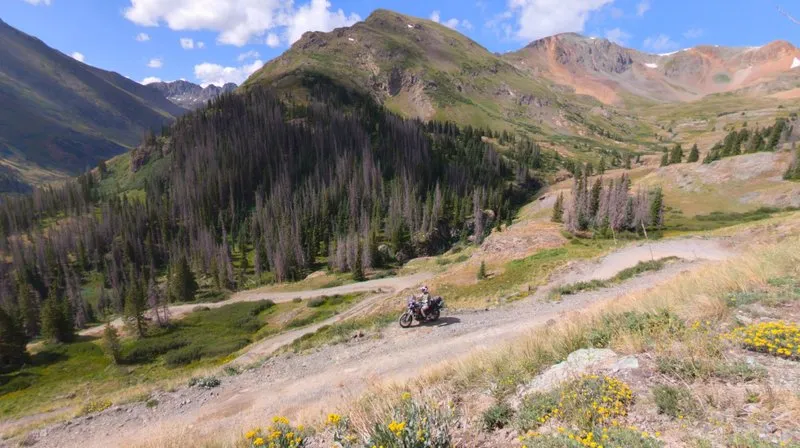
The appeal of this route is the constant change. In a single day you climb the paved Cottonwood Pass to 12,126 feet, the highest paved crossing of the Continental Divide, and shortly after that the unpaved Cumberland Pass at 12,034. The next day, on the Alpine Loop, you swap repeatedly between the asphalt of the Million Dollar Highway and loose rock in Corkscrew Gulch.
When you leave the pavement and the gravel starts, it’s a different kind of riding. You suddenly feel a bit more, hear more, sense more. That’s exactly the moment your thumb goes to the mode button, and exactly why it matters how fast and how reliably that works.
Off-Road ABS: The One Feature I Won’t Give Up
The clear verdict from two riders after 1,060 miles: off-road ABS is genuinely usable. Let the rear lock, brake into the corner, and the front stays very, very safe. I’m glad we had a system this good, where the regulation actually works.
The context is what makes that verdict worth anything. On the Alpine Loop it gets serious when it rains, because parts of it are red clay that turns unbelievably slick. Up at Crooked Creek Pass a local explained that the gravel road becomes almost impassable in the rainy season, because the log trucks polish it smooth.
In situations like that a locked rear wheel isn’t a mistake, it’s technique. You set the bike sideways, shorten the stopping distance, and keep your safety margin at the front. A system that forbids that makes you slower on loose ground, not safer.
Traction Control, and an Engine That Helps It
The second thing that worked is traction. This machine has genuinely good traction, and that isn’t down to electronics alone.
The engine is linear, but it wants revs. There’s no punchy point in the rev range where it grabs you. On tarmac I first read that as a weakness. In the dirt it’s exactly what you want: an engine with no pothole in its power curve is easier to meter at the throttle, and the traction control has to intervene less often. Electronics and engine character pull in the same direction here.
Where the Electronics Hit a Wall
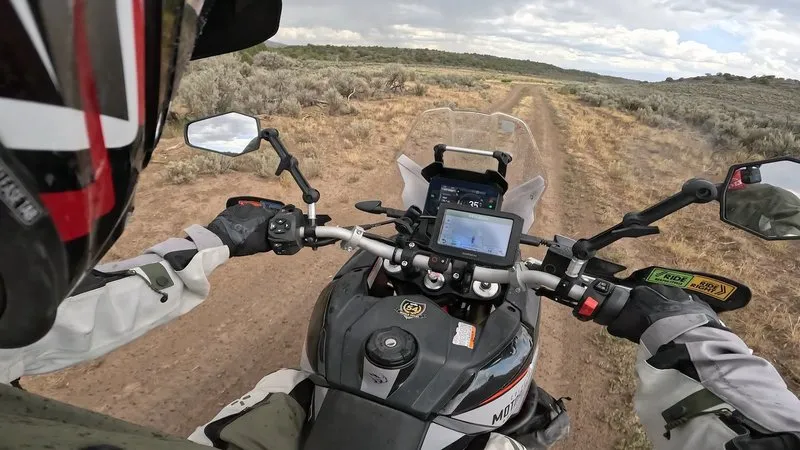
Now the honest part. From about 11,500 to 12,000 feet the throttle response started going doughy.
That isn’t an electronics fault, it’s physics. Air pressure falls with altitude, and at around 12,000 feet roughly 40 percent less oxygen arrives per breath, in your lungs and in the intake alike. The ECU compensates for what it can compensate for, but it can’t invent air.
For you that means: ride it a gear lower up there. Give it revs and it does a fantastic job even at 12,900 feet. If you come from the Alps and you’re used to passes below 8,000 feet, you have to recalibrate your throttle hand. That’s a rider’s learning task, not a warranty claim.
How I Actually Set the Modes
Since the question always comes: we didn’t fiddle much. Set Off Road, then ride.
The logic is simple. Of the three engine maps, the most aggressive is rarely the best on loose ground, because it costs you the metering you need for traction. Engine braking works the same way in reverse: too much overrun pushes the rear away from you on a steep descent, too little leaves you relying on the brake alone. The middle setting was the compromise that never got in our way across eight days.
I didn’t switch traction control off, even though “off” is one of the five settings. On a loaded trip, in thin air, with eight hours of riding behind you, the safety net is worth more than the last few percent of control. Somebody riding a single section against the clock may see it differently. We were on a trip, not at a race.
What Electronics Can’t Do
Which brings us to the paragraph that matters most. No level of intervention helps against the two things that genuinely worried us.
The first is fatigue. After eight hours of loose rock and washboard in thin air you make mistakes you wouldn’t have made in the morning. You don’t notice it as riding badly. You notice it as braking later and taking lines you’d have avoided earlier. The only fix is stopping sooner.
The second is mechanical vulnerability. If you go down on the left side, the gear lever breaks, and at that point the best ABS in the world is just parked at the side of the trail. Electronics improve how you ride. They change nothing about what happens when a component snaps two riding hours from the nearest road.
The Electronics That Aren’t on the Bike
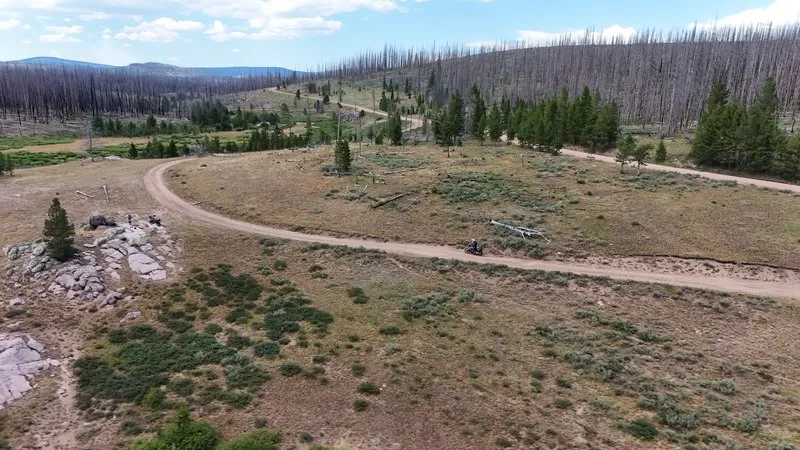
Some of the most important electronics on this trip weren’t part of the motorcycle. Riding two-up-in-convoy on gravel, the mesh intercom was the quiet hero. Not for music, but because you can call out ruts, cattle and oncoming traffic before the other person rides into them, and because you can reconcile navigation when your map scales drift apart.
Then there’s navigation itself. Both our Aprilias came from Colorado Motorcycle Adventures in Golden near Denver, complete with a preloaded GPS carrying every track. On a route where you have no cell coverage for long stretches, that isn’t a convenience, it’s basic equipment.
The Comparison I Wish I’d Had
Here’s what I’d have liked to know before the trip: how much of what you like off-road is actually electronics, and how much is chassis?
After eight days I’d say more chassis than the brochure suggests. Up on Cinnamon Pass near 12,600 feet, loose rock under the tires, exposed switchbacks, it was the precise line-holding that made the bike feel light, not an intervention level. The electronics didn’t do anything wrong while that happened, and that’s exactly their job.
One practical tip from the same corner, worth more than any menu: if you’re riding loaded, set your rear preload. It sounds mundane, but in technical terrain with full luggage it’s the difference between control and fighting the bike. Two minutes at the shock pays you back on every pass that follows.
My Practical Verdict
If I had to pick two things out of the whole package, they’d be off-road ABS with a defeatable rear wheel, and an engine you can meter cleanly. Everything else is pleasant but not decisive.
What I’d skip is the hunt for the perfect Individual setup. We rode in Off Road mode almost the entire time and set it up once. On a trip where you swap between pavement and gravel ten times a day, the system you can operate blind beats the one with the most parameters.