By NastyNils·
Motorcycle comparison · Tourer
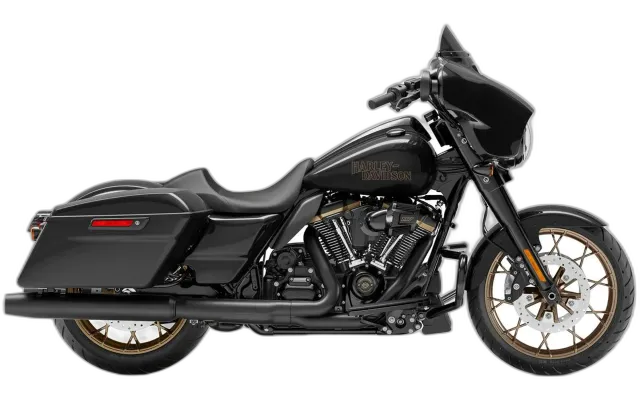
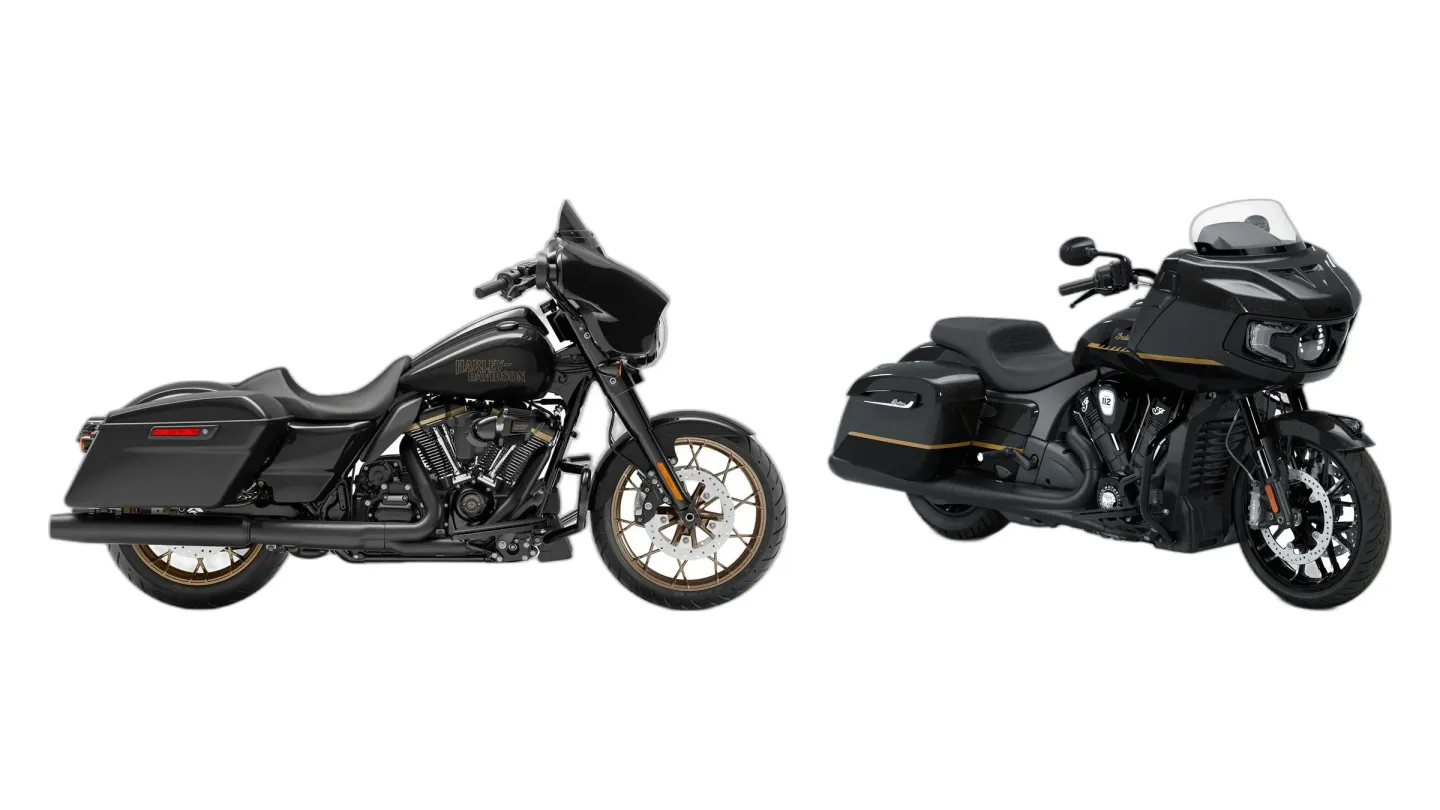
Harley-Davidson Touring Street Glide ST (MY2022) vs Indian Challenger (MY2020)
Roll on the Harley-Davidson Touring Street Glide ST and its air filter's barking right at your knee. The Indian Challenger's throttle shoves you forward at any revs.
So which one do you buy?
The Challenger has the edge if…
Sporty riding on twisty roads
A touch ahead: Challenger
On a winding road, the Challenger comes out a touch ahead. What tips it: better suspension. You wouldn't bet much on a gap like that.
Comfortable long-distance riding
Slight edge: Challenger
For a day of interstate and back roads, the Challenger makes a little more sense. Sit on both, because the gap is modest.
Which one's the smarter buy
No clear advantage
The Indian Challenger costs less, but that doesn't make it the clear better buy. Neither bike stands out as the smarter spend at these used prices.
What makes each one tick
Touring Street Glide ST
Down low, the Street Glide ST's V-twin shakes through the bars, and it's a shake that belongs to how the engine talks. Against the standard model, it turns in sharper with more ground clearance to lean on. Once the brake lever hauls it down to a parking-lot crawl, the mass doesn't vanish anymore. The Rinehart exhaust booms behind it.
Nils rode the Touring Street Glide ST in 2022 (NastyNils Testride).
Challenger
On Iron Mountain Road, the Challenger's stiff aluminum frame carves the bends with real agility. Corner entry asks little of the bar, and the suspension holds the chassis settled once it's leaned. The PowerPlus twin pulls hard everywhere. The plush seat's still cushioning you at day's end.
The Voice of Experience

What actually separates them
- The Challenger has the lower seat: 26.5 in (673 mm) vs 28.0 in (710 mm).
- The Touring Street Glide ST has the lower wet weight: 814 lb (369 kg) vs 842 lb (382 kg).
- The Challenger makes more peak power: 122 hp (91 kW) vs 103 hp (76 kW).
Which one for the way you ride
Daily commuting & city riding
Look elsewhere
Neither of these is a natural commuter. For daily traffic duty, look at something lighter and simpler.
A confidence-building first motorcycle
Not built for this
If this is your first motorcycle, keep looking. Neither one makes learning easy.
There's no real gap on running costs. Sit on both and let fit and price decide.
Who each one is built for
What's good, and what you'll live with
Touring Street Glide ST
Strengths
- Startling Roll-On Acceleration
- Composed Braking Under Lean
- Holds Its Value
- Monster torque from the Milwaukee-Eight 117
Trade-offs
- Mass At Walking Pace
- Firm Touring Seat
- Wind Loads The Bars
Challenger
What owners say
Strengths
- Mighty PowerPlus engine torque
- All-day touring comfort
- Premium feature set
- Surprisingly agile handling
Known problems to check before you buy
Touring Street Glide ST
- M8 lifter noise and potential failure Milwaukee-Eight engines can develop noisy or failed lifters, particularly in early 117ci batches, requiring warranty replacement.
- Electrical glitches causing limp mode Some owners report intermittent ECU faults that trigger limp-home mode, often traced to loose battery terminals or software bugs.
Challenger
- Display freezing and random glitches The digital display may freeze, enter a loading loop, reset ride data, or switch between day/night mode erratically. A restart usually resolves the issue.
- Premature battery failure The OEM battery may develop a dead cell after the first full season, even when kept on a tender. The bike also struggles to start in very cold weather.
What they cost used
These prices compare a 4-year-old Touring Street Glide ST with a 4-year-old Challenger.
- Touring Street Glide ST
- $25,000
- Challenger
- $20,000
At four years old, the Harley-Davidson Touring Street Glide ST sits around $25,000 while the Indian Challenger lands near $20,000. That's a $5,000 gap in the Challenger's favor. These figures come from earlier used-market records, not live listings.
What they share
- Fuel capacity
- 6.0 US gal (22.7 L)
- Gearbox
- 6-speed
- Front tire
- 130/60-19
Where the spec sheets split
| Touring Street Glide ST | Challenger | |
|---|---|---|
| Seat height | 28.0 in (710 mm) | 26.5 in (673 mm) |
| Wet weight | 814 lb (369 kg) | 842 lb (382 kg) |
| Touring Street Glide ST | Challenger | |
|---|---|---|
| Displacement | 1923 cc | 1768 cc |
| Engine | 45° V-twin | 60° V-twin |
| Cooling | Air/oil-cooled | Liquid-cooled |
| Power | 103 hp (76 kW) | 122 hp (91 kW) |
| Torque | 127 lb-ft (172 Nm) | 128 lb-ft (174 Nm) |
| Touring Street Glide ST | Challenger | |
|---|---|---|
| Fork | Telescopic | Upside-down (USD) |
| Rear tire | 180/55-18 | 180/60-16 |
What comes fitted, what costs extra
| Touring Street Glide ST | Challenger | |
|---|---|---|
| Traction Control | Option | Standard |
| Ride Modes | Not offered | Standard |
| Navigation | Standard | Option |
| USB Charging Port | Not offered | Standard |
| Keyless System | Not offered | Standard |
| Electrically Adjustable Windscreen | Not offered | Standard |
Head to head, area by area
Both bikes on the same scale, one area at a time.