By NastyNils·
Motorcycle comparison · Supersport
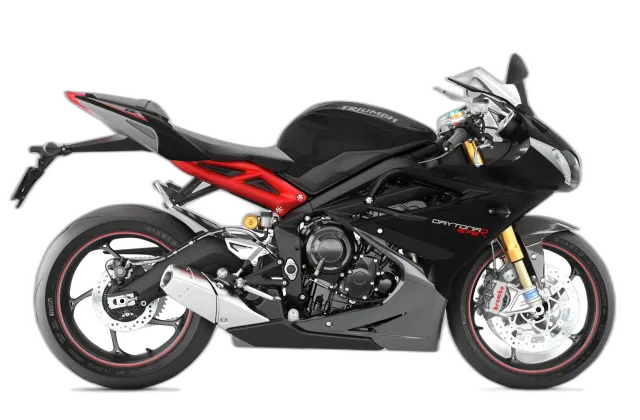
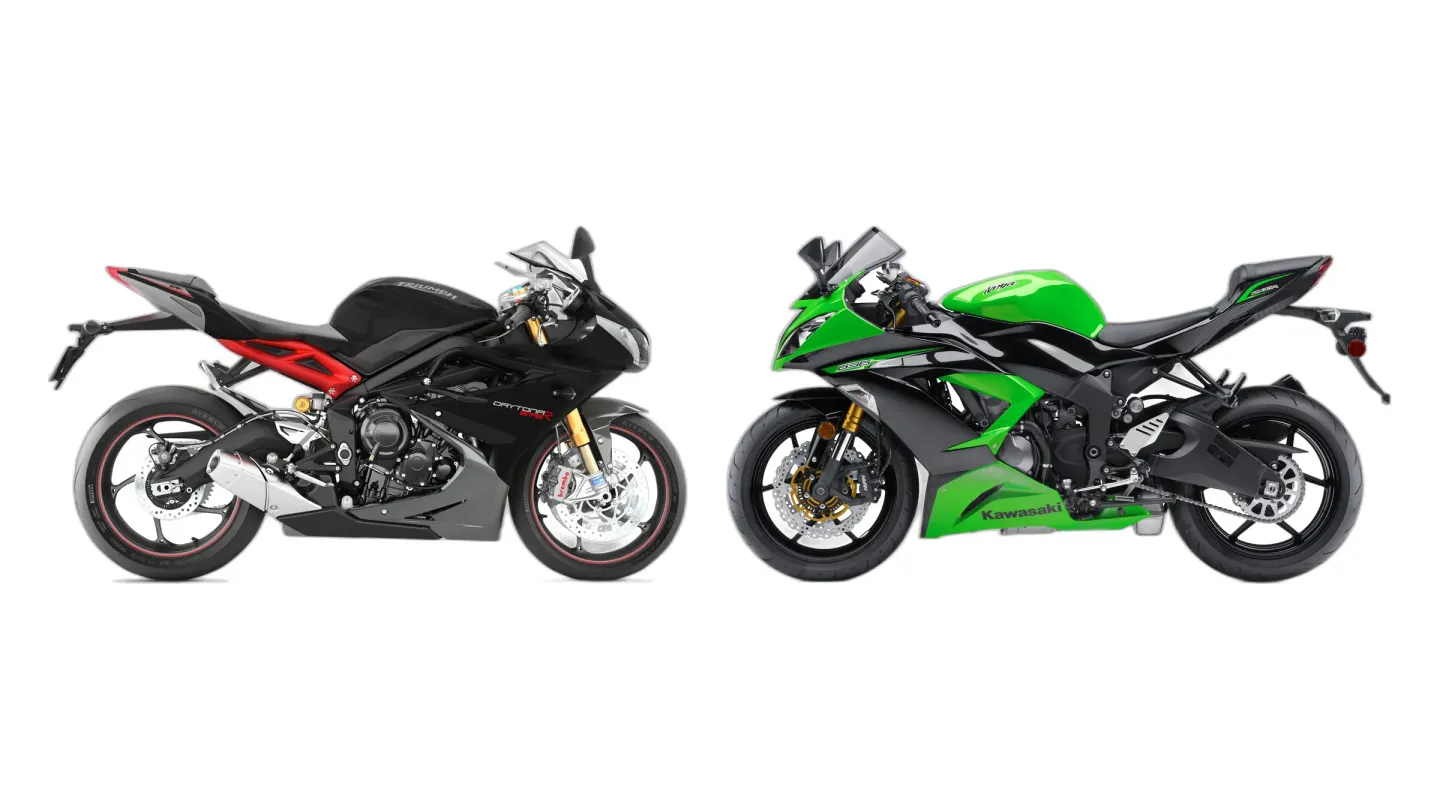
Triumph Daytona 675 (MY2013-R) vs Kawasaki Ninja ZX-6R (ZX636E)
Triumph Daytona 675 vs Kawasaki Ninja ZX-6R: which one to buy for the riding you do.
At turn-in, the Triumph Daytona 675's front settles, talks back and won't wander. The Kawasaki Ninja ZX-6R snaps in off a light push.
So which one do you buy?
The Daytona 675 has the edge if…
Racetrack use
Slight edge: Daytona 675
Between the curbs, the Daytona 675 asks a bit less of you at speed. That comes from more suspension adjustment and stronger brakes. It's a fine margin, nothing more.
Sporty riding on twisty roads
By a nose: Daytona 675
On a winding road, the Daytona 675 comes out a touch ahead. It's down to better suspension. You wouldn't bet much on a gap like that.
Which one's the smarter buy
Depends what you want it for
The Ninja ZX-6R costs less, but that doesn't make it the clear better buy. Neither bike wins on value at these used prices.
What makes each one tick
Daytona 675
Long before the chassis gets a say, the Daytona 675's triple makes itself heard, with an intake howl that rises to a scream near the top. The throttle doesn't wait for revs. There's real pull from the midrange, well below the top end. Mid-corner, the short frame stays put on its line.
Ninja ZX-6R
Through a chain of quick bends, the Ninja ZX-6R swaps sides in a hurry, and the bars don't stop reporting what the tires are doing. Its seat sets a reasonable crouch for sport riding behind a fairing that doesn't leave you fighting the wind. Each roll-on lunges forward.
The Voice of Experience

What actually separates them
- The Daytona 675 has the lower wet weight: 406 lb (184 kg) vs 423 lb (192 kg).
- The Daytona 675 has the larger engine: 675 cc vs 636 cc.
- ABS: standard on the Daytona 675, option on the Ninja ZX-6R.
Which one for the way you ride
Comfortable long-distance riding
Neither is a natural fit
For all-day comfort, both fall short. Keep the rides short and you'll get on fine with either.
On commuting and running costs, these two are a wash. That's where your budget and your inseam get the final say.
Who each one is built for
What's good, and what you'll live with
Daytona 675
What owners say
Strengths
- Exceptional handling and chassis composure
- Glorious triple engine with broad powerband
- Exhilarating soundtrack and character
- Premium Öhlins suspension and Brembo brakes
- Approachable yet razor-sharp track weapon
Ninja ZX-6R
What owners say
Strengths
- Strong midrange torque
- Sharp, responsive handling
- Surprisingly comfortable for a supersport
Known problems to check before you buy
Daytona 675
- Öhlins rear shock absorber recall (2014–2015 R models) Recall 15V255000 A recall was issued due to potential cracking of the shock absorber body. Affected units were replaced free of charge.
- Exup valve cable stretch triggers CEL The exhaust valve cables stretch over time, causing the check engine light to illuminate.
Ninja ZX-6R
No confirmed faults on file yet. That's not the same as fault-free.
What they cost used
These prices compare a 9-year-old Daytona 675 with a 9-year-old Ninja ZX-6R.
- Daytona 675
- about $8,700
- Ninja ZX-6R
- about $7,300
At nine years old, the Triumph Daytona 675 sits around $8,700 while the Kawasaki Ninja ZX-6R lands near $7,300. That's a $1,400 gap in the Ninja's favor. These are estimates from the used market, not live listings.
What they share
- Seat height
- 32.7 in (830 mm)
- Cooling
- Liquid-cooled
- Gearbox
- 6-speed
- Final drive
- Chain
- Fork
- Upside-down (USD)
- Front brake
- 310 mm
- Front tire
- 120/70-17
- Rear tire
- 180/55-17
Where the spec sheets split
| Daytona 675 | Ninja ZX-6R | |
|---|---|---|
| Wet weight | 406 lb (184 kg) | 423 lb (192 kg) |
| Daytona 675 | Ninja ZX-6R | |
|---|---|---|
| Displacement | 675 cc | 636 cc |
| Engine | Inline-three | Inline-four |
| Power | 126 hp (94 kW) | 131 hp (96 kW) |
| Peak power at | 12,500 rpm | 13,500 rpm |
| Torque | 55 lb-ft (74 Nm) | 52 lb-ft (71 Nm) |
| Peak torque at | 11,900 rpm | 11,500 rpm |
| Daytona 675 | Ninja ZX-6R | |
|---|---|---|
| Fuel economy | 31 mpg (US) / 7.63 L/100 km | 34 mpg (US) / 6.9 L/100 km |
| Fuel capacity | 4.6 US gal (17.4 L) | 4.5 US gal (17 L) |
What comes fitted, what costs extra
| Daytona 675 | Ninja ZX-6R | |
|---|---|---|
| ABS | Standard | Option |
| Traction Control | Not offered | Standard |
| Ride Modes | Not offered | Standard |
| Steering Damper | Not offered | Option |
| Quickshifter | Standard | Not offered |
Head to head, area by area
Both bikes on the same scale, one area at a time.