By NastyNils·
Motorcycle comparison · Supersport
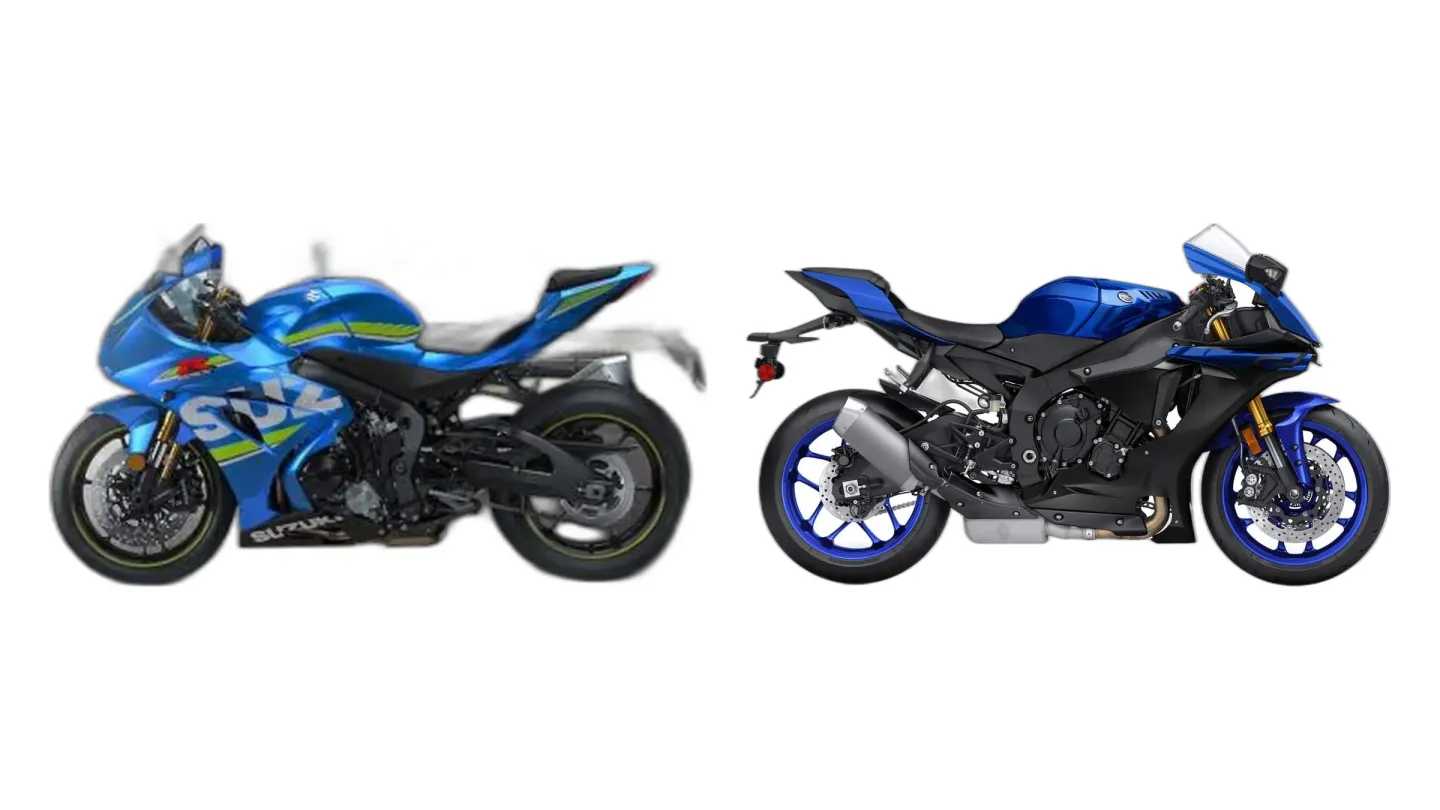
Suzuki GSX-R 1000 (MY2017-R) vs Yamaha YZF-R1 (RN49)
Suzuki GSX-R 1000 vs Yamaha YZF-R1: fast is a given. What sets them apart isn't.
You'll feel the Suzuki GSX-R 1000 stay settled as you roll the throttle open on exit, with engine and chassis pulling as one. On the Yamaha YZF-R1, that same twist of the grip sets off an uneven firing beat that's begging for revs. Its top end keeps rushing toward the limiter.
So which one do you buy?
The YZF-R1 has the edge if…
Sporty riding on twisty roads
Nose ahead: YZF-R1
The YZF-R1 is a touch more fun when the road starts bending. Credit a sportier chassis and more feel through the bars.
Racetrack use
Narrow edge: YZF-R1
Lap after lap, the YZF-R1 noses ahead. Most of that is more suspension adjustment. Your own riding will make a bigger difference than this gap.
Which one's the smarter buy
Value's a wash
At these used prices, neither bike comes out ahead on value. The small price gap doesn't make one the clear better buy.
What makes each one tick
GSX-R 1000
The GSX-R 1000 wants a sweeper taken at big speed, and it's happy to hold that line on the tires. Corner entry doesn't happen on its own: you push hard on the inside bar to drive the front through the arc, whatever tires it wears. It's old-school bar pressure that works. The front lever bites hard into each stop.
Nils rode the GSX-R 1000 in Australia in 2017 (NastyNils Testride).
YZF-R1
Big lean angles suit the YZF-R1, whose front end stays steady and keeps reporting what the tire's doing. On a long street ride, the firm suspension doesn't soften a bump much, and the forward crouch adds to the load. That trade isn't an accident. On a track, the YZF-R1 feels like it's shrunk around you.
Nils rode the YZF-R1 in 2017, and in Switzerland in 2020 (NastyNils Testride).
The Voice of Experience

What actually separates them
- The GSX-R 1000 has the lower seat: 32.5 in (825 mm) vs 33.7 in (855 mm).
- The YZF-R1 has the larger fuel tank: 4.5 US gal (17 L) vs 4.2 US gal (16 L).
- TFT Display: standard on the YZF-R1, not offered on the GSX-R 1000.
Which one for the way you ride
Comfortable long-distance riding
Both miss here
Neither of these is a mile-muncher. If big days are the plan, keep looking.
Call it even on commuting and running costs. Choose on fit, price and the one that makes you grin.
Who each one is built for
What's good, and what you'll live with
GSX-R 1000
Strengths
- Relentless top-end surge
- Corner exit stays planted
- Track-ready Brembo brakes
- Traction control gives real choices
- Torquey, broad-powerband engine
Trade-offs
- Turn-in needs deliberate effort
- Wheelie and TC share one dial
- Two safety recalls to verify
YZF-R1
What owners say
Strengths
- Addictive, charismatic engine
- Outstanding cornering precision
Trade-offs
- Tall seat height
Known problems to check before you buy
GSX-R 1000
- Gearshift double-click between 4th-5th and 5th-6th Shifting between higher gears can feel notchy, with a double-click sensation; adjustment does not always fix it.
YZF-R1
- Brake lever sponginess, weak initial bite, accelerated rotor glazing under track use The Advics 4-piston front calipers are competent, but the OEM pads, master cylinder, and rotor thickness are consistently identified as the system's weakness. ABS-induced lever sponginess is widely reported. Under sustained track use, rotors glaze and bite drops further. On 2018–2019 models, the linked-brake system draws criticism: the rear brake feels loose under heavy braking and can produce a tyre-squealing fishtail on track. Common owner remedy: replacement pads (HH compounds), braided lines, ABS-bypass for track-only bikes.
- Wafer-thin OEM seat causes acute discomfort on rides over approx. 60 minutes The OEM seat is universally described as "wafer-thin" and "torture after a couple of hours." Combined with high pegs, narrow tank, and aggressive bar position, road comfort is sub-class for use cases beyond track days and short fast-road rides. This is a deliberate design choice (track-bias positioning) rather than a defect, but it is consistently raised as a primary practical limitation of the bike.
- Auto-blipper requires excessive lever pressure at low rpm, or quickshifter sensor fails outright The MY2018+ auto-blipper (clutchless downshift) requires noticeably more lever pressure at low rpm according to riders. The quickshifter sensor itself can short out without warning, leaving both upshift and downshift functions inoperative until replacement.
What they cost used
These prices compare a 7-year-old GSX-R 1000 with a 7-year-old YZF-R1.
- GSX-R 1000
- about $14,100
- YZF-R1
- about $14,500
What they share
- Engine
- Inline-four
- Cooling
- Liquid-cooled
- Gearbox
- 6-speed
- Final drive
- Chain
- Front tire
- 120/70-17
- Rear tire
- 190/55-17
Where the spec sheets split
| GSX-R 1000 | YZF-R1 | |
|---|---|---|
| Seat height | 32.5 in (825 mm) | 33.7 in (855 mm) |
| Wet weight | 448 lb (203 kg) | 441 lb (200 kg) |
| GSX-R 1000 | YZF-R1 | |
|---|---|---|
| Displacement | 1000 cc | 998 cc |
| Power | 203 hp (149 kW) | 200 hp (147 kW) |
| Torque | 87 lb-ft (118 Nm) | 83 lb-ft (112 Nm) |
| GSX-R 1000 | YZF-R1 | |
|---|---|---|
| Fuel economy | 35 mpg (US) / 6.8 L/100 km | 34 mpg (US) / 7 L/100 km |
| Fuel capacity | 4.2 US gal (16 L) | 4.5 US gal (17 L) |
| GSX-R 1000 | YZF-R1 | |
|---|---|---|
| Wheelbase | 56.1 in (1425 mm) | 55.3 in (1405 mm) |
What comes fitted, what costs extra
| GSX-R 1000 | YZF-R1 | |
|---|---|---|
| TFT Display | Not offered | Standard |
Head to head, area by area
Both bikes on the same scale, one area at a time.