By NastyNils·
Motorcycle comparison · Supersport
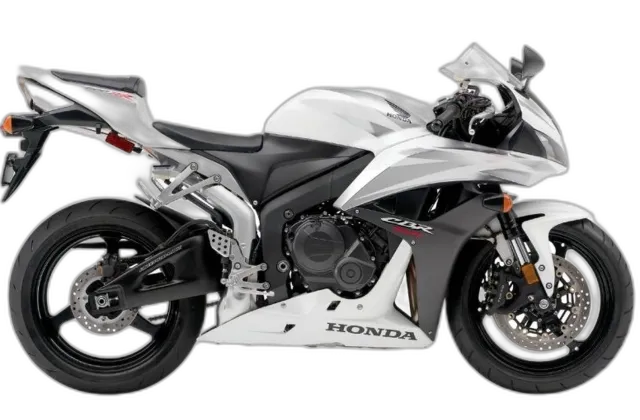
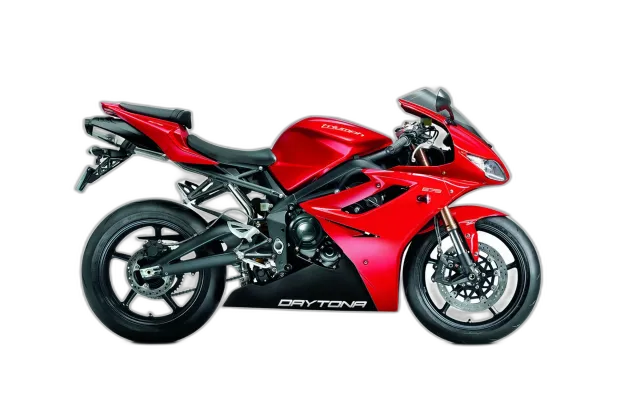
Honda CBR600RR (PC 40) vs Triumph Daytona 675 (D67LC2)
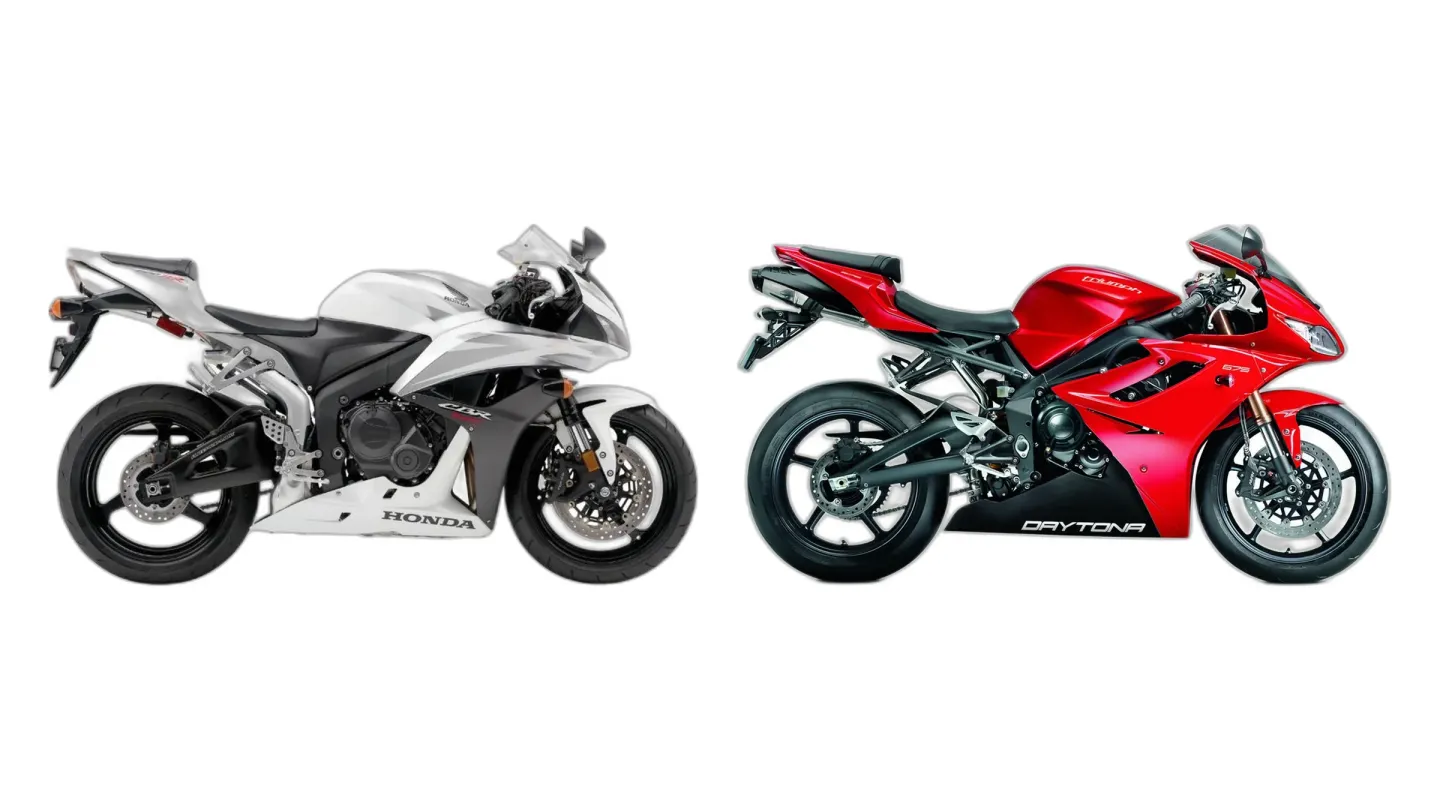
Honda CBR600RR vs Triumph Daytona 675: fast is a given. What sets them apart isn't.
Turn the Honda CBR600RR into a bend a gear high and you won't need to stab downshifts: the engine's still pulling. On the Triumph Daytona 675, you'll feel the slim chassis drop toward the apex the moment you lean. Its bars keep telling you what the front's doing.
So which one do you buy?
The CBR600RR has the edge if…
Keeping running costs low
Small edge: CBR600RR
Running costs lean slightly toward the CBR600RR. A well-kept example of either matters more.
Daily commuting & city riding
Inches ahead: CBR600RR
For the Monday-to-Friday grind, the CBR600RR pulls a nose in front. The difference is simpler maintenance. Your own commute could easily flip it.
Sporty riding on twisty roads
Slight edge: CBR600RR
On a twisty road, the CBR600RR edges ahead. Not by enough to settle it alone.
Racetrack use
By a nose: CBR600RR
For a day at the track, the CBR600RR makes slightly more sense. Tires and suspension setup can easily flip a gap like that.
Which one's the smarter buy
No clear advantage
The Daytona 675 costs less, but that gap doesn't make it the better buy. Neither bike is the clear winner on value.
What makes each one tick
CBR600RR
With its mass packed tight around the engine, the CBR600RR answers a nudge on the clip-ons right away, and it stays steady once it's settled on its line. At 410 lb (186 kg) wet, it's quick to flick from one tight backroad curve to the next. The throttle wakes a four that isn't peaky, with real shove long before the redline. The four hauls off every corner.
Nils rode the CBR600RR in Hungary in 2007, in Qatar in 2008, in Croatia/Dalmatia in 2013, and in Germany in 2017 (NastyNils Testride).
Daytona 675
A triple sits at the heart of the Daytona, with a broad, flat spread of torque that won't make you wring it out to go fast. The brake lever loads a Kayaba fork whose compression damping you can tune for how the nose settles into the stop. Tall pegs and low clip-ons fold you into a racing crouch that's tiring on long street rides. The triple's intake roars.
Nils rode the Daytona 675 in Spain in 2008 (NastyNils Testride).
The Voice of Experience

What actually separates them
- The Daytona 675 makes more peak power: 126 hp (94 kW) vs 121 hp (89 kW).
- The Daytona 675 makes more peak torque: 54 lb-ft (73 Nm) vs 49 lb-ft (66 Nm).
- The Daytona 675 has the larger engine: 675 cc vs 599 cc.
Which one for the way you ride
Comfortable long-distance riding
Look elsewhere
Both of these get tiring on a long day. A proper tourer will treat you better on big miles.
Who each one is built for
What's good, and what you'll live with
CBR600RR
What owners say
Strengths
- Excellent build quality and reliability
- Strong midrange for a supersport
Trade-offs
- Cramped riding position
Daytona 675
What owners say
Strengths
- Addictive exhaust note
- Torquey, characterful inline-triple engine
- High-quality suspension adjustability
Trade-offs
- Cramped supersport ergonomics
- Poor fuel economy for class
Known problems to check before you buy
CBR600RR
- Fuel pump impeller may deform and cause failure Recall 24V864000 A recall covers certain 2007 and 2009-2017 CBR600RR models: improperly molded fuel pump impellers can deform, leading to sudden fuel pump failure and stalling.
Daytona 675
- Indicator stem recall (NHTSA 13V-104) Recall 13V104000 Affected 2012-2013 Daytona 675 models may have defective indicator stems that require replacement. This is a safety recall due to potential loss of turn signal functionality.
- Oil/water heat exchanger failure The oil-to-water heat exchanger can internally fail, allowing coolant and oil to mix. This can lead to engine damage if not caught early. Aftermarket delete kits are popular.
- Regulator/rectifier failure Recall 12V445000 The R/R can overheat, leading to charging system failure and potentially leaving the rider stranded. Covered by NHTSA recall campaign 12V445000 for 2006-2009 models.
- EXUP valve seizing The exhaust valve in the collector box can seize due to corrosion or carbon buildup, triggering the check engine light. Often occurs around 15,000 miles; can be freed by adjustment or removed.
What they cost used
These prices compare a 14-year-old CBR600RR with a 14-year-old Daytona 675.
- CBR600RR
- about $7,300
- Daytona 675
- about $6,100
At 14 years old, the Honda CBR600RR sits around $7,300 while the Triumph Daytona 675 lands near $6,100. That's a $1,200 gap in the Daytona's favor. These are US market estimates, not live listings.
What they share
- Seat height
- 32.3 in (820 mm)
- Cooling
- Liquid-cooled
- Gearbox
- 6-speed
- Final drive
- Chain
- Fork
- Upside-down (USD)
- Front tire
- 120/70-17
- Rear tire
- 180/55-17
Where the spec sheets split
| CBR600RR | Daytona 675 | |
|---|---|---|
| Wet weight | 410 lb (186 kg) | 417 lb (189 kg) |
| CBR600RR | Daytona 675 | |
|---|---|---|
| Displacement | 599 cc | 675 cc |
| Engine | Inline-four | Inline-three |
| Power | 121 hp (89 kW) | 126 hp (94 kW) |
| Peak power at | 13,500 rpm | 12,600 rpm |
| Torque | 49 lb-ft (66 Nm) | 54 lb-ft (73 Nm) |
| Top speed | 158 mph (255 km/h) | 156 mph (251 km/h) |
| CBR600RR | Daytona 675 | |
|---|---|---|
| Fuel capacity | 4.8 US gal (18.2 L) | 4.6 US gal (17.4 L) |
| CBR600RR | Daytona 675 | |
|---|---|---|
| Front brake | 310 mm | 308 mm |
| Wheelbase | 54.1 in (1375 mm) | 54.9 in (1395 mm) |
What comes fitted, what costs extra
| CBR600RR | Daytona 675 | |
|---|---|---|
| ABS | Option (from 2009) | Not offered |
| Quickshifter | Option | Not offered |
Head to head, area by area
Both bikes on the same scale, one area at a time.