By NastyNils·
Motorcycle comparison · Supersport
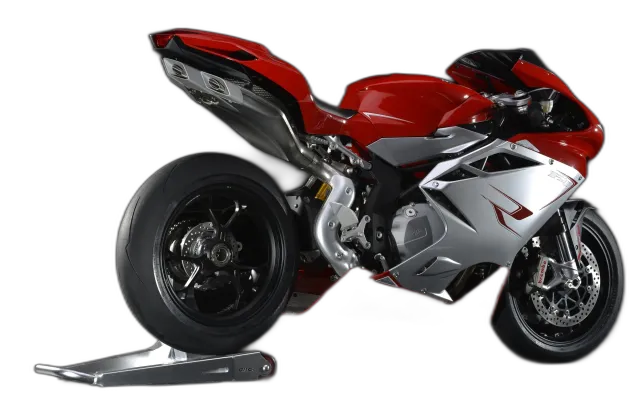
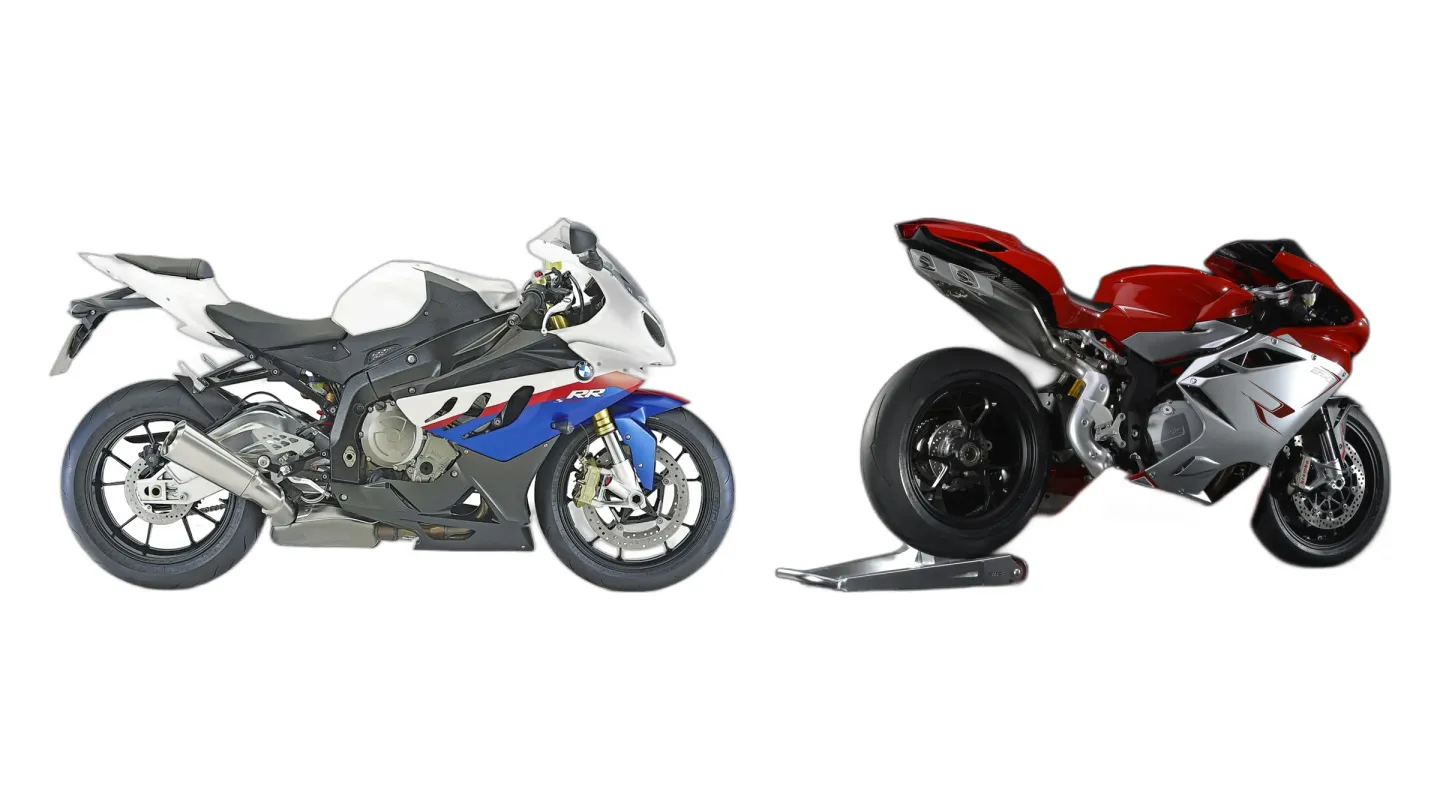
BMW S 1000 RR (K46) vs MV Agusta F4 (MY2014-R)
BMW S 1000 RR vs MV Agusta F4: fast is a given. What sets them apart isn't.
On a wet, dusty road, the BMW S 1000 RR's Rain mode doesn't nag your throttle; it corrects so quietly you'll barely notice. The MV Agusta F4's short-stroke four revs eagerly and doesn't spend its rush early. Near the redline, it's one long surge.
So which one do you buy?
The S 1000 RR has the edge if…
Racetrack use
Edges it: S 1000 RR
Lap after lap, the S 1000 RR noses ahead. Your own riding will make a bigger difference than this gap.
Sporty riding on twisty roads
By a nose: S 1000 RR
The S 1000 RR nudges ahead once the pavement starts to wiggle. Don't expect a night-and-day difference.
Keeping running costs low
Slight edge: S 1000 RR
Day to day, the S 1000 RR works out slightly cheaper to own. The saving is small.
Daily commuting & city riding
Nose ahead: S 1000 RR
On the way to work, the S 1000 RR asks a little less of you. Close enough that the test ride should settle it.
Which one's the smarter buy
Nothing in it on value
At these used prices, neither bike is the clear better buy for the money. The S 1000 RR and the F4 sit too close in cost to separate on value alone.
What makes each one tick
S 1000 RR
Through a long, fast sweeper, the S 1000 RR holds its lean with the front tracking true. The suspension takes a bump mid-arc without upsetting the fork, and you're still on the gas. Downshifts don't click home. Comfort parts soften the perch, not the pace.
Nils rode the S 1000 RR in Portugal in 2009, in Andalusia, Austria, Slovakia, and the Czech Republic in 2010, in Andalusia, Hungary, Slovakia, and the Eifel in 2011, in Andalusia and Spain in 2012, in 2014, in Andalusia in 2015, in Oman & UAE in 2016, and in Qatar in 2017 (NastyNils Testride).
F4
Wound out, the F4's quad exhausts howl. The ride-by-wire fueling stutters with the grip only partly turned and doesn't pick up cleanly. On longer rides the rearsets cramp a taller rider, and the fan won't shut off in slow traffic. Into a bend, the Brembos bite and the front talks.
The Voice of Experience
What actually separates them
- The S 1000 RR has the lower seat: 32.1 in (815 mm) vs 32.7 in (830 mm).
- The S 1000 RR has the lower wet weight: 450 lb (204 kg) vs 463 lb (210 kg).
- ABS: standard on the F4, option on the S 1000 RR.
Which one for the way you ride
A confidence-building first motorcycle
Not built for this
Neither of these is a sensible first motorcycle. Learn on something smaller and lighter, then come back.
Who each one is built for
What's good, and what you'll live with
S 1000 RR
Strengths
- Top End Never Signs Off
- Traction Control That Trims
- Clutchless In Both Directions
- Planted In Fast Sweepers
- Class-leading peak power
Trade-offs
- It Does Not Flick
- Thin Below The Power Band
- City Riding Is Work
- Brake Lever Point Migrates
- Snatchy throttle response (2010–2011)
F4
What owners say
Strengths
- Incredible top‑end power delivery
- Exotic styling and craftsmanship
- Superb front‑end feel and brakes
Trade-offs
- Cramped riding position
- Excessive heat buildup
- Heavy weight compared to rivals
- Non‑linear throttle response
Known problems to check before you buy
S 1000 RR
- Fuel pump flange may crack and leak fuel Recall 20V471000 The pneumatic fastening tool used at the fuel-pump supplier introduced stress at the pump flange during assembly. Over time, cracks can propagate at the flange and fuel can leak — fire risk in the presence of an ignition source. The recall covers MY2010–MY2011 S 1000 RR within a much larger 50,184-unit BMW two-wheel campaign that also covered other BMW Motorrad models. Remedy: dealer reinforces the flange with a support ring or replaces the fuel pump. A follow-up campaign (NHTSA 20V471) replaces fuel pumps that received only the support-ring repair under 13V617.
- Sachs suspension underdamped for spirited / track use (especially 2010) The 2010 Sachs front fork is widely judged underdamped for spirited or track use; damping was improved in 2011 within the same generation. Cartridge re-valving is non-trivial because Sachs uses non-standard shim sizes — most track riders fit aftermarket cartridge kits. The Sachs rear shock is not user-rebuildable, and seal leaks have been reported.
- Quickshifter intermittent or inoperative — wiring/connector at shift sensor Quickshifter stops working intermittently or completely. Documented root cause is most often the wiring or connector at the shift-sensor side rather than the sensor itself; BMW issued a service measure on the shift sensor. Some dealers misdiagnose and replace the sensor unnecessarily before fixing the wiring.
- Balance-pipe / exhaust valve servomotor failure On MY2015–2016 K46 bikes (and some MY2017–2018), the balance-pipe valve servomotor bushing wears, the actuating cables can break, or the servo can seize in the activated position. Symptom: loud clicking on ignition, fault code, valve stuck open or closed. BMW has replaced full header systems under warranty in some documented cases. Aftermarket "servo eliminator" devices (HealTech, Servo Buddy) are common workarounds.
- DDC dashboard error / calibration failure On MY2015–2018 K46 bikes optioned with DDC (Dynamic Damping Control), a "DDC!" dashboard warning or calibration failure can appear. Documented root causes include corroded or loose battery terminals, CAN-bus faults, and rear travel sensor displacement. Often resolves with re-calibration or wiring fix; in some cases the DDC shock has been replaced under warranty.
- Brake judder / pulsing at the lever, mostly under track / hard road use Brake judder reported at the lever after hard use. Community consensus is that the cause is most often uneven pad-material deposit on the stock rotors (rather than true disc warpage), with stock pads judged inadequate for sustained track use. Common owner fix: switch to higher-spec pads (e.g., Brembo Z04) or upgraded discs.
- Cam chain rattle at cold start (cam chain tensioner spring pressure) Loud cam chain rattle, particularly on cold start. BMW issued a service measure that replaces the original BLACK screw plug at the cam chain tensioner with a longer SILVER screw plug to increase tensioner spring pressure. The fix is applied only after approximately 9,300 mi (15,000 km) and only when the symptom is documented. Some owners switch to aftermarket manual cam chain tensioners (e.g., Alpha Racing) for track use. No engine failures attributed to the rattle in documented sources.
- Vibration through tank, handlebars and pegs above 6,000 rpm Distinct vibration through tank, bars, footpegs and mirrors, intensifying past approximately 10,000 rpm. The K46 inline-four has no secondary balancer. Mirrors can blur at sustained high revs.
- Aluminium frame transfers significant heat to rider's inner legs The aluminium twin-spar frame (used as a load-bearing element with the engine inclined into it) transfers significant engine and exhaust heat to the rider's inner legs, particularly in low-speed traffic and warm weather. Documented across all K46 model years. Common owner-installed mitigation: aftermarket carbon frame covers (e.g., Ilmberger).
F4
- Excessive engine heat and fan failure The engine tends to overheat during slow or stationary riding. Plastic cooling fan blades can fail, leading to even higher temps; aftermarket metal blades are a common fix.
What they cost used
These prices compare an 11-year-old S 1000 RR with an 11-year-old F4.
- S 1000 RR
- about $12,300
- F4
- about $12,500
What they share
- Engine
- Inline-four
- Cooling
- Liquid-cooled
- Gearbox
- 6-speed
- Final drive
- Chain
Where the spec sheets split
| S 1000 RR | F4 | |
|---|---|---|
| Seat height | 32.1 in (815 mm) | 32.7 in (830 mm) |
| Wet weight | 450 lb (204 kg) | 463 lb (210 kg) |
| S 1000 RR | F4 | |
|---|---|---|
| Displacement | 999 cc | 998 cc |
| Power | 199 hp (146 kW) | 195 hp (143 kW) |
| Peak power at | 13,500 rpm | 13,600 rpm |
| Torque | 83 lb-ft (113 Nm) | 82 lb-ft (111 Nm) |
| Peak torque at | 10,500 rpm | 9,600 rpm |
| S 1000 RR | F4 | |
|---|---|---|
| Fuel capacity | 4.6 US gal (17.5 L) | 4.5 US gal (17 L) |
| S 1000 RR | F4 | |
|---|---|---|
| Front tire | 120/70 ZR17 | 120/70-17 |
| Rear tire | 190/55 ZR17 | 200/55-17 |
What comes fitted, what costs extra
| S 1000 RR | F4 | |
|---|---|---|
| ABS | Option | Standard |
| Wheelie Control | Option | Standard |
| Quickshifter | Option | Not offered |
Head to head, area by area
Both bikes on the same scale, one area at a time.