By NastyNils·
Motorcycle comparison · Sport Tourer
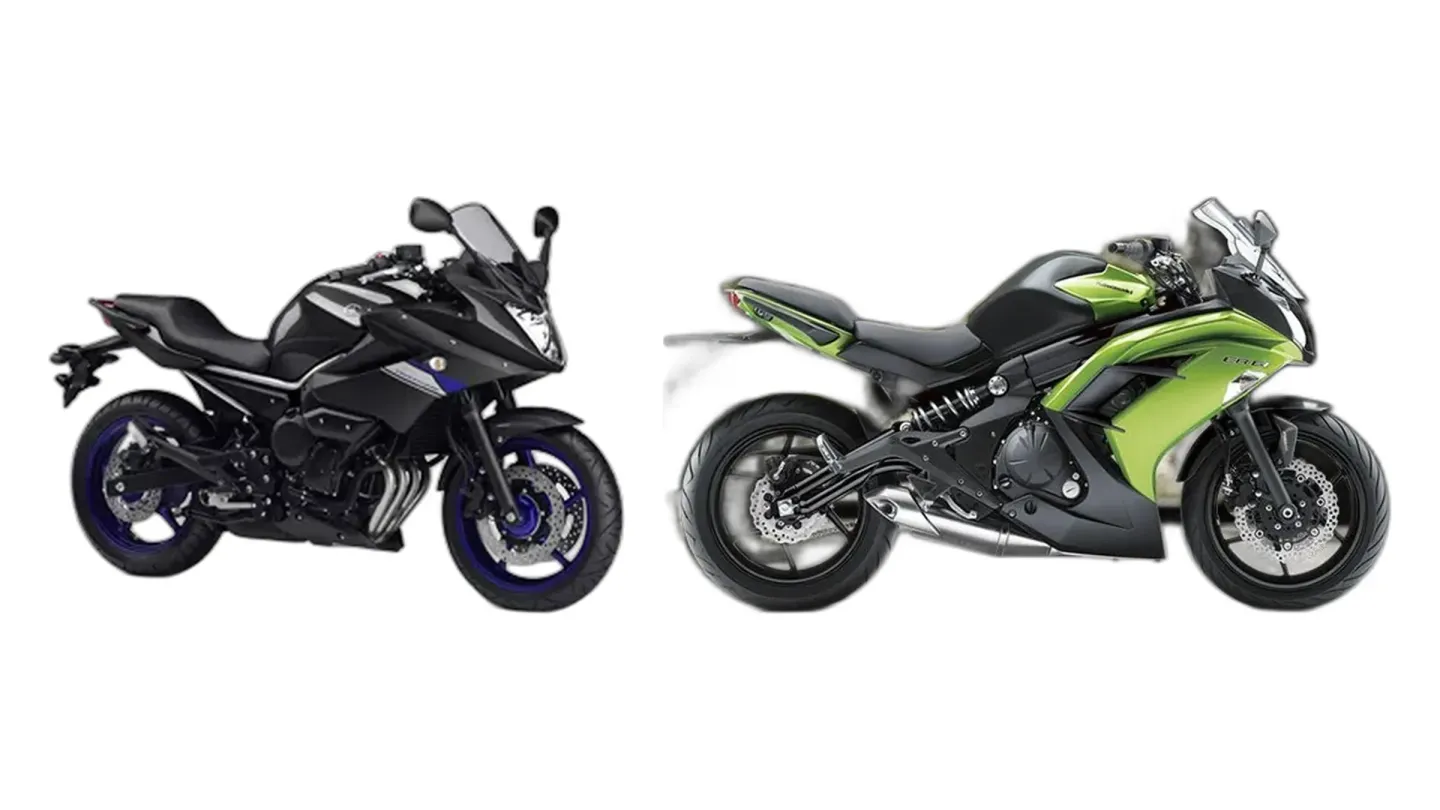
Yamaha XJ6 Diversion (MY2009) vs Kawasaki ER-6f (ER6f-MY2006)
Yamaha XJ6 Diversion vs Kawasaki ER-6f: which one you'd rather spend the big miles on.
You'll feel the Yamaha XJ6 Diversion's soft fork wallow as you tip into a tight corner, and the shock doesn't hold it still either. The Kawasaki ER-6f's front end turns in at a nudge of the bar. Its long swingarm holds the line through the arc.
So which one do you buy?
The ER-6f has the edge if…
Sporty riding on twisty roads
By a nose: ER-6f
The ER-6f nudges ahead once the pavement starts to wiggle. Don't expect a night-and-day difference.
Keeping running costs low
Narrow edge: ER-6f
Day to day, the ER-6f works out slightly cheaper to own. The saving is small.
A confidence-building first motorcycle
Slight edge: ER-6f
Learning the ropes leans slightly toward the ER-6f. Your own comfort on it should come first.
Daily commuting & city riding
Inches ahead: ER-6f
On the way to work, the ER-6f asks a little less of you. The difference is simpler maintenance and easier maneuvering in tight spots. Close enough that the test ride should settle it.
What makes each one tick
XJ6 Diversion
Crawling through traffic, the XJ6 Diversion's inline-four pulls without fuss from low revs, and the light clutch lever doesn't fight back. A bump sends the rear bobbing. The budget suspension bounces off broken pavement and won't settle on rolling roads. Its low-end torque tugs it clean off every stoplight.
Nils rode the XJ6 Diversion in Australia in 2009 (NastyNils Testride).
ER-6f
Behind the ER-6f's fairing, the bar sits upright and the narrow waist pulls your knees in close. A twist of the throttle wakes the twin, and it's got a solid shove through the middle revs. The trellis frame snaps through bends.
Nils rode the ER-6f in Sicily in 2006 (NastyNils Testride).
The Voice of Experience

What actually separates them
- The ER-6f has the lower wet weight: 441 lb (200 kg) vs 465 lb (211 kg).
- The XJ6 Diversion makes more peak power: 78 hp (57 kW) vs 72 hp (53 kW).
- The ER-6f makes more peak torque: 47 lb-ft (64 Nm) vs 44 lb-ft (60 Nm).
Which one for the way you ride
Call it even on long days. Choose on fit, price and the one that makes you grin.
Who each one is built for
What's good, and what you'll live with
XJ6 Diversion
What owners say
Strengths
- Smooth, refined inline-four engine
Trade-offs
- Basic, underdamped suspension
ER-6f
What owners say
Strengths
- Lively and flexible parallel-twin engine
- Excellent value for money
- Frugal fuel economy
Known problems to check before you buy
XJ6 Diversion
- Exhaust collector box rust The collector box under the engine is a known corrosion hotspot prone to rusting through and causing exhaust gas leaks.
ER-6f
- Frame cracking at engine mounts (early models) On early models, the high-tensile steel trellis frame can develop stress cracks around the upper engine mounting brackets due to engine vibration and mounting stress.
What they share
- Seat height
- 30.9 in (785 mm)
- Cooling
- Liquid-cooled
- Gearbox
- 6-speed
- Final drive
- Chain
- Fork
- Telescopic
- Front tire
- 120/70-17
- Rear tire
- 160/60-17
Where the spec sheets split
| XJ6 Diversion | ER-6f | |
|---|---|---|
| Wet weight | 465 lb (211 kg) | 441 lb (200 kg) |
| XJ6 Diversion | ER-6f | |
|---|---|---|
| Displacement | 600 cc | 649 cc |
| Engine | Inline-four | Parallel twin |
| Power | 78 hp (57 kW) | 72 hp (53 kW) |
| Peak power at | 10,000 rpm | 8,500 rpm |
| Torque | 44 lb-ft (60 Nm) | 47 lb-ft (64 Nm) |
| XJ6 Diversion | ER-6f | |
|---|---|---|
| Fuel capacity | 4.6 US gal (17.3 L) | 4.1 US gal (15.5 L) |
| XJ6 Diversion | ER-6f | |
|---|---|---|
| Front brake | 298 mm | 300 mm |
Head to head, area by area
Both bikes on the same scale, one area at a time.