By NastyNils·
Motorcycle comparison · Scooter
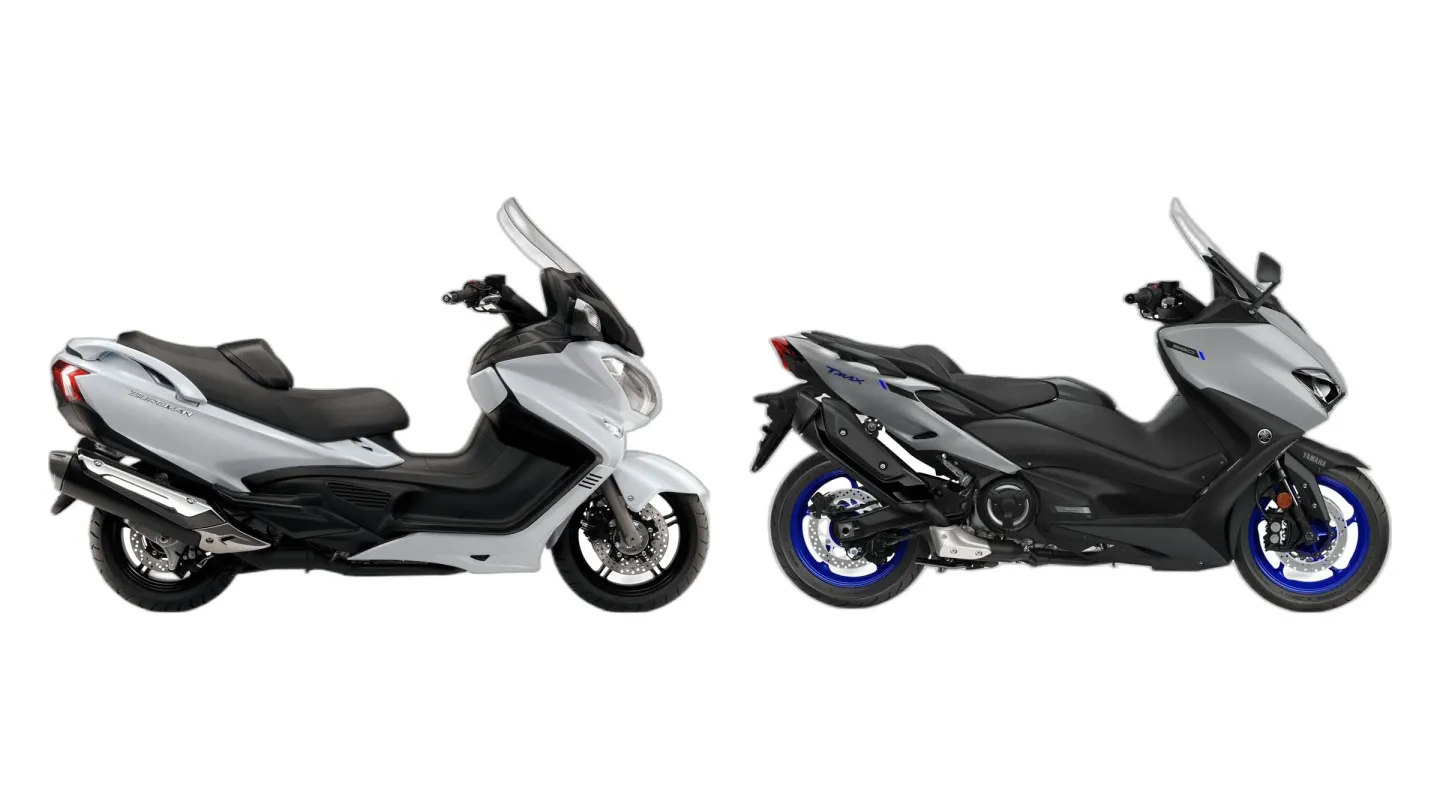
Suzuki Burgman 650 (MY2013) vs Yamaha TMAX 560 (MY2020)
Suzuki Burgman 650 vs Yamaha TMAX 560: which one to buy for your commute.
Rolling off a stoplight, the Suzuki Burgman 650's throttle pulls smooth and even, and it's never straining. The Yamaha TMAX 560 slingshots off that same twist.
So which one do you buy?
The Burgman 650 has the edge if…
Comfortable long-distance riding
Nose ahead: Burgman 650
The Burgman 650 nudges ahead once the miles pile up. Still, it's a narrow gap.
The TMAX 560 has the edge if…
Daily commuting & city riding
Small edge: TMAX 560
The TMAX 560 makes slightly more sense as a commuter. That comes from friendlier manners. Don't read much into a gap this small.
Sporty riding on twisty roads
Narrow edge: TMAX 560
On a winding road, the TMAX 560 comes out a touch ahead. What tips it: a sportier chassis and more feel through the bars. You wouldn't bet much on a gap like that.
What makes each one tick
Burgman 650
Cold mornings show the Burgman 650's touring side, because the adjustable backrest sets you where the seat heater reaches your lower back. There's a more urgent machine behind the power button, with revs climbing at once and the transmission kicking back. Fast corners with a rough surface find its touring ceiling, and the bike doesn't pretend otherwise. Corner entry wakes the chassis up.
Nils rode the Burgman 650 in the Odenwald in 2013, and in the Odenwald in 2026 (NastyNils Testride).
TMAX 560
Hard cornering brings the TMAX 560 alive, yet it hasn't lost its commuting roots. The belt-driven CVT doesn't shake or lag, and the power comes on evenly. The aluminum frame holds the arc.
The Voice of Experience

What actually separates them
- The Burgman 650 has the lower seat: 29.5 in (750 mm) vs 31.5 in (800 mm).
- The TMAX 560 has the lower wet weight: 485 lb (220 kg) vs 611 lb (277 kg).
- The Burgman 650 makes more peak power: 55 hp (40 kW) vs 48 hp (35 kW).
Which one for the way you ride
A confidence-building first motorcycle
No verdict: Burgman 650
Too much motor for a beginner: the Burgman 650 sits this one out.
These two run dead level on running costs. Sit on both in the showroom and trust what your body says.
Who each one is built for
What's good, and what you'll live with
Burgman 650
Strengths
- Storage for real life
- Weather simply stays out
- A seat you settle into
- Transmission modes that matter
- Sharper than it looks
Trade-offs
- Bumpy fast corners
- Cockpit feels a tier below
- Fiddly trip computer access
- Nowhere to mount a phone
- Soft, wallowy suspension
TMAX 560
What owners say
Strengths
- Strong acceleration off the line
- Surprisingly sporty handling for a scooter
- Excellent underseat storage
- Smooth and responsive CVT transmission
What they share
- Engine
- Parallel twin
- Cooling
- Liquid-cooled
- Fuel capacity
- 4.0 US gal (15 L)
- Front tire
- 120/70-15
Where the spec sheets split
| Burgman 650 | TMAX 560 | |
|---|---|---|
| Seat height | 29.5 in (750 mm) | 31.5 in (800 mm) |
| Wet weight | 611 lb (277 kg) | 485 lb (220 kg) |
| Burgman 650 | TMAX 560 | |
|---|---|---|
| Displacement | 638 cc | 562 cc |
| Power | 55 hp (40 kW) | 48 hp (35 kW) |
| Peak power at | 7,000 rpm | 7,500 rpm |
| Torque | 46 lb-ft (62 Nm) | 41 lb-ft (56 Nm) |
| Peak torque at | 5,000 rpm | 5,250 rpm |
| Burgman 650 | TMAX 560 | |
|---|---|---|
| Fork | Telescopic | Upside-down (USD) |
| Front brake | 260 mm | 267 mm |
| Rear tire | 160/60-14 | 160/60-15 |
What comes fitted, what costs extra
| Burgman 650 | TMAX 560 | |
|---|---|---|
| Traction Control | Not offered | Standard |
| Manually Adjustable Rear Suspension | Standard | Not offered |
| Smartphone Connectivity | Not offered | Option |
| Keyless System | Not offered | Standard |
| Luggage System | Not offered | Option |
Head to head, area by area
Both bikes on the same scale, one area at a time.