By NastyNils·
Motorcycle comparison · Retro Classic vs Naked Bike
Kawasaki Z 900 RS (MY2018) vs Z900 (MY2020)
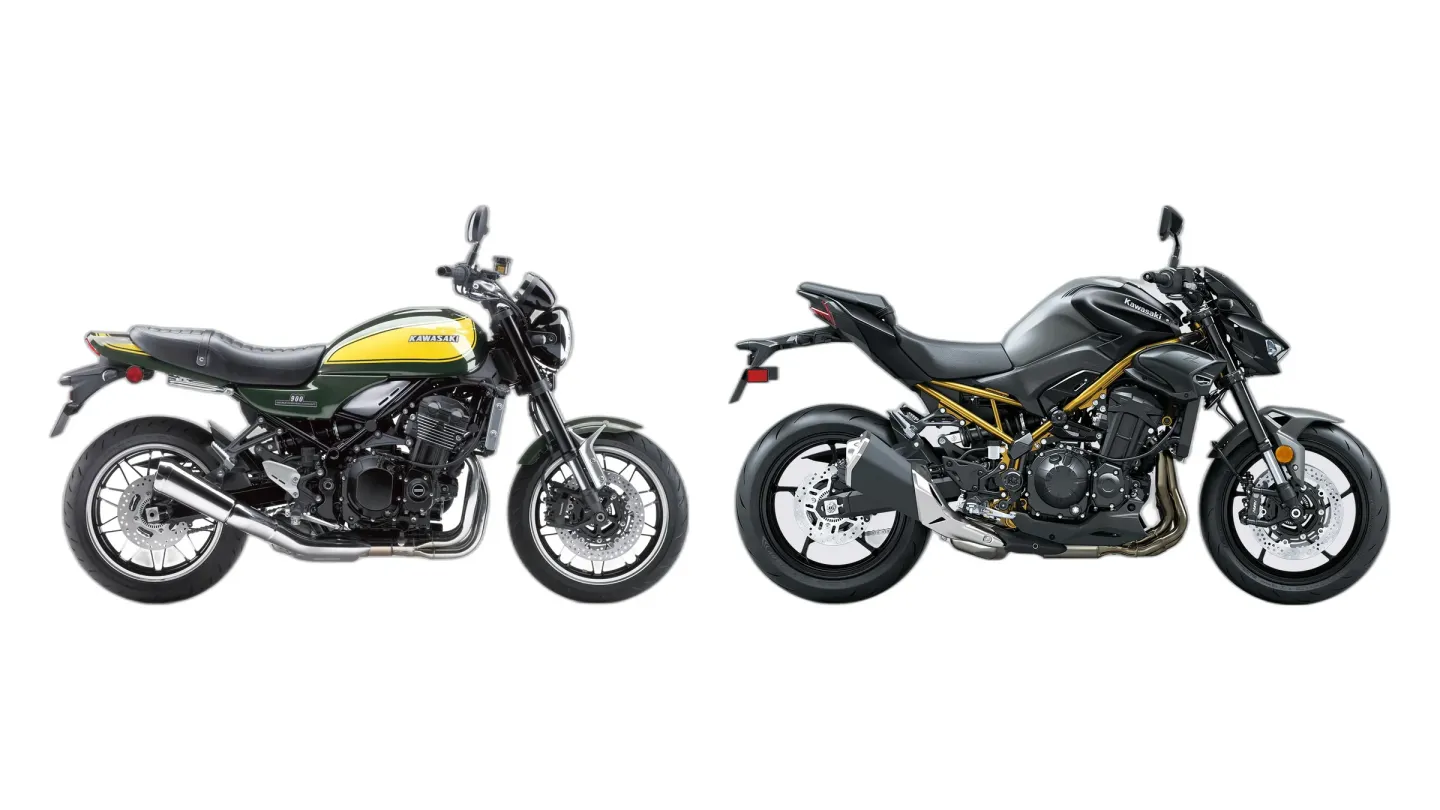
Kawasaki Z 900 RS vs Z900: where they split, and which one to buy.
Turning into a quick bend, the Kawasaki Z 900 RS doesn't dawdle behind its classic bodywork. The Kawasaki Z900 tips in and holds its line.
So which one do you buy?
The Z 900 RS has the edge if…
Traveling with luggage
By a nose: Z 900 RS
Loaded for the road, the Z 900 RS comes out a touch ahead. Credit a better passenger seat. Don't read too much into a gap this narrow.
The Z900 has the edge if…
Daily commuting & city riding
Narrow edge: Z900
Through rush hour, the Z900 is a little easier to live with. Only a little.
What makes each one tick
Z 900 RS
Wide bars and an upright reach to the pegs keep you sitting tall on the Z 900 RS, yet there's room to slide around and work the grips hard. Its fork keeps talking through a long run of mountain switchbacks, and the chassis doesn't lose its steady rhythm. The rear shock doesn't take a sharp bump as gently as the front end does. Two-up at night, it'll still steer.
Nils rode the Z 900 RS in Styria and Switzerland in 2018, and in Austria and Montenegro in 2024 (NastyNils Testride).
Z900
Past the low revs, the Z900's inline-four pulls hard with a surge in the middle, and it'll keep spinning willingly to the limiter. Down low, there's a snatch in the throttle. Out of a corner the front wheel goes light, yet the bars don't twitch and the chassis keeps pointing at the exit. The rear tire bites and drives.
Nils rode the Z900 in Austria and Switzerland in 2020 (NastyNils Testride).
The Voice of Experience

What actually separates them
- The Z900 has the lower seat: 31.5 in (800 mm) vs 32.9 in (835 mm).
- The Z900 makes more peak power: 125 hp (92 kW) vs 111 hp (82 kW).
- Ride Modes: standard on the Z900, not offered on the Z 900 RS.
Which one for the way you ride
A confidence-building first motorcycle
Both fall short
If this is your first motorcycle, keep looking. Neither one makes learning easy.
On twisty roads and running costs, these two are a wash. That's where your budget and your inseam get the final say.
Who each one is built for
What's good, and what you'll live with
Z 900 RS
Strengths
- Torque from the basement
- Built for long days
- Tall-rider friendly ergonomics
- Fully adjustable at both ends
- Faster than it looks
Trade-offs
- Rear shock thumps sharp hits
- Loose through transitions
- No quickshifter offered
- No wind protection
- Stock seat uncomfortable on long rides
Z900
Strengths
- Approachable Or Fast, Your Call
- Proven Over Months Of Testing
- Brakes Beat Their Spec Sheet
- Seat Fits A Wide Range
- Planted, Precise Chassis
Trade-offs
- Handlebar Too Thin
- Menus Fight Back
- Firm In Daily Traffic
- Snatchy Throttle Down Low
- No wind protection
Known problems to check before you buy
Z 900 RS
- Front tire may develop internal blistering (Sumitomo manufacturing defect) Due to a defective manufacturing process during sidewall rubber installation, the front tire may develop blistering on the inner surface. A tire with internal blistering can fail and increase crash risk. Tire supplier: Sumitomo Rubber Industries, Ltd. Non-compliant with FMVSS 119. Affects only MY2024 Z900RS ABS, Z900RS Café ABS, and Z900RS SE ABS.
- Rear brake line and ABS wheel speed sensor cable can contact rear tire During factory assembly, the rear brake line and wheel speed sensor cable may have been incorrectly routed, allowing them to contact the rear tire. This can damage the brake line (brake fluid loss, reduced braking performance) or sever the ABS sensor cable (ABS failure, incorrect speedometer reading). Affects both Z900 and Z900RS MY2018.
- ABS hydraulic unit contaminated with aluminum shavings The ABS hydraulic unit may have been contaminated with aluminum shavings during manufacturing (defective fixture shaving ABS pump housing). This can cause the front or rear wheel to lock up during braking despite ABS. Affects MY2019 Z900RS ABS and Z900RS Café ABS.
- False neutrals and clunky/agricultural shift action The gearbox occasionally misses shifts, especially during quick upshifts. Most frequently reported between 5th and 6th gear, but also from neutral to 1st when departing. Downshifts are agricultural and clunky. Higher-quality engine oil and correct shift lever position can alleviate the problem. Design-inherent, not an isolated defect — known from the Z900 platform, confirmed for the Z900RS.
- Front brake lacks sharp initial bite, spongy lever feedback Despite radial-mount four-piston Nissin calipers, the front brake lacks direct, firm initial bite. The lever feel is indirect, especially during aggressive downhill braking. Braided steel lines and higher-performance brake pads significantly improve feel. The SE model (from MY2022) with Brembo M4.32 calipers and braided steel lines resolves this issue from the factory.
- ABS activates prematurely, especially on front brake The Nissin ABS unit activates prematurely, especially at the front brake during harder braking. The ABS is not deactivatable on any 2018–2024 model year. This reduces confidence during aggressive braking and trail braking. The ABS kicks in earlier than desired.
- Footpegs scrape tarmac at moderate cornering speeds The lower and further-forward footpeg position (compared to Z900) combined with the factory-soft rear suspension setting (minimum preload from factory) causes the footpegs to scrape the road at moderate cornering speeds. The short feeler pegs ("Angstnippel") wear down quickly. Solution: increase rear shock preload by 3–5 turns.
- Snatchy, on-off throttle response at low RPM (ECU mapping) The Z900RS exhibits abrupt, jerky throttle behavior at low RPM and low speeds, particularly when rolling on throttle from closed, departing from standstill, and during gentle gas application in corners. The fuel-cut programming (overrun fuel cutoff for emissions compliance) causes abrupt injection on/off behavior. The dual throttle valve system (sub-throttle servo) with cable-operated main throttle exacerbates the issue. The problem is most pronounced on MY2018–2019 models. Common remedies: ECU reflash (e.g., Ivan's Performance), throttle cable adjustment. Later model years show improvement according to multiple sources.
- Engine revs to 2,500–4,000 rpm on cold start On cold start, the engine revs up to 2,500–4,000 rpm to bring the catalytic converter to operating temperature faster (Euro 4/5 emissions compliance). This is particularly intrusive in residential areas. It is not a defect but a deliberate ECU calibration for emissions standards. Some owners report occasional stalling during warm-up phase.
- Clutch judder/shudder when cold during takeoff The clutch exhibits pronounced judder when cold during engagement into first gear. Multiple owners report the problem partially persists after warm-up. Some dealers consider this normal behavior. Possible remedies: soak clutch plates in oil overnight (dealer recommendation), use higher-quality engine oil. The clutch judder when cold is a widely documented complaint.
Z900
- Base Model Suspension Struggles with Spirited Riding and Heavier Riders The standard suspension—KYB USD fork with no compression damping adjustment—dives excessively under hard braking. The rear shock sags during acceleration. It proves inadequate for heavier riders (200+ lb) and two-up riding. The setup is designed primarily for commuting and medium-speed riding. The 2022 SE with Öhlins S46 dampers and improved fork solves these issues.
- False Neutrals and Clunky Transmission The transmission occasionally misses shifts, especially during quick upshifts above ~6,000 rpm. Most frequent between 2nd-3rd and 3rd-4th gears. Design-related play in the shift linkage. Downshifts described as clunky. Issue carried over from previous model—engine and transmission are carry-over parts.
- Front ABS intervenes prematurely under hard braking The ABS calibration is conservative and tends to intervene early, particularly at the front wheel under hard braking or over bumpy and uneven surfaces. Riders feel pulsing at the brake lever and a lengthened stop before the tire has reached its real grip limit. The system has a single fixed calibration that does not change with the selected riding mode, and there is no rider-selectable ABS-off function, so the early intervention is present at all times.
- Snatchy/Jerky Throttle Response at Low RPM The Z900 exhibits jerky, on/off-like throttle response at low RPM and speeds, particularly in 1st and 2nd gear. The motorcycle lurches when holding a constant low speed. Improved compared to the 2017-2019 generation, but not resolved. The first degree of throttle turn has a sharp snatch that disrupts smooth application, and snatchy low-speed throttle manners persist. Caused by emissions-related ECU tuning, not a mechanical defect.
- Unstable Bluetooth Connection, App Crashes, Pairing Issues The Kawasaki Rideology app (for the TFT display) exhibits recurring Bluetooth connectivity issues on both iOS and Android. Pairing drops after restarting the motorcycle, particularly with Android/Samsung devices. In rare cases, the cockpit's Bluetooth chip fails entirely, requiring instrument cluster replacement. App update 2.8.2 added a requirement for internet connectivity during the Bluetooth handshake.
- Turn Signal Mount Rubber Inserts Become Brittle and Break The rubber inserts holding the stock turn signals in the body become brittle and break, causing the signals to hang loose on their wires. Vibration and UV radiation accelerate deterioration. OEM replacement turn signals also fail within 1–2 years. Affects multiple Kawasaki models of the same design, not just the Z900.
- Idle RPM Decreases Over Time, Causing Rough Running Idle RPM gradually decreases over time, resulting in rough idle, stumbling, and occasional stalling. Some owners report idle RPM dropping below 1,000. Cold-start idle can climb to 2,500 rpm. Possible solutions include idle RPM adjustment, ECU software update, and fuel quality verification.
- OEM Front Brake Pads Wearing Out Faster Than Expected The stock sintered brake pads wear out during normal use after approximately 8,000–10,000 miles until reaching the wear limit. Inner pads wear faster than outer pads.
- Surface Corrosion on Stock Steel Screws and Fasteners Stock steel screws and fasteners develop surface rust, especially in humid or coastal climates. Kawasaki uses standard steel fasteners instead of stainless steel or coated hardware.
- Rear brake line and ABS wheel speed sensor cable can contact rear tire During factory assembly, the rear brake line and wheel speed sensor cable may have been incorrectly routed, allowing them to contact the rear tire. This can damage the brake line (brake fluid loss, reduced braking performance) or sever the ABS sensor cable (ABS failure, incorrect speedometer reading). Affects both Z900 and Z900RS MY2018.
- False neutrals and clunky/agricultural shift action The gearbox occasionally misses shifts, especially during quick upshifts. Most frequently reported between 5th and 6th gear, but also from neutral to 1st when departing. Downshifts are agricultural and clunky. Higher-quality engine oil and correct shift lever position can alleviate the problem. Design-inherent, not an isolated defect — known from the Z900 platform, confirmed for the Z900RS.
- Footpegs scrape tarmac at moderate cornering speeds The lower and further-forward footpeg position (compared to Z900) combined with the factory-soft rear suspension setting (minimum preload from factory) causes the footpegs to scrape the road at moderate cornering speeds. The short feeler pegs ("Angstnippel") wear down quickly. Solution: increase rear shock preload by 3–5 turns.
What they cost used
These prices compare a 4-year-old Z 900 RS with a 4-year-old Z900.
- Z 900 RS
- $10,000
- Z900
- $7,500
At four years old, the Kawasaki Z 900 RS sits around $10,000 while the Kawasaki Z900 lands near $7,500. That's a $2,500 gap in the Z900's favor. These figures come from earlier US market records, not live listings.
What they share
- Displacement
- 948 cc
- Engine
- Inline-four
- Cooling
- Liquid-cooled
- Fuel economy
- 44 mpg (US) / 5.3 L/100 km
- Fuel capacity
- 4.5 US gal (17 L)
- Gearbox
- 6-speed
- Final drive
- Chain
- Fork
- Upside-down (USD)
- Front tire
- 120/70-17
- Rear tire
- 180/55-17
Where the spec sheets split
| Z 900 RS | Z900 | |
|---|---|---|
| Seat height | 32.9 in (835 mm) | 31.5 in (800 mm) |
| Wet weight | 474 lb (215 kg) | 467 lb (212 kg) |
| Z 900 RS | Z900 | |
|---|---|---|
| Power | 111 hp (82 kW) | 125 hp (92 kW) |
| Torque | 73 lb-ft (98 Nm) | 73 lb-ft (99 Nm) |
| Top speed | 139 mph (224 km/h) | 153 mph (246 km/h) |
| Z 900 RS | Z900 | |
|---|---|---|
| Wheelbase | 57.9 in (1470 mm) | 57.3 in (1455 mm) |
What comes fitted, what costs extra
| Z 900 RS | Z900 | |
|---|---|---|
| Ride Modes | Not offered | Standard |
| TFT Display | Not offered | Standard |
| Smartphone Connectivity | Not offered | Standard |
| Heated Grips | Option | Not offered |
Head to head, area by area
Both bikes on the same scale, one area at a time.