By NastyNils·
Motorcycle comparison · Naked Bike
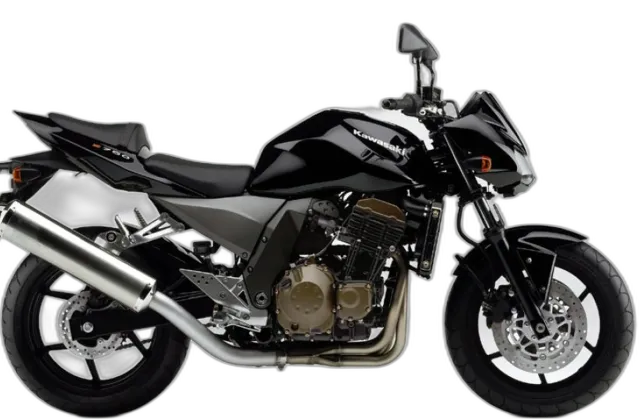
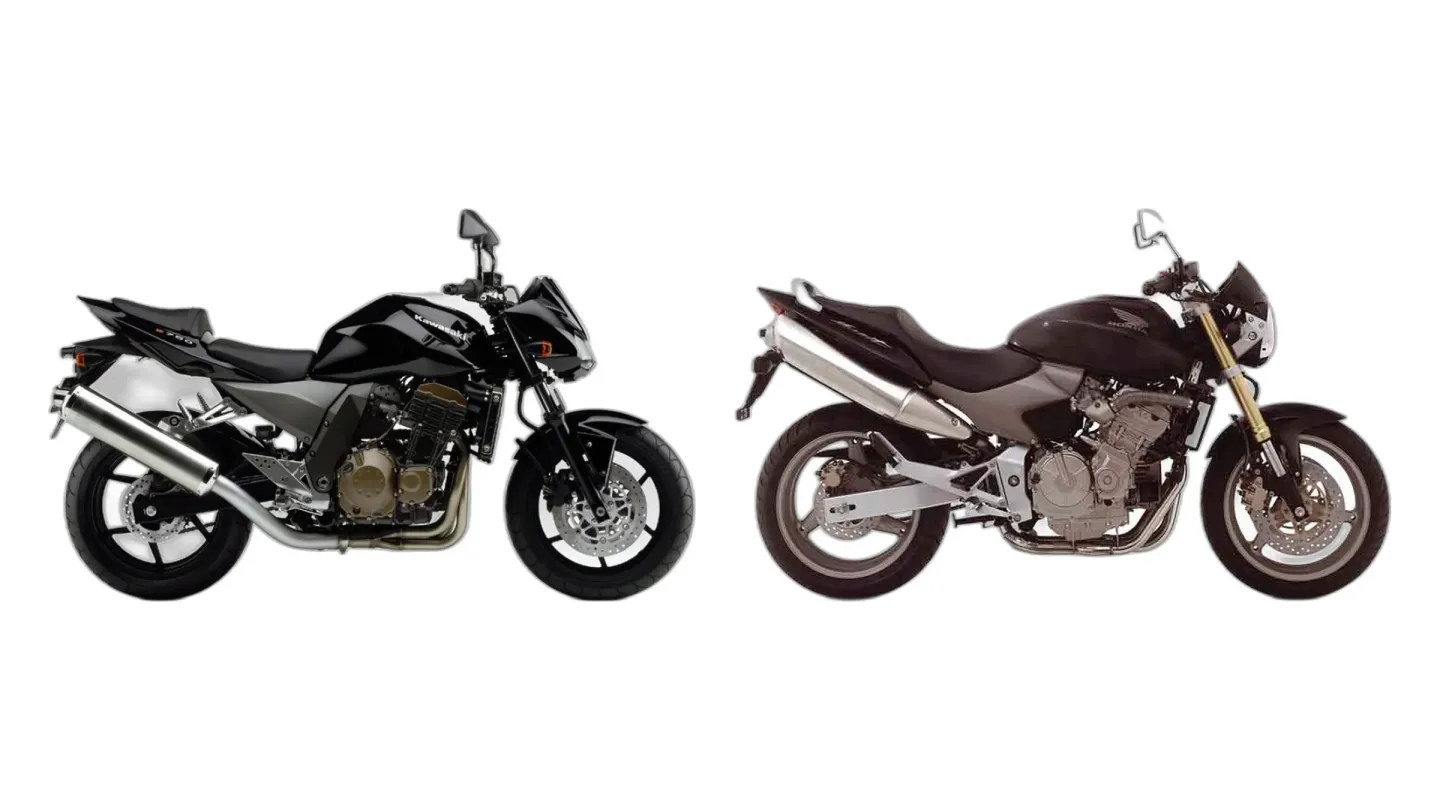
Kawasaki Z750 (MY2004) vs Honda CB600F Hornet (PC36)
Kawasaki Z750 vs Honda CB600F Hornet: which one's easier to live with every day.
Deep in the midrange, the Kawasaki Z750 already pulls hard, and it's still climbing into a top-end rush. Down there, the Honda CB600F Hornet hangs back and won't respond with any urgency. Wound up tight, it finally comes alive.
So which one do you buy?
The Z750 has the edge if…
Sporty riding on twisty roads
A touch ahead: Z750
Through a string of corners, the Z750 feels a little more eager. Put it down to harder acceleration. The gap is small, so ride both.
What makes each one tick
Z750
Light bars and a stiff frame let the Z750 flick from bend to bend on the Angeles Crest Highway. A sharp bump exposes the suspension. The soft fork sinks while the rear shock kicks back harshly, and the bike won't settle at high pace or with a heavier rider aboard. Its superbike-bred four can't wait to rev.
CB600F Hornet
Forgiving manners shape every mile on the CB600F Hornet, and a sloppy line into a bend doesn't throw it off. A pinned throttle keeps the four spinning eagerly toward its power peak at 12,000 rpm. The CBR lineage shows up there. Its bar threads the Monday commute through city traffic.
The Voice of Experience

What actually separates them
- The CB600F Hornet has the lower seat: 31.1 in (790 mm) vs 32.1 in (815 mm).
- The CB600F Hornet has the lower wet weight: 437 lb (198 kg) vs 481 lb (218 kg).
- The Z750 makes more peak power: 110 hp (81 kW) vs 97 hp (71 kW).
Which one for the way you ride
Comfortable long-distance riding
Not built for this
Big miles aren't where either one shines. You'll be watching for the next rest stop.
A confidence-building first motorcycle
Neither is a natural fit
If this is your first motorcycle, keep looking. Neither one makes learning easy.
Traveling with luggage
Neither one fits
Loading up for a long trip isn't a strength of either bike. Expect to compromise on what you bring.
They come out level on commuting. The better-kept used example is the smarter money.
Who each one is built for
What's good, and what you'll live with
Z750
What owners say
Strengths
- Rev-happy, superbike-derived engine
- Outstanding value for performance
Trade-offs
- Budget suspension lacks composure
- Adequate but wooden front brakes
- Prone to cosmetic corrosion
- Uncomfortable seat for longer trips
CB600F Hornet
What owners say
Strengths
- Rev-happy engine with sporty potential
- Low running costs
Trade-offs
- Low power at low RPM
- Basic suspension (2002–2004)
- Poor wind protection
Known problems to check before you buy
Z750
No confirmed faults on file yet. That's not the same as fault-free.
CB600F Hornet
- Automatic cam chain tensioner failure The stock automatic cam chain tensioner can wear and fail. Symptom: rattling/clattering when closing the throttle while warm. Widely cited as the most well-known problem of the Hornet series. Aftermarket solutions (manual cam chain tensioners) are common.
- Radiator fan not engaging; overheating tendency The thermostat-controlled radiator fan can fail due to a blown fuse (10A under seat), temperature sensor defect, or fan motor failure. Leads to overheating in stop-and-go traffic. Low coolant from neglected maintenance exacerbates the problem.
- Voltage regulator/rectifier failure The regulator/rectifier can fail, causing charging problems (battery not charging or overcharging). Symptoms: dead battery, blown bulbs, fluctuating voltage. Heat-related, as it is mounted close to the engine. This is a known cross-generational Honda problem, not specific to the PC36 but documented for it.
- Sticking float needle valves in carburetors The float chamber needle valves can stick, causing excessive fuel consumption or fuel overflow. Occurs particularly after extended storage. Requires carburetor cleaning.
- Surface corrosion on lower triple clamp The lower triple clamp is prone to surface corrosion with year-round use and road salt exposure. Not a structural problem, but visually noticeable and progressive if maintenance is neglected.
What they share
- Engine
- Inline-four
- Cooling
- Liquid-cooled
- Gearbox
- 6-speed
- Final drive
- Chain
Where the spec sheets split
| Z750 | CB600F Hornet | |
|---|---|---|
| Seat height | 32.1 in (815 mm) | 31.1 in (790 mm) |
| Wet weight | 481 lb (218 kg) | 437 lb (198 kg) |
| Z750 | CB600F Hornet | |
|---|---|---|
| Displacement | 748 cc | 599 cc |
| Power | 110 hp (81 kW) | 97 hp (71 kW) |
| Peak power at | 10,500 rpm | 12,000 rpm |
| Torque | 55 lb-ft (75 Nm) | 46 lb-ft (63 Nm) |
| Peak torque at | 8,200 rpm | 9,500 rpm |
| Top speed | 138 mph (222 km/h) | 142 mph (229 km/h) |
| Z750 | CB600F Hornet | |
|---|---|---|
| Fuel economy | 35 mpg (US) / 6.73 L/100 km | 36 mpg (US) / 6.5 L/100 km |
| Fuel capacity | 4.8 US gal (18 L) | 4.5 US gal (17 L) |
| Z750 | CB600F Hornet | |
|---|---|---|
| Fork | Telescopic | Upside-down (USD) |
| Front brake | 300 mm | 296 mm |
| Front tire | 120/70-17 | 120/70-ZR17 |
| Rear tire | 180/55-17 | 180/55-ZR17 |
Head to head, area by area
Both bikes on the same scale, one area at a time.