By NastyNils·
Motorcycle comparison · Naked Bike
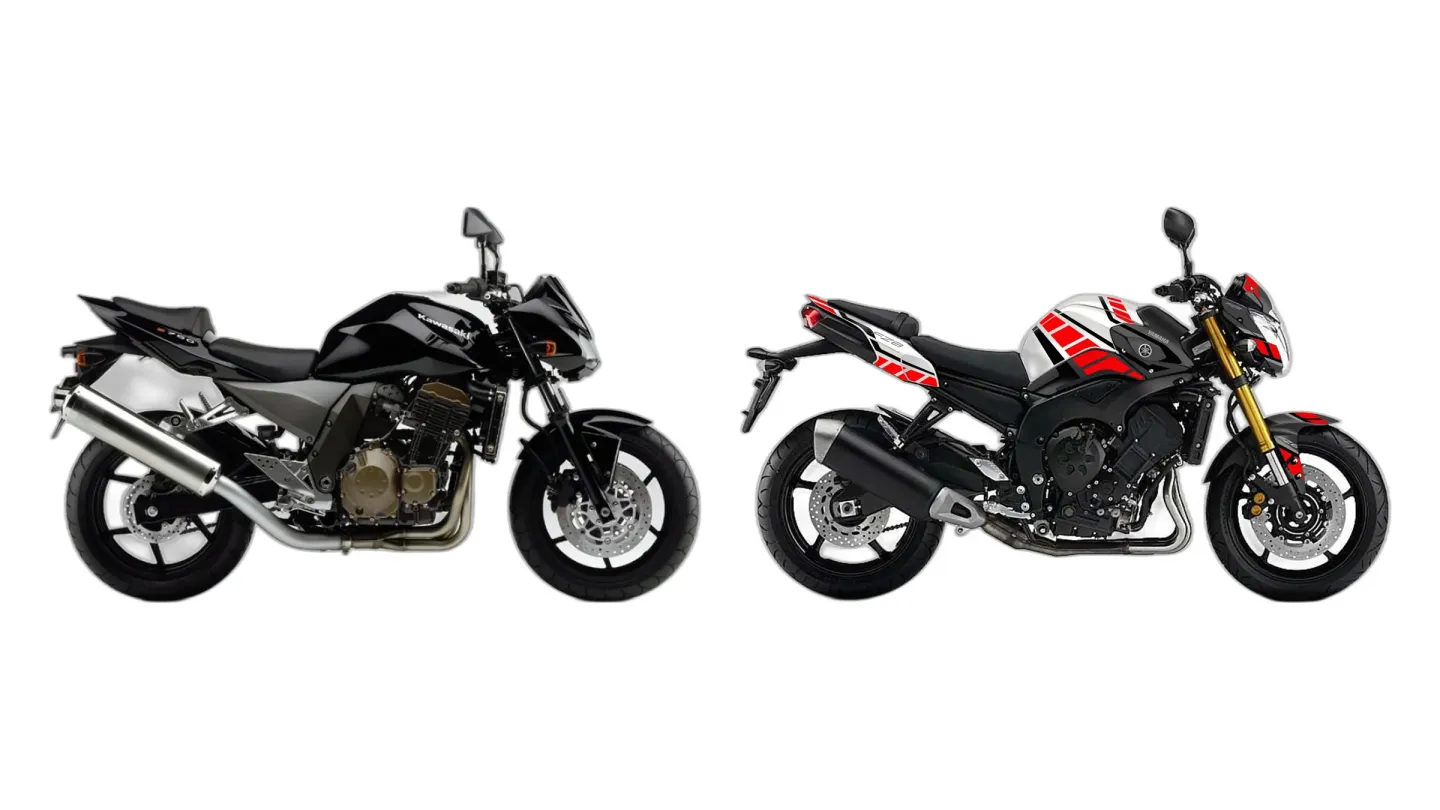
Kawasaki Z750 (MY2004) vs Yamaha FZ-8N (MY2010)
Kawasaki Z750 vs Yamaha FZ-8N: which one to buy, and what actually separates them.
Tip into a tight bend on the Kawasaki Z750 and the light bars pull its nose in while the stiff frame doesn't flex. The Yamaha FZ-8N steers in quick, then holds its arc.
So which one do you buy?
The Z750 has the edge if…
Daily commuting & city riding
Small edge: Z750
The Z750 edges it for the daily grind. It's a small gap, not a reason on its own.
Sporty riding on twisty roads
By a nose: Z750
Back-road fun leans slightly toward the Z750. Most of that is harder acceleration. It's a narrow call, so trust your test ride.
The FZ-8N has the edge if…
Traveling with luggage
Slight edge: FZ-8N
On a multi-day trip, the FZ-8N makes slightly more sense. That comes from a better reliability record. Small difference, and the right luggage can close it.
What makes each one tick
Z750
There's a superbike-derived four in the Z750 that revs with an appetite rival middleweights can't match. The brake lever feels wooden on the first squeeze, and the two-piston calipers won't bite hard until there's heat in them. Ridden normally, they stop fine. The top end arrives in one hard rush.
FZ-8N
Smoothness comes first in the FZ-8N's detuned four, which builds power in an even line you can read well ahead. The throttle gets a mild answer, and the motor doesn't swell through the middle or wake up near redline. Its power never catches you out. The front end darts through city traffic.
The Voice of Experience

What actually separates them
- The FZ-8N has the lower wet weight: 465 lb (211 kg) vs 481 lb (218 kg).
- The FZ-8N makes more peak torque: 60 lb-ft (82 Nm) vs 55 lb-ft (75 Nm).
- The Z750 has the larger fuel tank: 4.8 US gal (18 L) vs 4.5 US gal (17 L).
Which one for the way you ride
Comfortable long-distance riding
Both miss here
Neither one is built for long-haul comfort. For big miles, look at a proper tourer or sport tourer.
A confidence-building first motorcycle
Neither is a natural fit
For a brand-new rider, both are the wrong place to start. Learn the basics on a smaller bike first.
Who each one is built for
What's good, and what you'll live with
Z750
What owners say
Strengths
- Rev-happy, superbike-derived engine
- Outstanding value for performance
Trade-offs
- Budget suspension lacks composure
- Adequate but wooden front brakes
- Prone to cosmetic corrosion
- Uncomfortable seat for longer trips
FZ-8N
What owners say
Strengths
- Affordable entry into the middleweight naked class
Trade-offs
- Engine feels strangled and lacks excitement
What they share
- Seat height
- 32.1 in (815 mm)
- Engine
- Inline-four
- Cooling
- Liquid-cooled
- Gearbox
- 6-speed
- Final drive
- Chain
- Front tire
- 120/70-17
- Rear tire
- 180/55-17
Where the spec sheets split
| Z750 | FZ-8N | |
|---|---|---|
| Wet weight | 481 lb (218 kg) | 465 lb (211 kg) |
| Z750 | FZ-8N | |
|---|---|---|
| Displacement | 748 cc | 779 cc |
| Power | 110 hp (81 kW) | 106 hp (78 kW) |
| Peak power at | 10,500 rpm | 10,000 rpm |
| Torque | 55 lb-ft (75 Nm) | 60 lb-ft (82 Nm) |
| Peak torque at | 8,200 rpm | 8,000 rpm |
| Top speed | 138 mph (222 km/h) | 143 mph (230 km/h) |
| Z750 | FZ-8N | |
|---|---|---|
| Fuel capacity | 4.8 US gal (18 L) | 4.5 US gal (17 L) |
| Z750 | FZ-8N | |
|---|---|---|
| Fork | Telescopic | Upside-down (USD) |
| Front brake | 300 mm | 310 mm |
What comes fitted, what costs extra
| Z750 | FZ-8N | |
|---|---|---|
| ABS | Not offered | Option |
| Manually Adjustable Front Suspension | Not offered | Standard (from 2013) |
Head to head, area by area
Both bikes on the same scale, one area at a time.