By NastyNils· ·
Motorcycle comparison · Hyper Naked vs Naked Bike
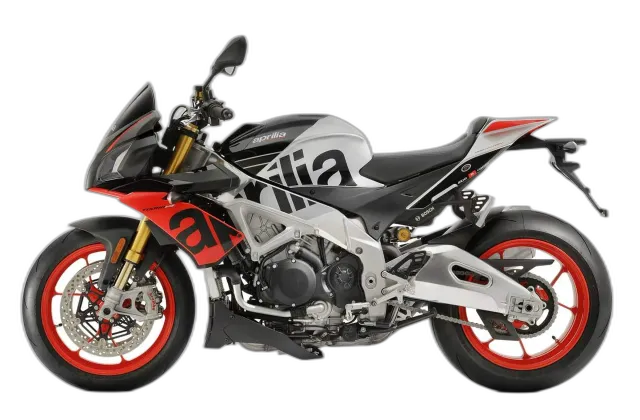
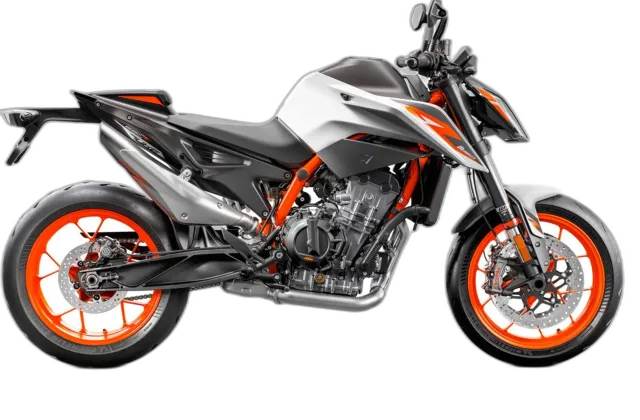
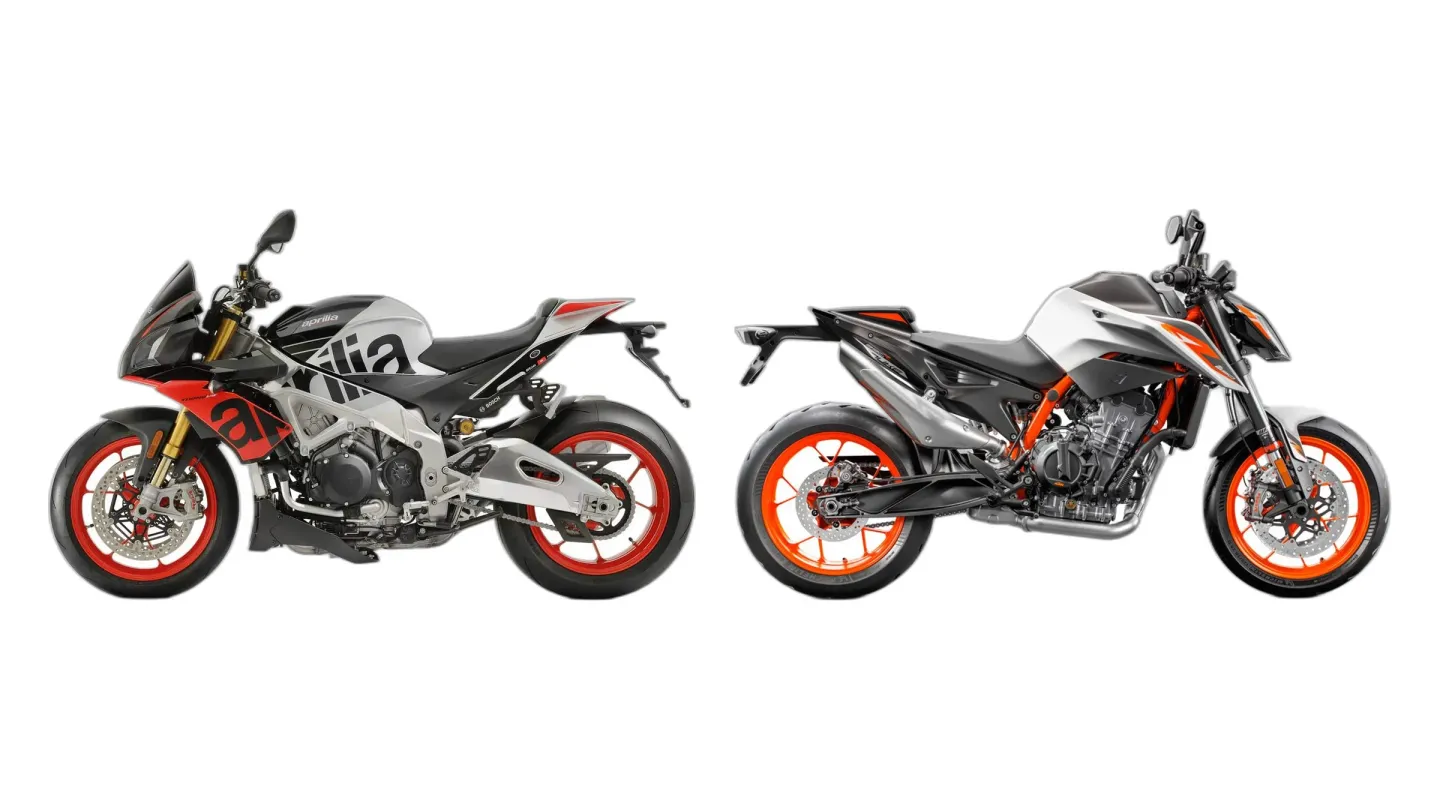
Aprilia Tuono V4 1100 (ZD4KZ-Factory) vs KTM 890 Duke R (MY2020)
Aprilia Tuono V4 1100 vs KTM 890 Duke R: no fairing, no excuses. Here's how to pick.
Rolling off a closed throttle, the Aprilia Tuono V4 1100 hangs right on your wrist, and it's still easy to meter the pull in Race mode. The KTM 890 Duke R's engine wants to be wound hard in a chassis that's all business. You finish the session still craving more.
So which one do you buy?
The 890 Duke R has the edge if…
Riding two-up with a passenger
Edges it: 890 Duke R
Two-up, the 890 Duke R edges it. Small margin.
Daily commuting & city riding
A touch ahead: 890 Duke R
On the way to work, the 890 Duke R asks a little less of you. Most of that is simpler maintenance and friendlier manners. Close enough that the test ride should settle it.
Which one's the smarter buy
Two different jobs
The Tuono V4 1100 and the 890 Duke R do different jobs, so neither is the clear better buy for the money.
What makes each one tick
Tuono V4 1100
On the Angeles Crest Highway's fast sweepers, the Tuono's chassis picks a line and won't let go of it. Off the brake lever and into the turn, the front tire talks back and there's no wallow through the transition. The slimmer tank opens room to move around the seat while the small screen keeps the bike steady at speed. The V4's exhaust howls deep.
Nils rode the Tuono V4 1100 in Hungary and Italy in 2021 (NastyNils Testride).
890 Duke R
There's a V-twin-like pulse in the 890 Duke R's twin as it thumps from low revs. Wind it out and eventually it just stops being interesting. Wheelie control and traction control are handled independently, and Track mode lets you dial in the TC level that suits your tires and conditions. Corner entry is where it's at its sharpest: the front turns in light and settles neutral mid-corner. The bar stays still on exit.
Nils rode the 890 Duke R in Austria and Hungary in 2020, and in 2021 (NastyNils Testride).
The Voice of Experience
What actually separates them
- The Tuono V4 1100 makes more peak power: 175 hp (129 kW) vs 121 hp (89 kW).
- The Tuono V4 1100 makes more peak torque: 89 lb-ft (121 Nm) vs 73 lb-ft (99 Nm).
- The Tuono V4 1100 has the larger engine: 1077 cc vs 889 cc.
Which one for the way you ride
Comfortable long-distance riding
Wrong job for both
Big miles aren't where either one shines. You'll be watching for the next rest stop.
Traveling with luggage
Both miss here
Saddlebags and long trips don't suit these two. They're better at day rides.
Look at twisty roads and you'll find two bikes doing the same job equally well. Fit is what breaks the tie.
Who each one is built for
What's good, and what you'll live with
Tuono V4 1100
Strengths
- Throttle You Can Actually Feel
- Rear Steers You To The Apex
- Faster Without More Horsepower
- Slim Tank, Real Room
- Planted Through Fast Sweepers
Trade-offs
- Too Loud For Long Days
- More Plastic Than A Naked Wants
- Runs Hot In City Traffic
- Soft, Uneven Low-Rpm Power
- Build quality below class standard
890 Duke R
Strengths
- Turn-in reads your mind
- Superbike brakes, featherweight bike
- Midrange that shoves
- Electronics that enable
- Genuinely competitive on track
Trade-offs
- Built for sport, not comfort
- Bars buzz at highway pace
- Top end runs dry early
- Quickshifter stiffened under load
- Excessive heat radiation in slow traffic
Known problems to check before you buy
Tuono V4 1100
- High coolant temperatures and overheating tendency at low speeds The Euro 5 Tuono runs very hot in slow city traffic and when idling at traffic lights, because the radiator and fan cannot shed enough heat without steady airflow. Coolant temperature climbs into the warning range and stays high until the bike is moving at a sustained pace again. Owners report having to switch the engine off during long stops to keep temperatures under control.
- Dog wear in 3rd and 4th gear with intensive quickshifter use With frequent quickshifter use under full throttle and high rpm, the dogs in 3rd and 4th gear wear faster than normal. False neutrals then occur between 3rd/4th and 4th/5th gear. Aprilia has hardened replacement parts available for 3rd and 4th gear. The problem has been documented since the V4 platform and is also confirmed for Euro 5.
- Valve guide failure requiring cylinder head replacement An exhaust valve guide in the rear cylinder can work loose or detach, resulting in substantial loss of cylinder compression during leak-down testing and severe engine power loss resembling an electronic limp mode.
- Noticeable power deficit and uneven throttle response in the lower rpm range The Euro 5 mapping causes a measurable power gap below 5,500 rpm. Throttle response at 4,000-5,500 rpm feels uneven/pulsating. When transitioning from 5-15% throttle to closed throttle, the engine can react jerkily. An Aprilia Race Map or Rapid Bike tuning kit largely resolves the problem.
- Soft paintwork, scratch-prone surfaces, corroding fasteners The paintwork is described as extremely scratch-prone — without adequate clear coat. Graphics/decals in some areas have no clear coat and are quickly damaged by stone chips. Fasteners and washers (particularly mudguard mountings) are not stainless and show early corrosion. Body panels do not fit precisely and have visible panel gaps.
890 Duke R
- OEM front brake disc warping / pulsing Front brake rotors (Galfer OEM discs) warping, causing pulsing/juddering when braking. Some owners report discs warped from factory. Replaced under warranty in many cases. Some owners switch to aftermarket discs (e.g., MetalGear) with better results. The issue concerns the Galfer discs, not the Brembo Stylema calipers themselves.
- Valve cover gasket oil weep Slow oil seepage occurs from the valve cover gasket, particularly at the half-moon sections. The weeping is most evident during high operating temperatures or after spirited riding.
- Countershaft sprocket seal oil seep Oil leaks from behind the front sprocket cover on the left side, originating from the countershaft seal. Symptoms range from minor seeping to dripping that can reach the drive chain and rear tire.
- Thermostat housing / coolant system seep Coolant seeps or leaks from the plastic thermostat housing or the hose connections at the cylinder head water fitting, typically caused by narrow original hose clamps, a fragile plastic housing, or improperly sealed cooling hoses.
What they cost used
These prices compare a 3-year-old Tuono V4 1100 with a 3-year-old 890 Duke R.
- Tuono V4 1100
- $13,700
- 890 Duke R
- $8,500
At three years old, the Aprilia Tuono V4 1100 sits around $13,700 while the KTM 890 Duke R lands near $8,500. That's a $5,200 gap in the KTM's favor. These are recorded figures from the US used market, not live listings.
What they share
- Cooling
- Liquid-cooled
- Gearbox
- 6-speed
- Final drive
- Chain
- Fork
- Upside-down (USD)
- Front tire
- 120/70-17
Where the spec sheets split
| Tuono V4 1100 | 890 Duke R | |
|---|---|---|
| Seat height | 32.5 in (825 mm) | 32.8 in (834 mm) |
| Tuono V4 1100 | 890 Duke R | |
|---|---|---|
| Displacement | 1077 cc | 889 cc |
| Engine | V4 | Parallel twin |
| Power | 175 hp (129 kW) | 121 hp (89 kW) |
| Peak power at | 11,350 rpm | 9,250 rpm |
| Torque | 89 lb-ft (121 Nm) | 73 lb-ft (99 Nm) |
| Peak torque at | 9,000 rpm | 7,750 rpm |
| Top speed | 168 mph (270 km/h) | 153 mph (246 km/h) |
| Tuono V4 1100 | 890 Duke R | |
|---|---|---|
| Fuel economy | 28 mpg (US) / 8.5 L/100 km | 50 mpg (US) / 4.74 L/100 km |
| Fuel capacity | 4.7 US gal (17.9 L) | 3.7 US gal (14 L) |
| Tuono V4 1100 | 890 Duke R | |
|---|---|---|
| Front brake | 330 mm | 320 mm |
| Rear tire | 200/55-17 | 180/55-17 |
| Wheelbase | 57.5 in (1460 mm) | 58.3 in (1482 mm) |
What comes fitted, what costs extra
| Tuono V4 1100 | 890 Duke R | |
|---|---|---|
| Wheelie Control | Standard | Option |
| Launch Control | Standard | Option |
| Electronic Suspension | Standard | Not offered |
| Cruise Control | Standard | Option |
| Quickshifter | Standard | Option |
| Tire Pressure Monitoring (TPMS) | Not offered | Option |
| Heated Grips | Not offered | Option |
Head to head, area by area
Both bikes on the same scale, one area at a time.