By NastyNils·
Motorcycle comparison · Cruiser vs Naked Bike
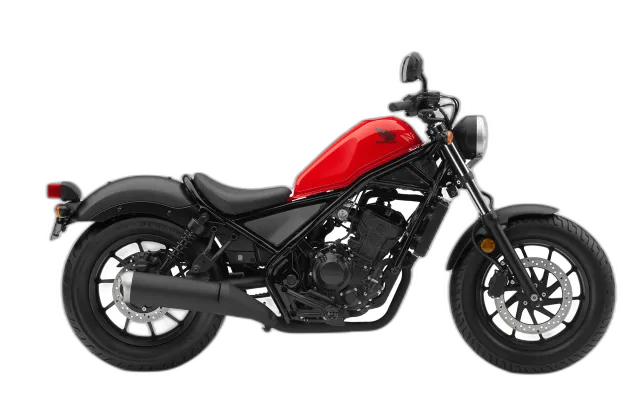
Honda Rebel 300 (CMX300) vs CB300R (Gen1)
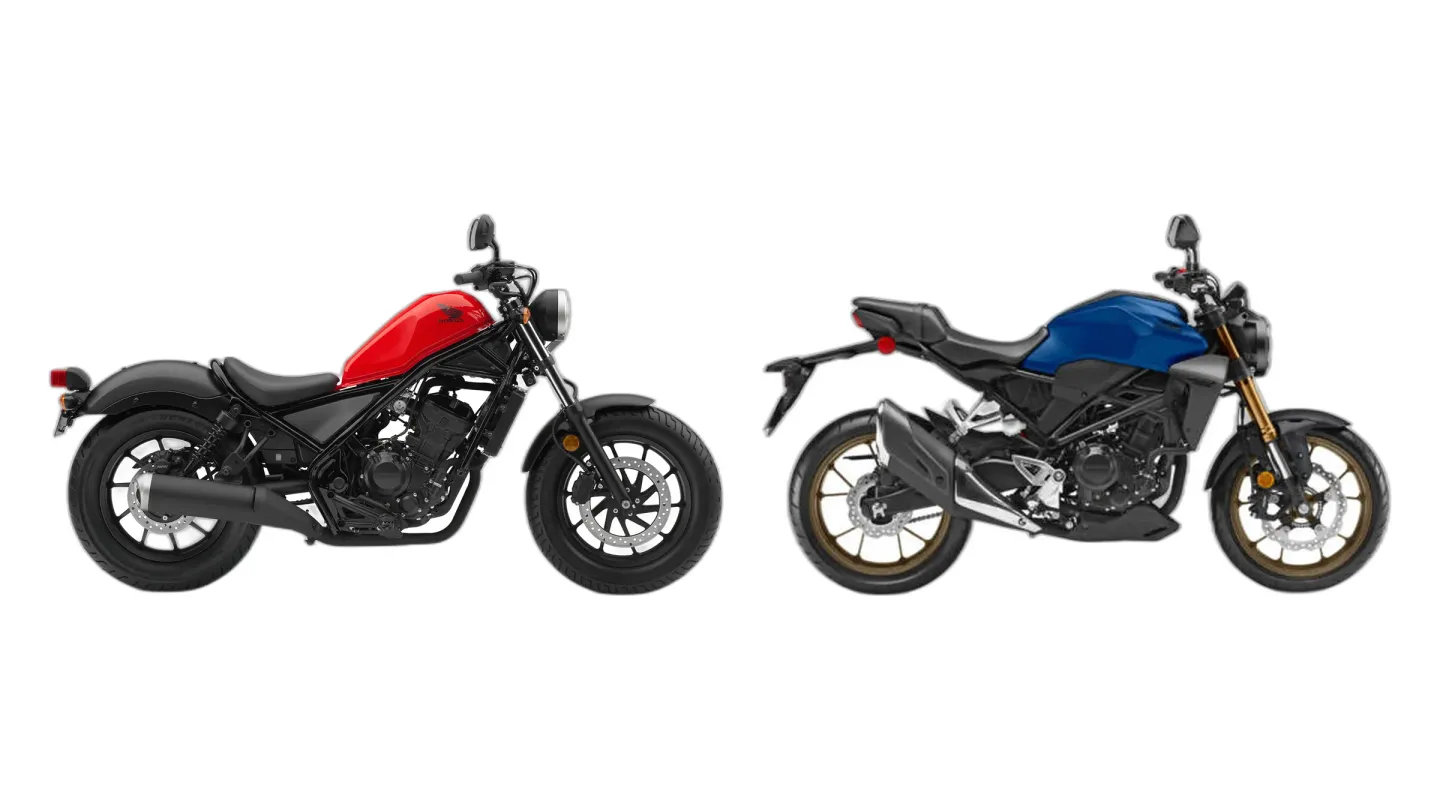
Honda Rebel 300 vs CB300R: different classes, one choice. Here's how to make it.
At the first tight turn-in, the Honda Rebel 300 sits low and doesn't fight you as it leans over. The Honda CB300R flicks over at the slightest bar nudge.
So which one do you buy?
Buy the CB300R if…
Daily commuting & city riding
Gets the nod: CB300R
The CB300R earns its keep in weekday traffic better than the other one. The difference is lighter steering and easier everyday riding. For a daily commuter, it's the clear choice.
The CB300R has the edge if…
Sporty riding on twisty roads
Edges it: CB300R
The CB300R is a touch more fun when the road starts bending. What tips it: a sportier chassis and more feel through the bars.
A confidence-building first motorcycle
Nose ahead: CB300R
For your first season, the CB300R makes slightly more sense. Thank more comfort and easier controls for that. Fit and confidence at a standstill still come first.
What makes each one tick
Rebel 300
Low at 27.2 in (690 mm), the Rebel 300's saddle puts the pavement close, and its low center of gravity lets it thread crowded streets at walking pace. On the interstate there's little steam left in the engine. Passing doesn't come without a downshift. In town, the throttle snaps the single awake down low.
CB300R
On the Bay Area Ridge Roads, the CB300R carries only 315 lb (143 kg) on a short wheelbase, and it's quick to swap sides through a chain of bends. There's nothing sudden in the counterbalanced single's pull as the revs climb. The brake lever works a radial Nissin caliper, hardware the entry-level class rarely sees. The bare cockpit keeps eyes forward.
The Voice of Experience

What actually separates them
- The Rebel 300 has the lower seat: 27.2 in (690 mm) vs 31.5 in (801 mm).
- The CB300R has the lower wet weight: 315 lb (143 kg) vs 364 lb (165 kg).
- The CB300R makes more peak power: 31 hp (23 kW) vs 27 hp (20 kW).
Which one for the way you ride
Comfortable long-distance riding
Not their thing
Both of these get tiring on a long day. A proper tourer will treat you better on big miles.
Don't look for a gap on running costs: there isn't one. Go by how each one fits you.
Who each one is built for
What's good, and what you'll live with
Rebel 300
What owners say
Strengths
- Approachable for all riders
- Customizable, modern bobber style
- Low maintenance, Honda reliability
- Peppy, fuel-efficient engine
Trade-offs
- Seat becomes uncomfortable on longer rides
- Underwhelming highway performance
- Soft suspension limits cornering
CB300R
What owners say
Strengths
- Lightweight, flickable handling
- Approachable, beginner-friendly power
Known problems to check before you buy
Rebel 300
- Right crankcase cover plug may leak (recall 23V-261) Recall 23V261000 On certain 2023 models, improper painting of the press-fit plug hole can cause the plug to dislodge when the engine heats up, leading to oil spraying onto the exhaust or rear tire.
- Honda accessory tank pads peeling The adhesive-backed accessory tank pads can lift or peel from the fuel tank in hot weather.
CB300R
- Headlight may flicker or shut off (safety recall) Recall 25V210000 A manufacturing defect in the headlight assembly's internal circuitry can cause flickering or total failure due to vibration. Honda issued a safety recall (NHTSA 25V210) for 2018–2025 models to replace the headlight.
- Loud chain noise on new bikes Some owners report excessive chain noise early in ownership, possibly due to improper adjustment or a quality defect.
What they cost used
These prices compare a 5-year-old Rebel 300 with a 5-year-old CB300R.
- Rebel 300
- $3,900
- CB300R
- $4,400
At five years old, the Honda Rebel 300 sits around $3,900 while the Honda CB300R runs about $4,400. That's a $500 gap in the Rebel 300's favor. These figures come from earlier US market records, not live listings.
What they share
- Displacement
- 286 cc
- Engine
- Single-cylinder
- Cooling
- Liquid-cooled
- Torque
- 20 lb-ft (27 Nm)
- Gearbox
- 6-speed
- Final drive
- Chain
- Front brake
- 296 mm
Where the spec sheets split
| Rebel 300 | CB300R | |
|---|---|---|
| Seat height | 27.2 in (690 mm) | 31.5 in (801 mm) |
| Wet weight | 364 lb (165 kg) | 315 lb (143 kg) |
| Rebel 300 | CB300R | |
|---|---|---|
| Power | 27 hp (20 kW) | 31 hp (23 kW) |
| Peak power at | 8,000 rpm | 9,000 rpm |
| Peak torque at | 6,000 rpm | 7,500 rpm |
| Rebel 300 | CB300R | |
|---|---|---|
| Fuel capacity | 3.0 US gal (11.2 L) | 2.6 US gal (9.8 L) |
| Rebel 300 | CB300R | |
|---|---|---|
| Fork | Telescopic | Upside-down (USD) |
| Front tire | 130/90-16 | 110/70-17 |
| Rear tire | 150/80-16 | 150/60-17 |
| Wheelbase | 58.7 in (1491 mm) | 53.2 in (1352 mm) |
What comes fitted, what costs extra
| Rebel 300 | CB300R | |
|---|---|---|
| ABS | Option | Standard |
Head to head, area by area
Both bikes on the same scale, one area at a time.