
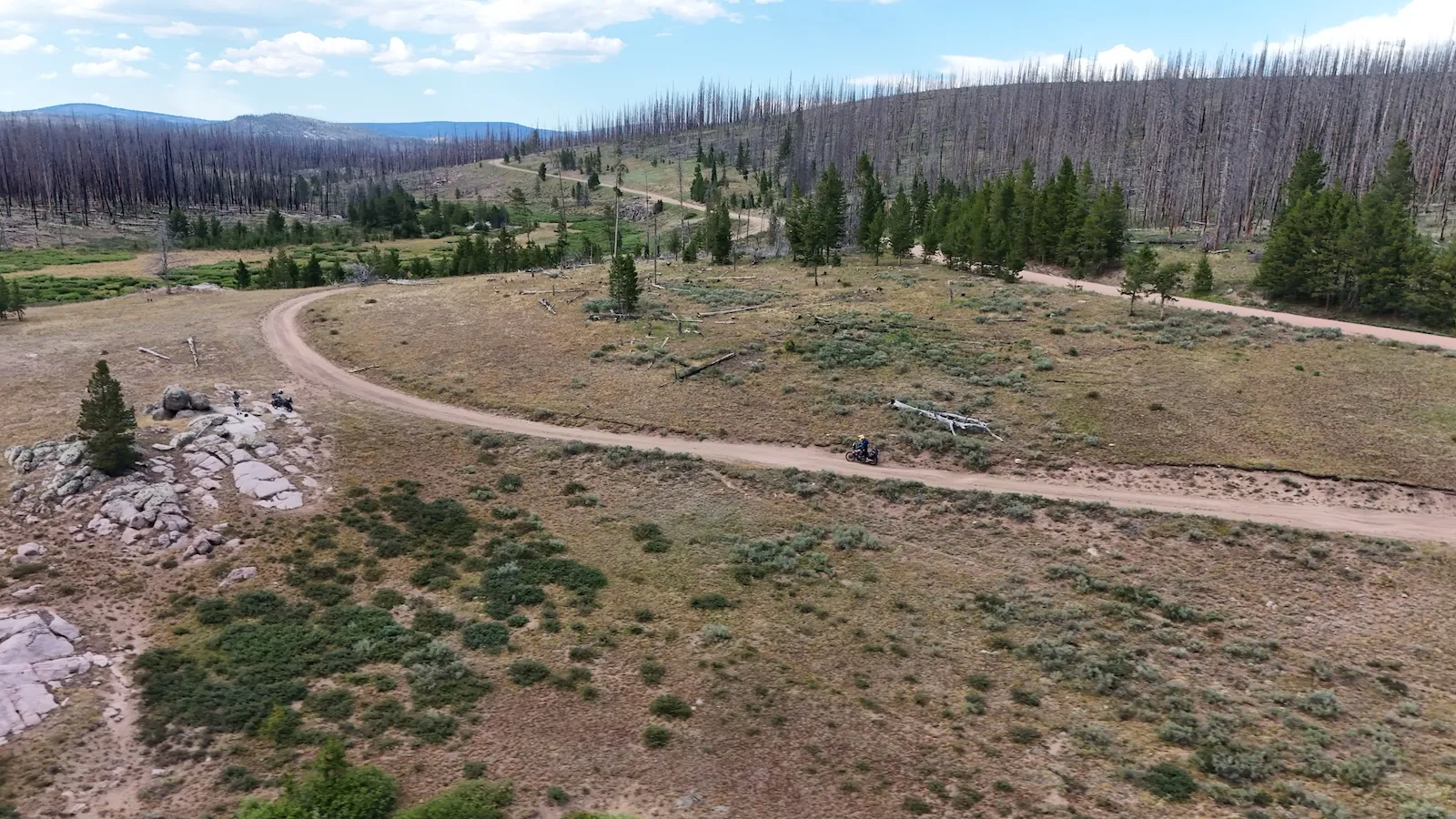
There are riding mistakes you make once and never again. And there is one you keep making your whole life, no matter how many miles sit on the clock. Mine is simple: I look at the rocks. Not far ahead where I want to go, but six feet in front of my own wheel, at the loose stuff that is worrying me right now. It happened to me again on the Colorado Backcountry Discovery Route, more than twenty years into doing this for a living, and what surprised me was how fast the fix works. It costs no money, no weight and no shop time. It costs one deliberate thought.
The Undignified Stumbling on Two Wheels
Day three, early morning in Steamboat Springs, and I was sitting in an empty ski area sorting out the day before. We had climbed Berthoud Pass at 11,307 feet, crossing the Continental Divide, and then spent hours on wide gravel roads that Americans drive in ordinary cars. No hard enduro, no drama, nothing that calls for courage. And still it did not flow, and the reason was not the motorcycle, not the tire and not the surface.
On gravel you are constantly tempted to look down at your front wheel and check which nasty rocks are lying there. What you get for that is an undignified stumbling on two wheels, and the whole time it feels as though the ground is to blame. It is not. What actually happened is that I stopped steering the bike and started reacting to problems that were already underneath me. And the treacherous part is that it takes no difficult section at all. One wide, harmless corner that you fail to look through as you turn in is enough for the whole thing to come apart.
The Mistake Has a Name
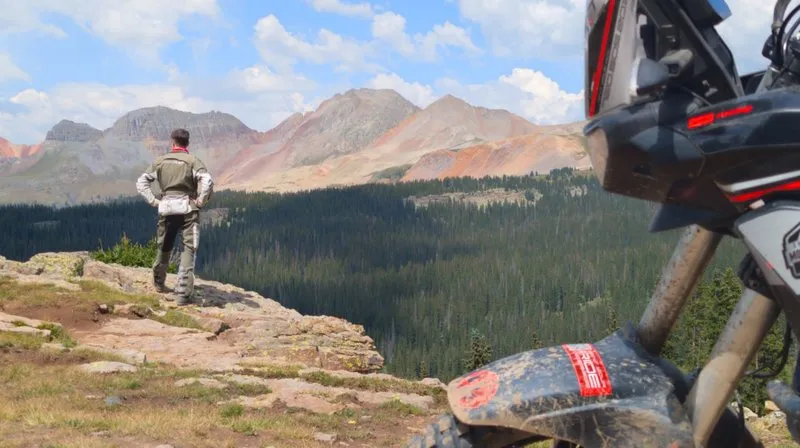
What happened to me is well described and has its own term: target fixation. It comes out of fighter-bomber training in the Second World War, where pilots fixed so hard on their target that they flew into it. The mechanism is that a person looks at an object so intently that they steer toward it, and thereby increase the exact risk they were trying to avoid. It is documented for fighter pilots, racing drivers, paraglider pilots and car drivers, but on a motorcycle it bites particularly hard, because the steering responds to the smallest and partly unconscious movements of the rider.
On top of that sits an anatomical limit that explains the whole thing. We only see sharply in a tiny window, the fovea, and that covers roughly two degrees of visual angle. At ten degrees off that centre, acuity is up to ten times worse, because the density of cones falls away toward the edge. Which means you cannot see the rock in front of the wheel and the corner exit sharply at the same time. You have exactly one sharp point to spend, and every second you decide again whether you spend it on the past or on the future.
What the Research Measured
You do not have to take this from a motorcycle journalist. Land and Lee measured in Nature back in 1994 where drivers look while they steer. The answer: they seek the tangent point on the inside edge of the bend, and they find it one to two seconds before they even reach the corner. The timing underneath that is the interesting part. Gaze angle and steering angle follow the same dynamics, but the steering input trails the eyes by roughly eight tenths of a second.
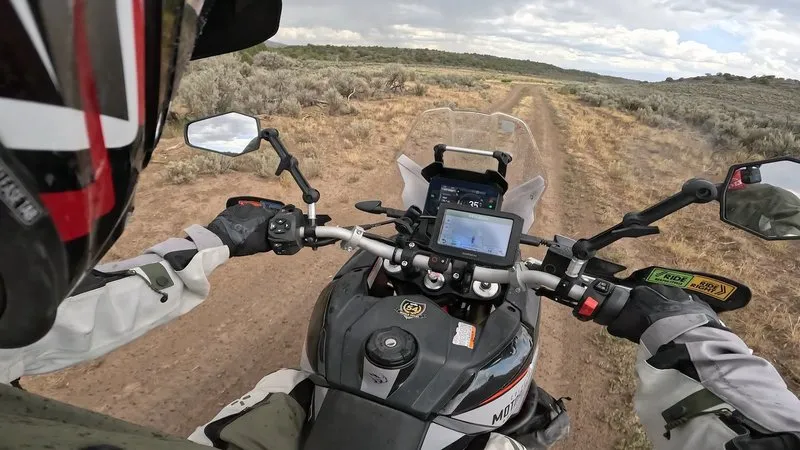
So your gaze is not background music, it is the instruction. What I am looking at now is what I will ride in about a second. Stare at the rock directly in front of the wheel and you hand your own control system an instruction that is already stale by the time it gets executed. This is why off-road riding schools give a very concrete number: look three to five seconds down the trail, not at the obstacle in front of the tire. That is considerably further out than it feels in the saddle, and that gap is exactly how you know you have not done it in a while.
Why Gravel in Particular Drags Your Eyes Down
It is no accident that this gets worse off pavement. On gravel you can see the danger. It is grainy, it has sharp edges, it lies there in plain sight and it looks like something a sensible person would keep an eye on. That is precisely the kind of threat our perceptual system has been optimized for over a very long time. On tarmac the bigger danger is usually invisible, a patch of gravel beyond the bend or a car that is not there yet, and that makes it easier to keep your eyes up.
There is also a mechanical argument worth knowing, because it is reassuring once you have understood it. The Aprilia Tuareg 660 runs a 90/90-21 front tire and 240 mm of travel at both ends. A larger front wheel meets an obstacle at a shallower angle, rolls over it rather than into it, and drops less deeply into holes than a small one does. In other words, the machine is already built to swallow the exact stuff you are staring at. Hand that job back to the chassis and lift your eyes, and the stumbling turns into remarkably composed gliding. The hardware was better than my head the entire time.
The Moment It Flips
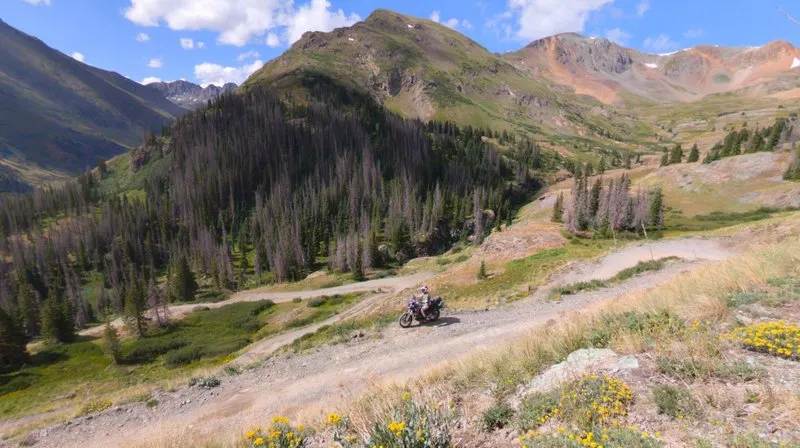
Two days later, Cumberland Pass, roughly 12,034 feet, unpaved. We rode a loop marked as difficult, and suddenly it worked. I was up on the pegs and the bike could be directed with real precision, not because I had become a better rider overnight, but because my eyes and my body were finally cooperating again. On Cinnamon Pass that became the state that sums up the whole subject for me: you stand on the pegs and draw circles through the rock ledges with your gaze and with tiny inputs through your feet, while your hands do almost nothing at all.
Incidentally, this is also the best argument for standing up, and a different one from the usual. Standing is the default position off-road rather than the exception, because the legs work as suspension and the centre of gravity drops. But it also buys you a longer view down the trail, simply because your eyes sit a foot higher. You fix two problems with one movement, which is about the best trade the whole of riding technique has to offer.
What the Crash Numbers Say
This is not a comfort topic, even if it feels like one while riding. The German automobile club ADAC analysed around 2,500 severe motorcycle crashes on rural roads. About a third of them were single-vehicle crashes, riders going down with nobody else involved. Within that group, rider error is the most common cause at 47 percent, with inappropriate speed following at 39 percent, typically in corners. Those numbers come from German road traffic rather than from gravel, but the mechanism underneath is the same one.
Accordingly, gaze technique across corner entry, apex, exit and the road beyond is a fixed part of the cornering courses run by ADAC and by the Austrian club ÖAMTC. I find that worth noticing, because it is the cheapest item in the entire safety toolbox. A better tire costs money, a suspension rebuild costs more, a course costs a day. Your gaze costs nothing and still sits at the top of every syllabus.
Three Things That Reliably Work for Me
First, start on purpose. For the first twenty minutes of any ride I consciously push my eyes too far ahead, further than feels correct, and after half an hour it runs by itself because the habit takes hold again. That is the real problem here: after a longer break, the forward-reaching gaze withers back into a wobbly series of short glances, and nobody is immune. New country, unfamiliar surface, a rental bike and jet lag are entirely sufficient to drop the brain into economy mode, where it looks straight back at the visible threat.
Second, invert the hairpin. Your eyes do not belong in the corner, they belong on the stretch of trail beyond it. In a tight hairpin the speed is low and the stabilising forces are weak, and that is exactly where most of us glue our eyes to the ground in front of the wheel. Third, catch yourself in the act. When it gets choppy I no longer ask what the surface is doing, I ask where I am looking. The honest answer is almost always the same one, and it is unpleasant enough that the correction happens immediately.
How to Ride This Yourself
Our two Tuaregs, the GPS units and the programmed tracks all came from Colorado Motorcycle Adventures near Denver. They rent to people who want to ride the route on their own and they also run fully guided versions with a lead rider and a sweep. The official route is 745 miles across six sections, and the harder sections have bypasses, which is what makes the whole thing accessible rather than heroic.
That is the honest summary of the skill question. If you can ride gravel confidently at home, you can ride this. What you actually need to bring is not bravery. It is the discipline to keep looking far enough ahead at the moment the ground starts shouting for your attention.