
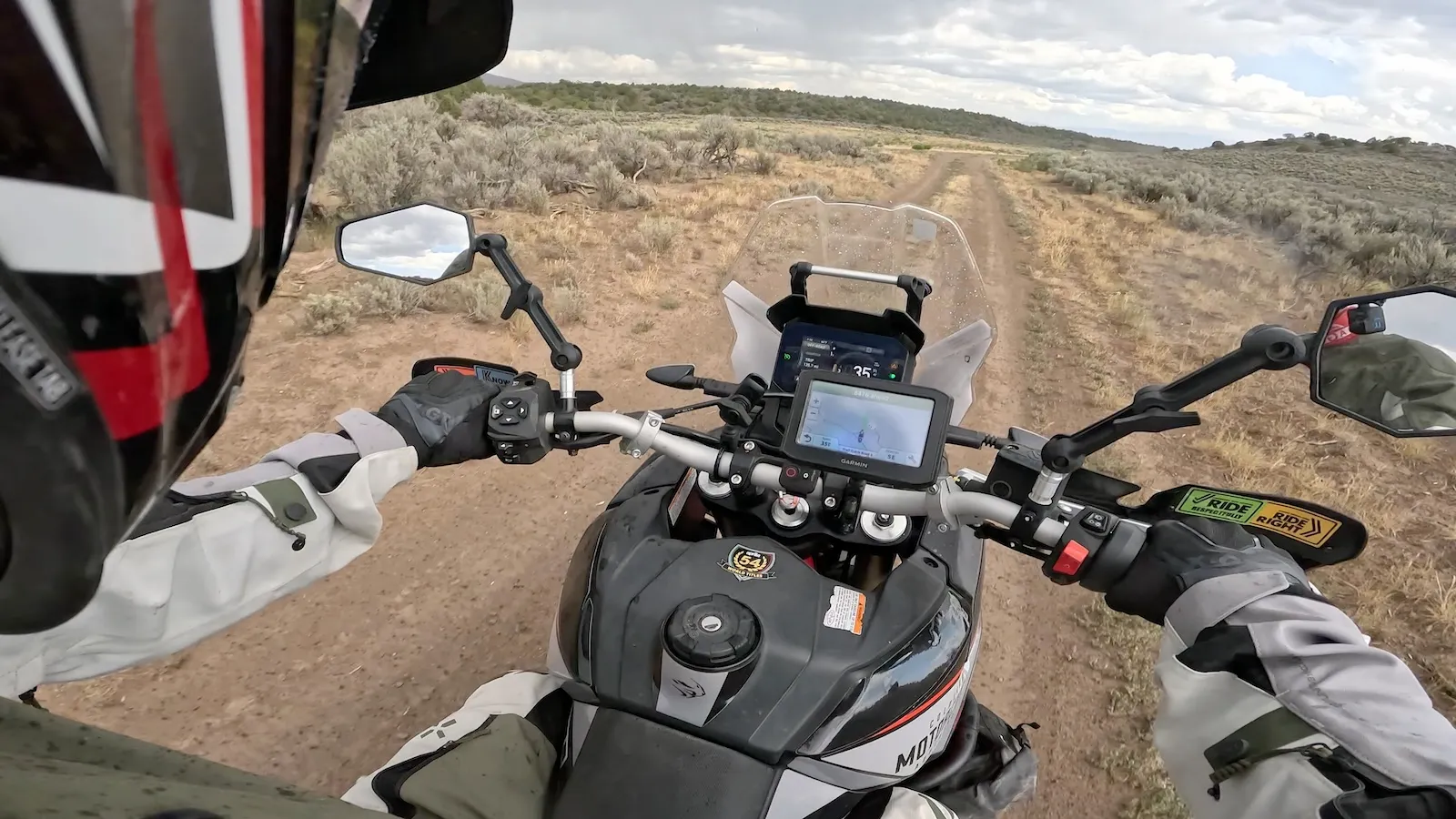
Few things get argued about online as reliably as tire pressure off-road. Received wisdom says drop the pressure, get more contact patch, get more grip. On the Colorado Backcountry Discovery Route we did the opposite, and here’s the honest explanation of why, and what it cost us.
What We Ran, and Why
What we do on long trips like this: we run a lot of tire pressure. Something like three bar, roughly 43 psi, front and rear.
There’s exactly one reason: so we don’t ride ourselves into a flat. It obviously punishes the front end’s line-holding. But it’s the lesser evil.
Those two sentences are the whole decision. And it isn’t a recommendation, it’s a trade-off under specific conditions. What those conditions were is the actual content of this article.
The Conditions That Force That Call
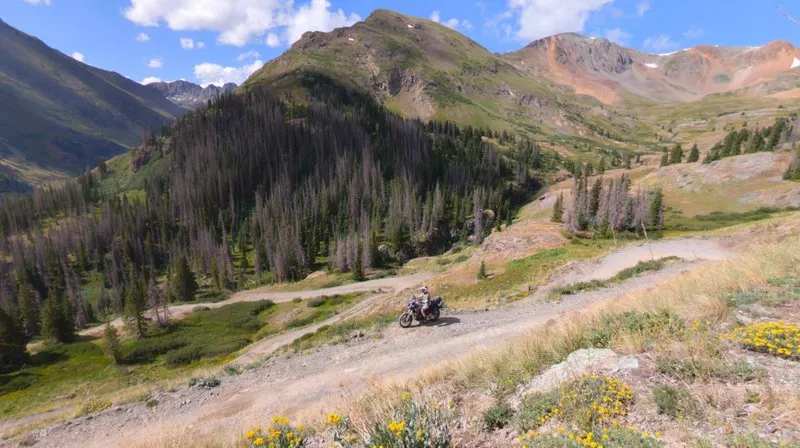
First, the surface. On the Alpine Loop, 65 miles of unpaved road between Lake City, Silverton and Ouray, the ground up at Cinnamon Pass near 12,640 feet is coarse rock with sharp edges. That’s exactly where pinch flats happen when there’s too little air in the tire: the tire gets squeezed against the rim, and the tube dies between rock and aluminium.
Second, distance. Out here you’re without cell coverage for long stretches and hours from the nearest workshop. A flat isn’t a twenty-minute annoyance, it’s the end of your riding day with a thunderstorm building.
Third, the constant switching. In a single day you climb the paved Cottonwood Pass to 12,126 feet, then the unpaved Cumberland Pass at 12,034 with coarse gravel, then a long dirt connector, and you finish over the paved Slumgullion Pass, whose north side is the steepest continuously paved road in Colorado at nine percent.
Anybody wanting the optimum pressure for each of those sections would be letting air out and pumping it back in four times a day. With a compressor, with time, in the sun. Nobody keeps that up for eight days.
What the High Pressure Costs
Now the honest part, so nobody complains afterwards. High front pressure costs you exactly what you need most off-road: feedback.
The tire conforms less around rocks, it deflects more readily, and the front gets nervous. On loose ground you have to work more deliberately with vision and body position, because the front wheel tells you less. That is what the line-holding penalty actually means in practice.
So the trade isn’t free. You swap feel for puncture resistance. If you’re out for a day ride close to home and a van could come get you, it’s a bad trade. If you’re eight days out with nobody to call, it’s the right one.
The Factor Almost Everybody Forgets: Heat
There’s a reason I’m careful about recommending a number to you. Tire pressure isn’t a constant.
As a rule of thumb, pressure changes about 1 psi for every 10 degrees Fahrenheit of ambient temperature, and friction heat during riding stacks on top of that. On this trip we had barely above freezing up top in the rain and 99 degrees down in Durango, on the same day.
Anyone who pumps to 43 psi on a cold morning pass is running well above that in the hot valley by afternoon. So: always check pressure cold, never after a ride, and factor in the day’s spread. In Colorado that spread is wider than anything you know from the Alps.
Wet Ground Rewrites the Whole Calculation
The second factor that turns a clean decision into a nervous one. We ran 50/50 tires, the usual adventure compromise, and they’re not exactly stars in the wet.
The Alpine Loop gets genuinely nasty when it rains, because parts of it are red clay that turns unbelievably slick. Up at Crooked Creek Pass a local explained that the gravel road becomes almost impassable in the rainy season: the log trucks polish it smooth, and then it’s properly slippery.
We took that seriously once and turned around. In Taylor Park a muddy water crossing sat in front of us, a mixture I won’t describe in detail. On those tires it was too risky for me, so one of us went around through the meadow and I turned back. That’s the most honest tire-pressure lesson of the whole trip: no pressure on earth saves you from a surface your tread wasn’t designed for.
How I’d Judge It Without a Gauge
Since I’m not giving you a number, here’s what I actually watch instead.
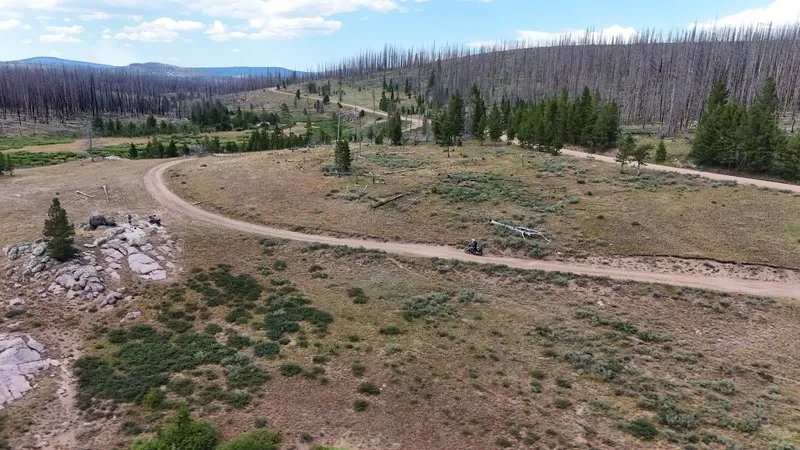
On coarse rock, if the front starts skating over the tops of stones rather than settling between them, you’re high. If the bike feels like it’s steering from somewhere behind the contact patch and the rim rings on impacts, you’re low. Somewhere between those two you’ll find your own compromise, and it will sit closer to the high end than a track-day mindset suggests.
The second thing I watch is the rim itself. If you’re picking up dents on the front rim over a few days, no amount of feel is worth it, because a bent rim ends the trip in a way a nervous front end never does.
And the third is simply the day ahead. A stage that’s mostly connecting pavement with a few dirt sections is a different problem from an all-day loop above treeline on loose rock. The pressure that’s wrong for one is right for the other, which is why the question never has a single answer.
What I’d Do Differently Next Time
Three things I’m taking with me.
First, the basic call stands. On a multi-day trip away from infrastructure, puncture protection outweighs the last bit of feel. I’d run it high again.
Second, I’d keep a small electric pump within reach instead of buried in the luggage roll. Not to vary four times a day, but to deliberately drop some pressure on the morning of a pure dirt stage and put it back in the evening. That effort pays off exactly when a whole day of off-road lies ahead.
Third, I’d take tire choice more seriously than pressure before the trip. A 50/50 tire is a good compromise for 745 miles of mixed route. If you know you’ll be riding mostly wet and muddy, the decision about tread pattern matters more than any number on the gauge.
The Mistake I Used to Make
So you don’t repeat it: I used to check pressure by feel, pressing on the tire with the bike standing. On a modern adventure tire with a stiff carcass you learn precisely nothing that way. Between 29 and 43 psi the tire feels almost identical at a standstill, and that difference is what decides whether you pinch a tube.
The second mistake was setting pressure once at the start of a trip and not looking at it again for eight days. Tires lose air, slowly, but they do. On a route where you move between 6,500 and 12,900 feet and between freezing and 99 degrees every single day, a one-minute look at the gauge each morning is the cheapest safety you can buy.
One Thing That Isn’t About Tires
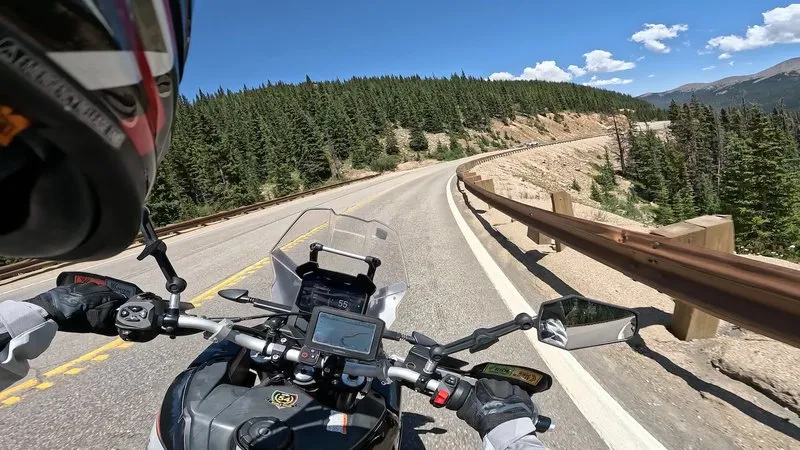
Because grip isn’t only what happens under you. On the wet descents, a fog-free visor in a closed enduro helmet was worth more than any tenth of a bar. Being able to see the line is the first condition for holding it.
The same goes for riding two-up-in-convoy: a mesh intercom lets you call out a rut or a slick section before the other rider is already in it. On a surface that changes character every few hundred meters, that warning is worth more than the perfect setup.
Our bikes and the whole route logistics came from Colorado Motorcycle Adventures in Golden, near Denver. That belongs in the tire conversation too: renting locally means riding on tires somebody chose who actually knows the route.