
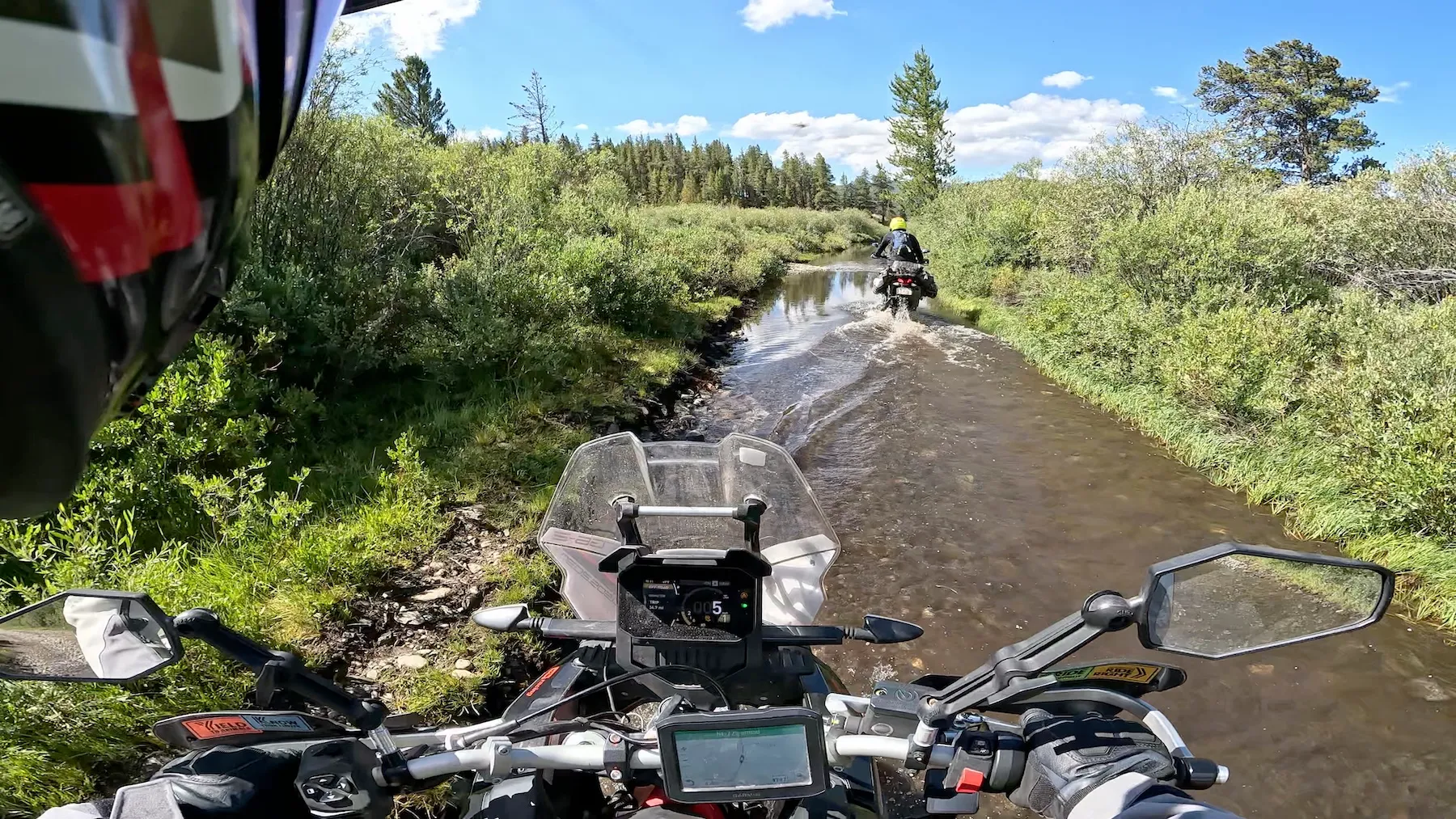
Day five on the Colorado Backcountry Discovery Route, just after ten in the morning, somewhere in Taylor Park at around 10,000 feet. In front of us, a river crossing. A local was working his way through it on a hard enduro, visibly having to fight for it. And then I said the thing that practically never gets said out loud on a trip like this: it is simply too remote out here for us. We turned around. Back onto tarmac, a detour, then back into the dirt later. No hero shot, no story, no applause. Two days later that decision turned out to be the best one of the whole trip.
First, the Crossing We Did Ride
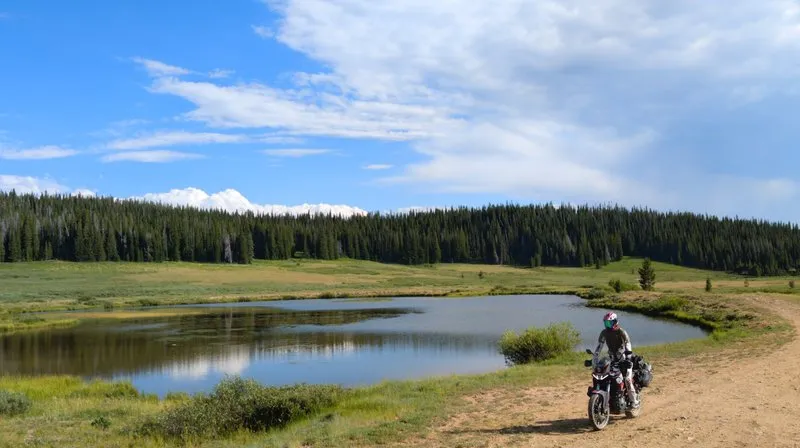
Because honesty demands it: half an hour before the river we had crossed another patch of water. A pond churned up by a cattle herd, and the colour of it forbade calling the stuff water at all. What played out there was textbook group dynamics in a group of two. I filmed and heckled, Clemens rode, and one of us was going to have to take one for the team. He picked the meadow beside the worst of it and got through. By that logic the next water would have been my turn, which is what makes the second crossing interesting: there we did not weigh up whose turn it was. We called it off.
Why Instinct Reliably Fails Here
In the saddle of a motorcycle you must not blindly trust the ancient parts of your brain. Our threat archive is millions of years old and built for situations that have nothing to do with riding. In front of a river that archive produces precisely the wrong assessment: the water is visible, the ego is tangible, and the actual risk stays hidden. The river looks manageable because all you can see is its surface, and the surface is the one part that tells you nothing about the depth or about the ground underneath.
On top of that sits a piece of arithmetic that never works out. Anybody who thinks a 600-mile day makes them the master of the pub gets put back in their place by the next man with 700. Off-road it is the same: there is always a harder ford, a braver mate, a more extreme video. Whoever rides against that scale loses by definition, because the scale has no upper end. That is not an exercise in modesty, it is a sober observation about a game you cannot win.
What Water Actually Does
Now the physics, because this is where gut feeling stops being useful. The National Weather Service has run a campaign for years called Turn Around Don’t Drown, and its central argument is not drama, it is ignorance: when you reach a flooded stretch you know neither the depth of the water nor the state of the ground underneath. More than half of all flood-related deaths happen because somebody drove or walked into it. Six inches of fast-moving water can knock an adult off their feet, twelve inches is enough to carry away a small car, and for trucks, vans and SUVs it takes eighteen to twenty-four. A motorcycle weighing 450 pounds on two contact patches the width of your hand is not the stable option here.
Then there is the mechanical write-off that almost nobody factors in. If water gets through the intake into the combustion chamber, the piston stops abruptly, because water does not compress. Bent connecting rods or cracked components are the result. And even when it ends well, you must not simply hit the starter on a drowned engine: you pull the plugs, turn the engine over in gear, check the airbox, then change the oil and filter. In a garage that is an hour of work. On a trail with no workshop it is the end of the trip.
Why Remoteness Is the Real Variable
My sentence that day was not that it was too difficult. It was that it was too remote. That is a different thing, and it is the actual point of this article. Skill decides whether you get through. Remoteness decides what happens if you do not. Those are two completely separate questions, and the second one gets skipped almost every time, because it is the more uncomfortable one and because no amount of training improves it.
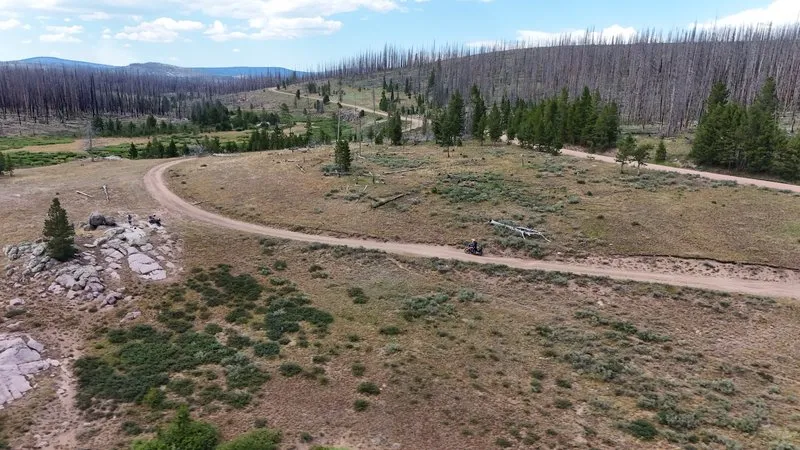
Colorado runs on the order of 4,000 backcountry rescue missions a year, more than any other US state. They are carried out by around 50 backcountry rescue teams, mostly volunteers who turn out with their own equipment. There is even a dedicated card for it, the CORSAR card, five dollars for a year and twenty for five, whose proceeds feed a fund that reimburses sheriffs for mission costs. On the Alpine Loop, where we rode the following day, large stretches have no mobile phone coverage, and the snow-free window only runs from roughly June to September. If something happens out there, the equation is not skill against difficulty. It is time against help.
Phil from our operator settled this with an anecdote better than any guidebook. He was out with the company owner when a bike went down, and it took the two of them an hour to get that single machine upright again. Two experienced people, one hour, for a job that takes two minutes in a garage. Alone it would not have worked at all, and that is precisely the number missing from the calculation when you stand in front of a ford wondering whether you can ride it.
What the Research Says About Groups
It helps to know that this is not a character flaw. Studies on risky riding show that group norms and self-image have the strongest direct influence on the intention to ride riskily of all the factors examined. In a group the pace typically rises, and mixed skill levels, peer pressure and rigid formation rules increase risk considerably. In a pair the effect is smaller than in a group of ten, but it is there, and it works all the more strongly the less you believe it applies to you.
Which is why I have adopted a simple rule that removes the whole mechanism: the decision to turn back may be made by anyone alone, without discussion and without justification. It is not put to a vote. As soon as a ford becomes a debate, the braver rider wins rather than the wiser one, because courage sounds better in an argument than caution does. That is what I mean when I say you should ride for yourself. It gets misread as selfishness and it is the opposite: riding for yourself also means taking responsibility for the safety of the group, because anybody who overreaches becomes everybody else’s problem.
The Answer Came Two Days Later
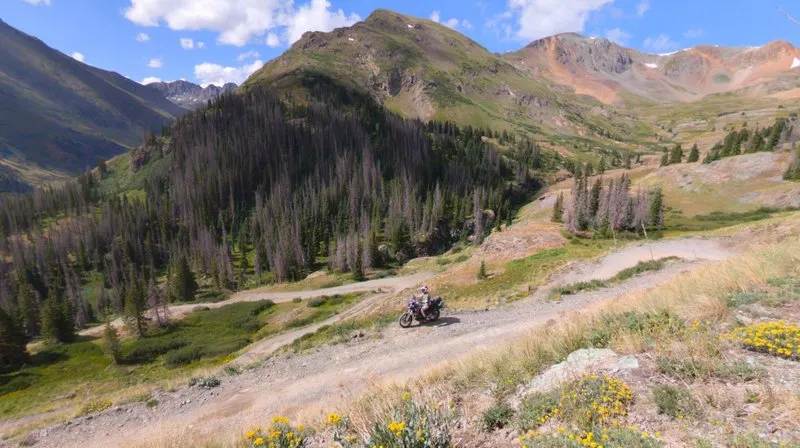
The next day we rode the Alpine Loop, 65 miles of unpaved roads between Lake City, Silverton and Ouray, with high passes around 12,600 feet above the tree line. It was the best day of the trip, and Clemens afterwards called the Alpine Loop the most impressive thing on the whole tour. And then came the calculation I made in hindsight: I am glad we did not push through that one water crossing, because you only have to imagine having missed the Alpine Loop for it.
That is the whole trick, and it has nothing to do with fear. A riding day is not the sum of its dares, it is a budget. What you lose at a ford, you pay for at the place you no longer get to ride. An hour of recovery, a drowned engine, a sprained hand, and the week becomes a different week. The mistake people make when weighing up a difficult section is not underestimating the risk. It is pricing a failure in repair bills instead of in lost days.
And Yes, the Comfort Zone Is Still the Point
So that this does not read as a plea for caution: sometimes you do have to leave your comfort zone to experience anything new at all. A motorcycle loves pulling you out of it now and then, but the value of that depends entirely on you having made the decision yourself. That is the difference between the two days. The Alpine Loop was a deliberate step out of the comfort zone. The river in Taylor Park would have been a step out of it because a stranger on a hard enduro was watching.
We had just seen that guy work real magic with his hard enduro, and I said so admiringly at the time. As an argument it is worthless: different motorcycle, different rider, different trip, different way home, and without 55 pounds of luggage. And if somebody gives you grief for turning back, that breed of pest is hit hardest by total indifference.
What Makes the Decision Easier
Turning back is easier when you are prepared. A satellite communicator with an SOS function lives in our luggage, because it makes the one question answerable that matters in front of every ford: how far away help actually is. The most important factor, though, is route planning. Our Tuaregs and the programmed tracks came from Colorado Motorcycle Adventures near Denver, and the 745 miles of the official route have bypasses at the hard sections. That is what turns retreating into an option rather than a failure. Without a planned alternative you are no longer deciding freely, because turning back would cost the whole day.