
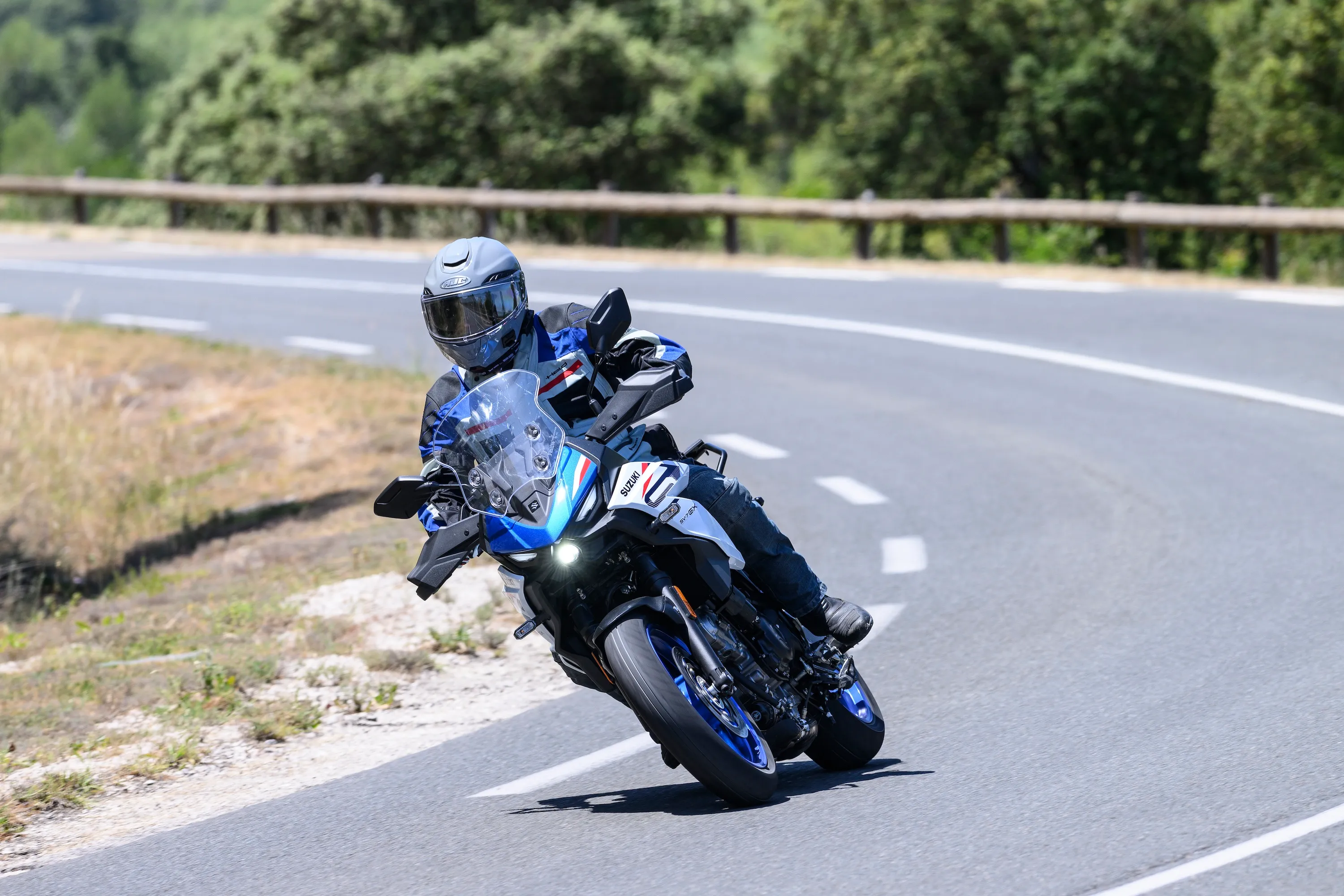
It’s almost hard to believe what a good motorcycle still costs these days. The Suzuki SV-7GX is one of those bikes where, after the first few miles, you don’t sit there picking apart individual components. You climb off grinning inside your helmet. Suzuki took the classic 645cc V-twin, gave it modern electronics, and dropped it into a sporty crossover package. The honest truth: this thing isn’t spectacular. And that’s exactly why it’s so good.
Around $9,000, and it doesn’t feel built down to a price
There’s a Suzuki virtue the industry tends to overlook: the bikes are rarely cheap, but they’re often a bargain. That distinction matters here. Suzuki has not announced a US price yet, and US bikes are expected around mid-2026. Going by Europe, you’re looking at roughly $9,000 (Suzuki lists €8,578 including delivery in Germany, about €7,999 without), with Austria around $9,300 (€8,890) and a Touring Edition near $10,400 (€9,890). Treat the dollar figure as a placeholder until Suzuki confirms US pricing — but in this class, that ballpark is a statement.
The trick isn’t that Suzuki cut corners everywhere. They spent where you actually feel it day to day, and left things off where brochure readers howl but riders in the saddle never shed a tear. No useless glitter. What you get instead is a usable display, ride-by-wire, traction control, ride modes, smartphone connectivity, and a bidirectional quickshifter. The result isn’t a luxury toy. It’s a surprisingly good motorcycle.
The V-twin keeps it narrow and familiar
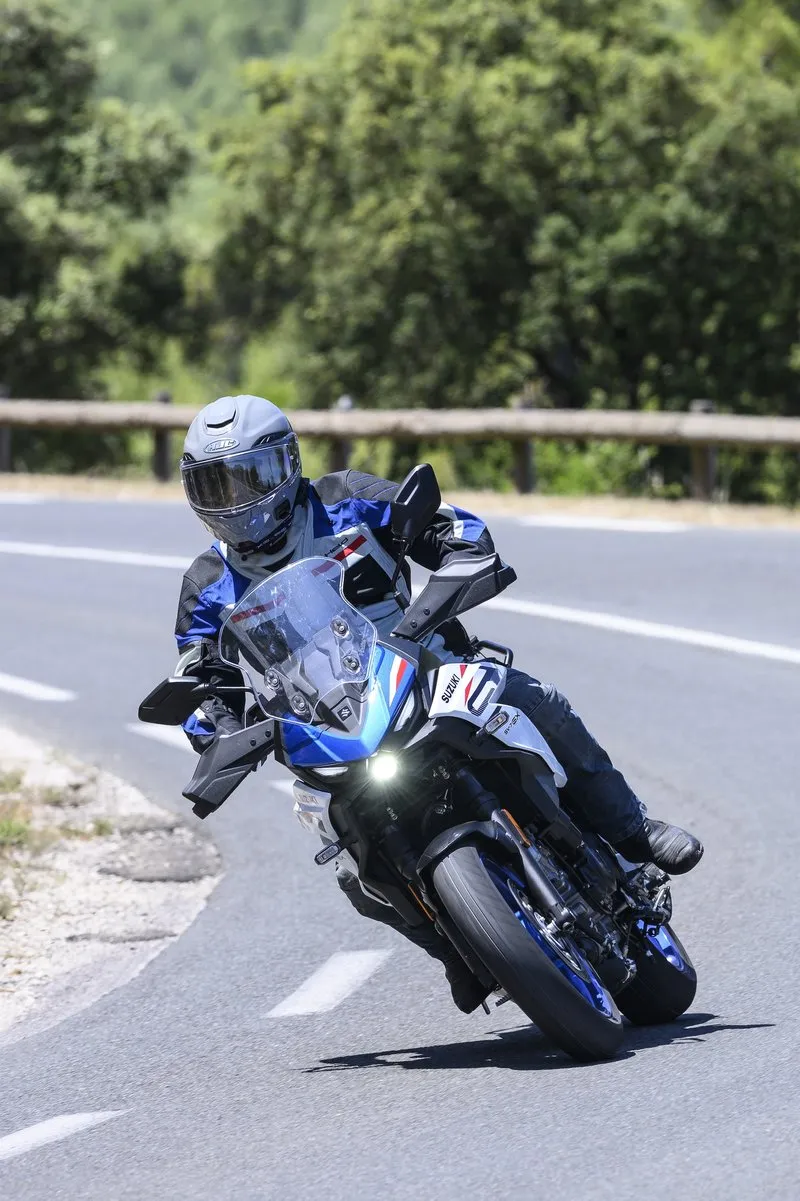
Suzuki could have taken the easy road. The 800cc parallel-twin platform is right there, it works well, and the market likes it. They stuck with the V-twin anyway, which is almost a luxury move — a V-twin is more expensive to build than a modern parallel-twin. More metal, more parts, more effort in the engine block.
In the saddle you understand the choice immediately. You’re sitting on a full-size motorcycle with a proper front end, wind protection, and a luggage rack, yet the machine feels incredibly narrow underneath you. Almost single-cylinder slim, but with the smoothness of a twin. That alone takes the intimidation out of the big touring fairing. Within a few hundred feet the SV-7GX turns into an easy, harmonious companion.
The engine doesn’t win you over with brutal punch. It wins you over with eagerness to rev, a light-footed quality, and that relaxed way it drives off out of a corner. If you’re chasing fear and adrenaline, there are better bikes for you. If you want a motorcycle that won’t bore an experienced rider yet won’t scare a newcomer, you’re in exactly the right place.
The quickshifter feels properly sorted
The quickshifter is one of the big points for me. Not because having one in 2026 is exotic, but because on the SV-7GX it doesn’t feel like a gadget bolted on after the fact. Suzuki says the shift lever travel, the linkage, and the shape of the shift dogs were all reworked so the system runs clean and lasts.
You feel that on the road. Shifts slide up and down butter-smooth, almost like a top-shelf modern engine. Meanwhile the basic design under you has been built since 1999, in more than 500,000 units. That settles me down. I always have a little old man in my head saying over coffee, “let’s wait and see how the first model year holds up.” With this base, I’d have a lot less of that worry.
The rest of the electronics stay out of your way too. Suzuki bundles the rider aids under its S.I.R.S. umbrella — ride modes, traction control, the quickshifter, ride-by-wire, Easy Start, and Low RPM Assist. In the saddle it all hangs together. Throttle response, ABS, and traction control are tuned for the real world. One thing to know: Suzuki’s spec sheet shows no IMU, so there’s no lean-angle-dependent intervention.
Touring comfort without the adventure-bike bulk
The SV-7GX is a crossover. Not a naked bike, not an adventure bike, not a classic sport-tourer. That’s where its strength sits. You get more comfort front and rear than a naked bike, but without the tall, towering ADV stance that has shorter riders quietly calling for help just trying to get aboard.
I’m 6 ft 0 in (184 cm), and with the taller seat I had a good all-day position. With the standard seat I’d put this bike at riders up to about 5 ft 10 in (178 cm); with the high seat, probably good to around 6 ft 2 in (188 cm). Above that I’d point you toward the V-Strom 800DE — not because the SV is bad, but because the knee angle gets tight for tall riders or anyone with long legs and big feet.
The upper body fits a surprising number of riders, though. The bar sits nicely, not too wide, not too narrow, the controls are compact, the display is clear. The windscreen is a simple solution but a sensible one: four screws, three positions. Suzuki also offers a touring screen that’s meant to give taller riders good protection. It reads like a smart mix of cool design and real usefulness.
At the parking lot, the magic stops
Suzuki lists a curb weight of 465 lb (211 kg). And sure, there’s always the standard line — once you’re rolling, you don’t feel the weight anymore. True here too. Once the SV moves, that narrow V-twin helps it feel lively, compact, and trustworthy.
But in the parking lot the magic is over. 465 lb is 465 lb. If you’re a very compact rider, or you just respect weight, you’re not pushing around a little Gladius or an old sneaker-light SV650 here. You’re moving a full-grown motorcycle with a big screen, sturdy build, and a real rear rack. That doesn’t come for free.
The good news: riding flips the picture completely. The engine pulls cleanly off the throttle, the bike drops willingly into a corner, the 160-section rear tire doesn’t make it lazy, and trust builds fast. Less experienced riders in particular will love this combination — it looks grown-up but doesn’t ride like a slab.
The equipment matches the price, not the ego
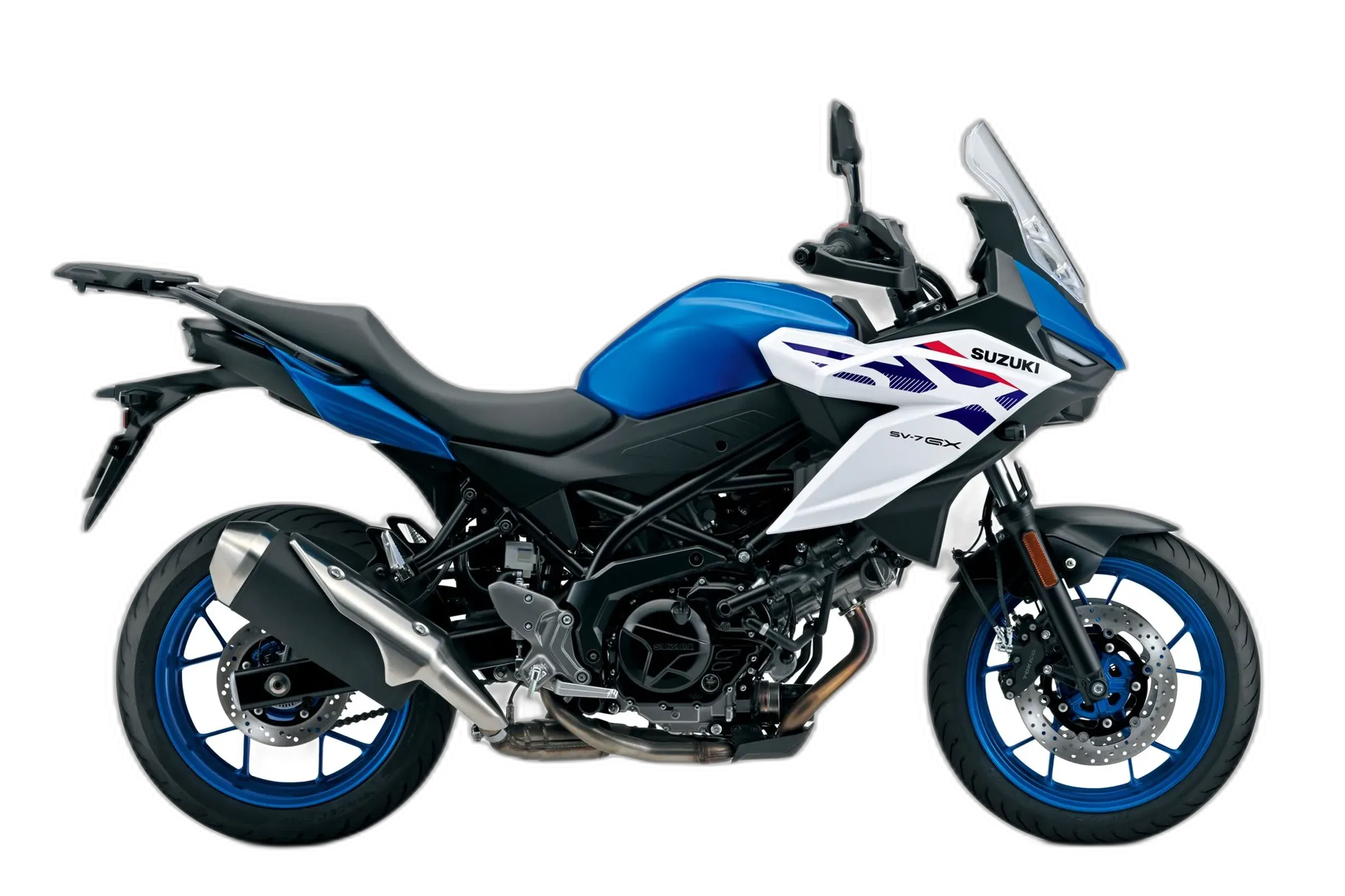
Sharp-eyed buyers will spot it right away: no radial-mount brakes, no upside-down fork, no spec-sheet jewelry. You can criticize that. But that’s also where the bike starts creeping toward $12,000-money. In the saddle I never had a moment where I thought something dramatic was missing.
The brakes and suspension might feel basic to a sporty rider, but never cheap. Next to a V-Strom 800DE you can tell there are higher-grade components and more finesse over there. Still, you don’t step off the SV-7GX thinking you’ve been riding something second-rate. Even spoiled testers with a lot of saddle time get off grinning. That’s a good sign.
The headlight looks a touch small. We couldn’t test it at night — we rode in glorious sunshine — but Suzuki and the engineers on site say the new reflectors and LED elements do a strong job, and Suzuki claims the high beam stays usable in lean up to around 30 degrees. Sounds good. I didn’t verify it.
The 4.2-inch TFT isn’t huge, but it’s used well. Pair it through the Suzuki Ride Connect Plus app and you get turn-by-turn arrows, call and calendar alerts, and ride and route data. Pairing was easy and the basics work. Does it replace a real nav unit? Probably not — for big tours you’ll likely still strap your phone to the bar. But there’s a USB-C port for charging, and the arrow navigation covers the short stuff: the next gas stop, or the way home in bad weather. No more, no less.
The luggage rack deserves a word too. It’s standard, which not everyone will love, and it doubles as the passenger grab handle. In practice it feels sturdy and genuinely useful. Pretty? Not really. It looks a little like someone bolted it on after the designer had already clocked out. But load gear on it and you’ll be glad it’s there.
Who this Suzuki makes the most sense for
I immediately pictured the neighbors and friends who keep asking me, “Nils, which bike should I buy?” With the SV-7GX my hit rate would be unusually high. I could recommend it to almost all of them. Almost. Not the buddy who’s 6 ft 4 in (192 cm). Not the guy always hunting an adrenaline jolt — if you want a big shove and a little fear in the saddle at 90 or 100 mph, you won’t be happy here.
For a lot of other riders it fits remarkably well. Coming off a naked bike, you gain comfort and wind protection but live with a softer, less direct front. Coming off an adventure bike, you get something more accessible, more compact, and lower, but you give up a little suspension travel on bad pavement. On one hand it’s a compromise. On the other, that’s exactly why it’s so strong.
Hand on heart: the SV-7GX doesn’t win any bar-stool category. Not the most power, not the lightest weight, not the fanciest brakes, not the wildest suspension. But it’s a motorcycle that will bring a lot of riders a lot of joy in everyday use. And those bikes often matter more than the loud heroes in the brochure.
Specs Suzuki quotes
The SV-7GX runs a liquid-cooled 645cc 90-degree V-twin with DOHC and four valves per cylinder. Suzuki lists peak power at 72 hp (54 kW) at 8,500 rpm and peak torque at 47 lb-ft (64 Nm) at 6,800 rpm. It meets Euro 5+ and uses ride-by-wire, a six-speed gearbox with a bidirectional quickshifter, three ride modes, three-level traction control plus off, Easy Start, and Low RPM Assist. Suspension travel is 4.9 in (125 mm) front and 5.1 in (129 mm) rear, with preload-adjustable shock. It comes on Pirelli Angel GT II tires, 120/70 ZR17 front and 160/60 ZR17 rear. Seat height is 31.3 in (795 mm) and curb weight 465 lb (211 kg). Suzuki says the SV-7GX reaches European dealers from September 2026, with US availability targeted for around mid-2026. The Touring Edition adds, among other things, a touring screen, a large tank bag, a soft luggage set, and a tank pad.
Strengths
- Strong value for the money
- Narrow, familiar V-twin character
- Excellent quickshifter
- Accessible ergonomics for a wide range of riders
- Great throttle response
- Genuinely comfortable for the road
Weaknesses
- 465 lb (211 kg) is noticeable at walking pace
- Too compact for very tall riders
- Luggage rack is sturdy but agricultural-looking