

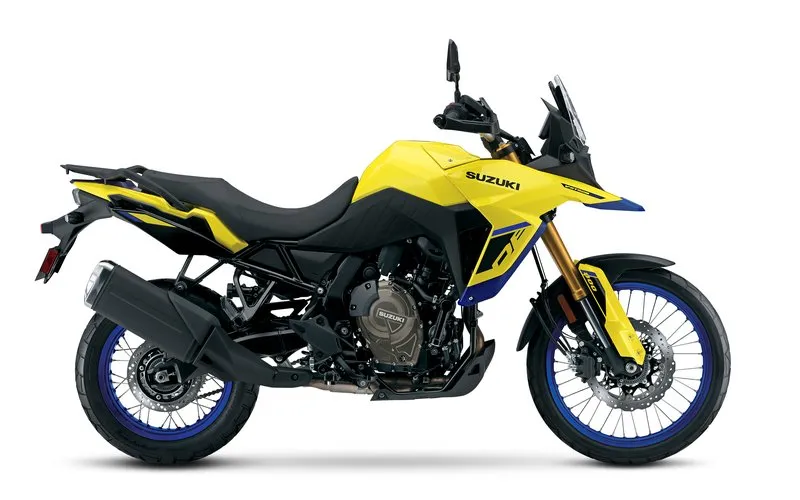
This bike doesn’t have the spec sheet that wins forum arguments. It runs 84 HP out of 776 cc, which a new KTM 890 Adventure R will dyno-stomp without breaking a sweat. The BMW F 900 GS bristles with electronics the V-Strom doesn’t even pretend to have. But after ten days of dirt, dust, and high-altitude grinding through four US states, the Suzuki V-Strom 800DE under me ran exactly the same on day ten as on day one. No oil weep. No loose hardware. Nothing leaked. Nothing rattled. That’s not an accident. That’s a Japanese manufacturing philosophy that’s been compounding for seventy years.
The Moment It Sinks In
Day eight, gas stop in Stanley, Idaho. Behind me: more than 1,200 miles, four US states, roughly 80 percent of it on gravel and dirt. Mornings starting at 34 °F, afternoons hitting 86 °F, washboard at 70 mph, gnarly forest roads, steep gravel climbs. I’m pumping fuel and just looking at the bike, and it hits me: this thing has zero ailments. Brakes still bite the same. Tires haven’t shifted on the rims. Nothing leaks. Suzuki built this engine to run, and that’s exactly what it does.

So why are Japanese motorcycles this reliable? Not one engineering trick. A stack of cultural imperatives that show up in how every single part is designed, made, and assembled.
The Three Japanese Words Behind the Build Quality
Three words live in the manufacturing DNA at Suzuki, Honda, and Yamaha. Once you know them, you can’t un-see them in the metal.
Kaizen — continuous improvement. Not the dramatic five-year platform refresh that Euro brands love. Thousands of small tweaks over decades. The DR650 has been the same basic bike since 1996. The V-Strom family has been getting steadily refined since 2002. That’s Kaizen in steel.
Monozukuri — the art of making things. It bundles human creativity with technical precision and bakes intrinsic pride into the line worker. You feel it when a component just looks settled, like nobody had to redesign it twice.
Genchi Genbutsu — “go and see.” Managers don’t run plants from filtered reports. They walk to the problem on the production floor, look at it, then decide. The feedback loop on build quality is short, ruthless, and human.
Stack one more thing on top: shame culture. In Japanese manufacturing, a defect isn’t a hiccup. It’s a personal failure that brings collective dishonor onto the team. That sounds heavy until you realize it produces the only thing that actually drives zero-defect engineering — the worker who flat-out refuses to ship a bad part.
Why Suzuki Looks Boring on Paper
Suzuki has its own internal motto: Sho-Sho-Kei-Tan-Bi. Smaller, less, lighter, shorter, beauty. It explains why the V-Strom 800DE shows up with 84 HP out of 776 cc while a KTM 890 Adventure R is out there flexing power numbers. Suzuki’s not racing the spec sheet. They’re building engines that don’t run at the limit, because parts that aren’t pushed don’t break.
Look at the DR650. Same carburetor for decades. Air-and-oil cooling. Owners regularly clear 62,000 miles without a major engine pull. That’s not luck. That’s the design choice to leave proven tech alone when nothing’s wrong with it.
Why the Tech Lag Is Actually the Point
Japanese brands typically roll out new electronics — ABS, IMU-based traction control, adaptive cruise — two to five years after the European houses do. American forum posters love to dunk on Japan for this. They’re missing the point. New tech doesn’t get shipped until it’s fully cooked. Euro brands take innovation risk. Japan takes reliability risk. Both are valid bets; only one of them leaves you stranded at altitude on the wrong side of a Sunday.
Consumer Reports has been tracking failure rates on this exact question for years. European brands sit between 29 and 40 percent four-year failure rate. Japanese brands stay between 11 and 15 percent. That’s not subjective. That’s a measured gap.
After 1,700 Miles
Ten days. 1,700 miles. Four US states. Bikes dropped, dust caked, midnight temperature crashes, 8,800-foot passes. We rolled into Salt Lake City and handed the bikes back at the dealer. Not one defect. No loose hardware. No leaks. Nothing.
The trade-off — let’s not pretend it doesn’t exist. Suzuki’s adventure bikes run heavier than the comparable KTMs. And in 2025, the V-Strom 800DE still doesn’t ship with heated grips or cruise control as standard — toys you genuinely miss when you’ve been in the saddle for nine hours and the temperature’s collapsing. Bolt them on, the bike doesn’t care.
So here’s what this comes down to. Euro brands are betting that you want the latest. Japanese brands are betting that you want it to start tomorrow. Both bets win, depending on what you actually need from the machine. But if you’re loading up for a real trip — a BDR run, a cross-country haul, a desert week — and you can’t afford one mechanical roulette spin, you’ll keep ending up on a Japanese bike. That’s not nostalgia. That’s math.
Quick Specs — Suzuki V-Strom 800DE (MY 2025)
Parallel twin, 776 cc, 84 HP. Test trip: 1,700 miles across four US states, 80 percent off-pavement, elevations to 8,800 ft, daily temperature swings 34°F to 86°F. Test verdict: zero defects.