
Nobody talks about the adrenaline-to-price ratio.
They talk about horsepower. They talk about torque figures, quarter-mile times, Nürburgring laps, and the number of riding modes packed into the electronics suite. They compare specifications in units that have almost no bearing on the actual experience of riding a motorcycle on an actual road on an actual Tuesday.
The adrenaline-to-price ratio is the metric that cuts through all of that. It measures something simple: how much raw, visceral, physical excitement does this machine deliver per dollar spent, per mile ridden, on the roads where you will actually ride it?
Measured this way, the superbike market looks completely different. And the mid-weight naked bike suddenly makes more sense than any sales chart currently suggests.
Key fact: The adrenaline-to-price ratio defined
The adrenaline-to-price ratio is the relationship between the intensity of the riding experience and the cost of producing it — measured in real-world conditions at legal and semi-legal speeds. A motorcycle with a high adrenaline-to-price ratio delivers maximum sensory intensity, physical engagement, and mechanical feedback without requiring extraordinary velocity or exotic purchase price. Mid-weight naked bikes, with their mechanical charisma, minimal aerodynamic protection, and accessible performance envelope, consistently produce the highest ratio in the market.
The spec-sheet horsepower obsession
The horsepower arms race started with a reasonable premise: more power means more capability. This was true, in a technical sense, for decades. Entry-level motorcycles genuinely lacked the power to do useful things at highway speeds. Pushing displacement and output solved real problems.
The current generation of 200-horsepower superbikes has moved into a category where the machines are solving problems that do not exist for the vast majority of riders using public roads. Two hundred horsepower requires two hundred miles per hour to justify itself. Two hundred miles per hour is not achievable legally, safely, or sustainably anywhere outside a closed racing circuit.
On public roads, a 200-horsepower superbike at the speeds that traffic, curves, and basic self-preservation allow is a machine operating at perhaps 15 to 20 percent of its designed intent. The sophisticated aerodynamics keep you stable at speeds you cannot reach. The advanced electronics manage traction at lean angles you dare not approach. The full fairing creates a sealed, protected cocoon that separates you from the environment so effectively that the relationship between the road and the rider approaches something closer to video game than visceral experience.
You are piloting an extraordinary machine in the wrong environment for it. The superbike makes you feel less.
The wind factor
Here is the most honest speed comparison in motorcycling.
80 miles per hour on a properly faired modern superbike: comfortable. Manageable. You are behind the screen, the wind is split around you, the noise is controlled, the sensation of velocity is moderate. The motorcycle is doing exactly what it was designed to do, which is insulate you from the atmosphere.
80 miles per hour on a mid-weight naked bike: a fistfight with the atmosphere. The wind is pulling your arms back. The buffeting against the chest is physical and continuous. Helmet pressure increases with speed in a way that makes velocity tactile and immediate. At 90 you are genuinely working. At 100, on a big naked bike with no windscreen, the wind is functioning as a natural speed limiter — not through fear, but through pure physics. The machine is telling you, through your entire body, that it is going fast.
This is the feature the superbike accidentally discarded in its pursuit of performance: feedback.
The wind pressure on a naked bike is not a design flaw. It is a design truth. It communicates velocity honestly. It makes moderate speeds exciting in a way that expensive, sophisticated fairings cannot replicate. The Yamaha MT-07 at 75 mph feels more intense and engaging than a Supersport at 120. This is not a statement about courage or talent. It is a statement about feedback architecture.
The charismatic engine
The second half of the naked bike’s advantage is mechanical charisma, and the Yamaha MT-07 is the clearest example in the current market.
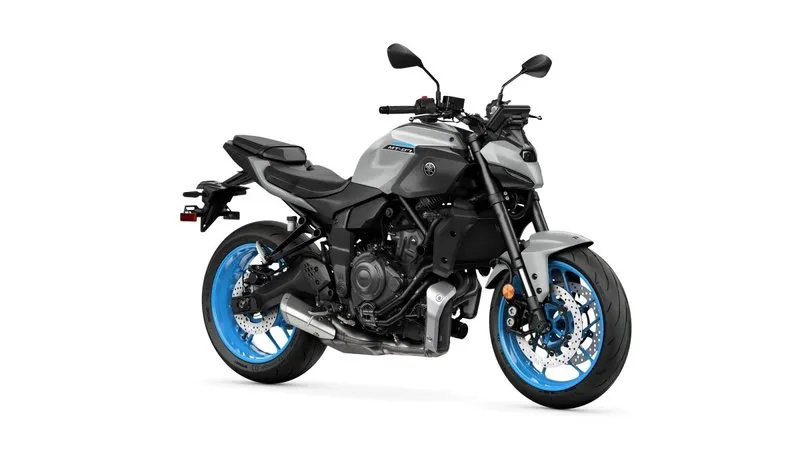
The MT-07 produces approximately 75 horsepower from a parallel twin. On paper, this is a modest number. Against the flagship superbike catalog, it looks unimpressive. In practice, it is the reason this motorcycle has been a bestseller for years running — not despite the modest figure, but because of how Yamaha chose to produce it.
The MT-07 engine does not deliver its power smoothly. It has torque character — specific points in the rev range where the delivery sharpens, punches, and behaves aggressively. The throttle response is quick and reactive. The engine sounds and feels like it is trying harder than its displacement numbers suggest. There is a sense of mechanical drama to the power delivery that a sanitized, flat-mapped four-cylinder producing twice the horsepower will never replicate.
A glatt-gebügelten power curve — an ironed-out, flat, perfectly linear delivery — is the opposite of charismatic. It is competent. It is boring. The rider reaches for more throttle to feel anything, and on a public road that means they are accelerating past the point of sense to find the sensation that the motorcycle should have been providing all along.
A mid-weight twin with honest, reactive, slightly unruly character gives that sensation at manageable speeds. The rider does not need to push boundaries to feel the motorcycle. The motorcycle communicates through the throttle, through the exhaust, through the vibration in the pegs and bars, at speeds that leave room for safety and intelligence.
The Sittenwächter effect
There is a German word — Sittenwächter — that translates roughly as moral guardian. In old civic usage, it meant a community official responsible for enforcing social norms.
On a naked bike at speed, the wind is the Sittenwächter. It enforces its own speed limit not through law enforcement but through physics. At 80 mph, the naked bike is communicating that it is going 80 mph, clearly and physically. The rider is engaged with velocity in a way that naturally promotes judgment. You feel what is happening. Feeling what is happening is, in itself, a moderating influence.
The superbike at 80 is quiet. The wind is managed. The rider is calm and comfortable. The machine is designed to feel composed at this speed, which means it is also designed to make this speed feel unremarkable. The feedback that might prompt a thoughtful recalibration of pace is absent. The next 20 mph arrives almost accidentally, because nothing warned you the first 20 had gone by.
This is not an abstract safety argument. It is a practical observation about how motorcycles communicate with riders, and why removing that communication has counterintuitive effects on riding behavior.
Comparison: Naked mid-weight vs. modern superbike on public roads
The bottom line
The superbike is an extraordinary machine. It is simply not designed for the roads where you ride it. Its brilliance is most accessible on a closed circuit at speeds that require a license, a transponder, and a paddock.
The naked mid-weight is designed precisely for the environment where you spend 99 percent of your riding life. It is loud. It is physical. It is reactive and honest and, in the best examples, genuinely charismatic in a way that no amount of peak horsepower can manufacture.
You are not paying for capability you cannot use. You are paying for the most intense version of motorcycling available in normal traffic at normal speeds.
That is a better deal. Not for everyone. But for most people, on most roads, in most conditions — that is a better deal.