
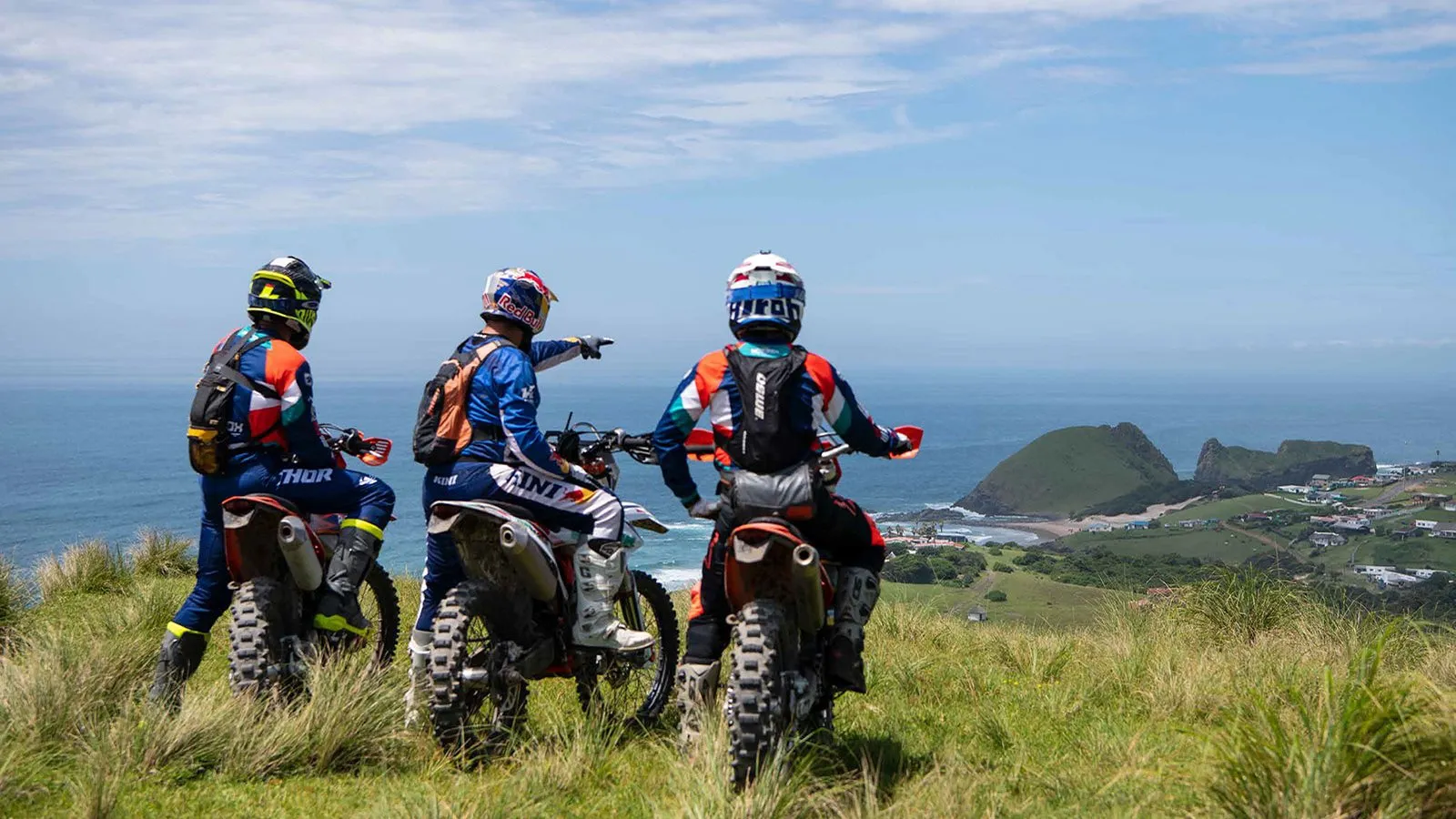
Fair warning: I’m a sucker for superlatives, and I usually cut half of mine before anybody reads them. These stay in. To me, there’s hardly a hard enduro tour that piles up as many superlatives as the one with Alfie Cox on South Africa’s Wild Coast. For me: tears of joy guaranteed. When you’re working an enduro up a green slope with the sea in view, it feels like riding up to heaven. The catch sits in the same breath, though. The terrain is genuinely demanding, and no beach postcard will tell you that.
Green Hills Above a Wild Ocean
The warm Agulhas Current runs offshore, and the climate stays mild and subtropical. Behind the coast the land rolls away in soft green hills, and the shoreline can’t make up its mind: bays, beaches, lagoons, rocky headlands, then cliffs that drop straight into the sea. Evergreen forest hides in the ravines between the grassland. The big rivers, the Kei, the Mthatha, the Mbashe and the Mzimvubu, open into mouths with sandy bays.
Up north in Pondoland the drama turns vertical. Flat sandstone tablelands alternate with brutally steep gorges like the Msikaba, and between Port St Johns and Oribi Gorge sits the Pondoland Centre of Endemism, a botanical hotspot full of plants that grow nowhere else. At Waterfall Bluff near Lusikisiki, waterfalls pour off sheer cliffs into the Indian Ocean, with the pyramid of Cathedral Rock jutting out of the water next door. The Magwa Falls plunge 466 feet into a gorge.
The DNA of this coast, though, is the life lived in that landscape. Between the Great Kei and the Mtamvuna, the Wild Coast belonged to the Transkei homeland under apartheid, nominally independent from 1976 to 1994 and never recognized internationally. It’s the traditional home of the Xhosa, among them the Gcaleka, Thembu, Mpondo and Bomvana, and every track to the coast runs through that heartland. Thatched rondavels dot the hills. Cattle lie on the beaches like sunbathers who never paid for a lounger. Apart from Port St Johns and Coffee Bay, the coastal settlements north of the Kei are often a handful of houses, and the tourist crowds never turned up. The Xhosa call Hole in the Wall esiKhaleni, the place of sound, after the surf thundering through the rock, and many locals see it as a gateway to the world of the ancestors. Coffee Bay, the story goes, took its name from a wreck that washed coffee beans ashore. Nelson Mandela was born in 1918 in Mvezo on the Mbashe River and grew up in Qunu, where he’s buried, about 20 miles southwest of Mthatha on the N2.
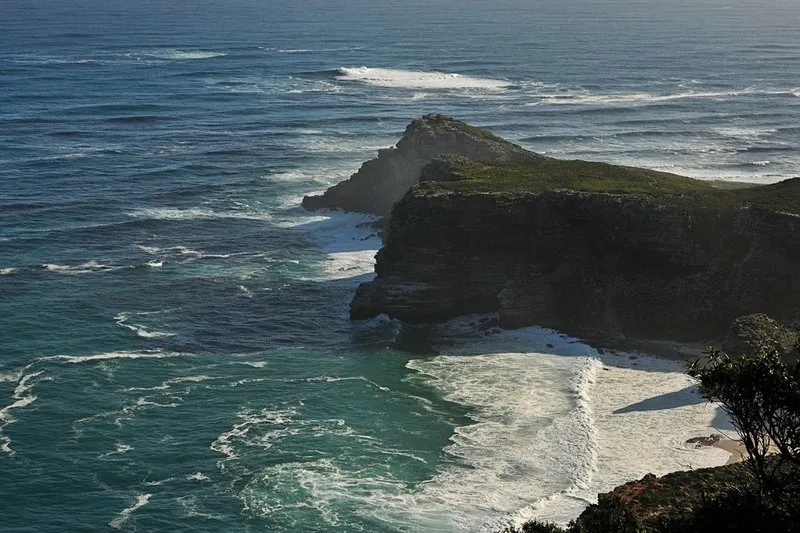
Surf, rock and a green cap on top: South Africa’s coast knows how to make an entrance.
What the Ground Does Here
Pavement first, because there isn’t much. The N2 runs far inland, and you reach the coast on spurs branching off toward the sea. North of the Kei, only Coffee Bay and Port St Johns have a paved road down from the N2. Everything else is gravel. The road into Coffee Bay is asphalt with potholes, and past town it turns to gravel toward Hole in the Wall. Across the former Transkei the roads run rough, with potholes and long gravel stretches through green hills and small villages.
Then the dirt. On the enduro routes the ground keeps switching: grassy hills, stony goat paths, forest, rock, river crossings. The crossings are part of the daily program, and they’re often slick, with greasy stones, water depth that’s hard to read and holes deeper than you’d expect. Steep climbs lead straight off the beaches onto clifftops above the Indian Ocean. Here’s the hard truth: after rain it gets worse. I’m no hero on a muddy climb, and this coast would find that out fast. Forest climbs and byways go muddy and slippery, and the back roads of the Transkei hold steep, beaten-up sections with deep ruts and mud holes.
The hazards come with consequences. After heavy rain, rivers and lagoons swell dangerously, and the weather service advises against crossing a swollen river. In 2023 a tourist drowned near Coffee Bay crossing a lagoon in flood. When the water’s up, you take the long way. Cows, goats, sheep, donkeys and horses wander the roads freely, they can stop traffic dead, and collisions happen. After dark, animals often stand on the road and appear out of nowhere, so plan to be off the road by nightfall.
Bluntly put: a gravel spur to the coast and a goat path up a cliff are two different sports. On your own, the gravel roads carry you to the villages and bays. Off them, you’re into steep climbs from the beach, slick fords and rutted byways with mud holes. Treat that as hard enduro ground.
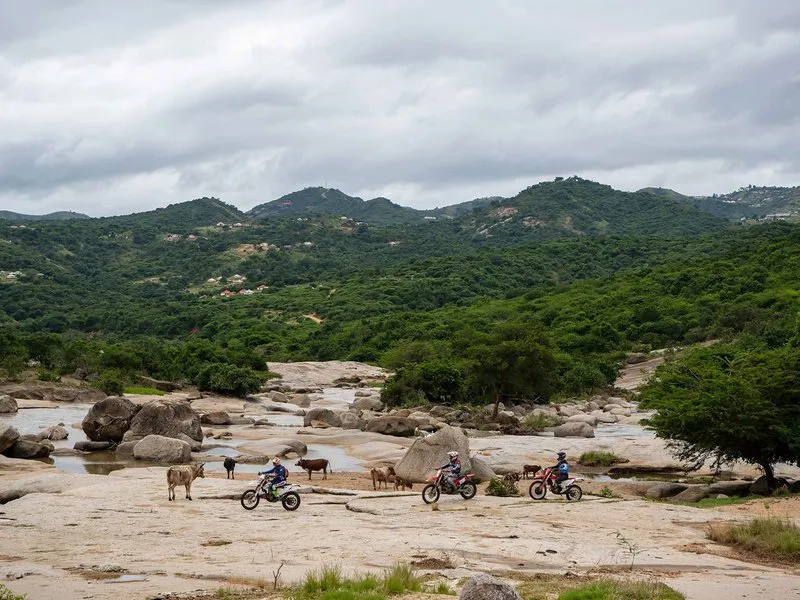
Rock slabs, cattle and no rush at all: bring patience, and a little balance.
Riding With Alfie Cox
You’ll find the South Africa Enduro tour with Alfie Cox in the RIDE KTM program, organized by Alfie Cox Racing in Cato Ridge, KwaZulu-Natal. Alfie won the very first Erzberg hare scramble, an extreme enduro race, in 1995 on a KTM. He’s won the Roof of Africa, Lesotho’s hard enduro race, nine times and finished second in the 2002 Dakar motorcycle class. Cool guy, too. He’s along for the whole tour, helps at the nasty obstacles and, if needed, rides your bike up or through himself. I’d hand mine over with a grin, no shame at all.
The program runs 8 days with five riding days and two rest days. The first three start at the White Clay Resort near Coffee Bay, on three loops of roughly 43 to 50 miles each, and stages of that length take five to six hours in the saddle. It’s 98 percent off-road, technique over speed, through rural villages, across rivers and over two-track, those dirt lanes with a grassy strip between two wheel ruts.
The tour is advertised for riding levels 1 to 5 (of 5), with a bypass for every technical section, and the tours are adapted to the riders’ ability. On KTM’s scale, levels 1 and 2 are rated suitable for beginners, while Levels 3 to 5 bring extreme climbs, demanding stream crossings, rock steps and slippery ground, with off-road practice expected. Details live on the Ride KTM: dates, info and prices page.
On day four you transfer with Alfie by vehicle, about 310 miles, to KwaZulu-Natal and his smallholding. Two riding days within 62 miles of the farm run through forest, sugar cane, villages, rivers and bushland, and a trip through a safari park closes it out.
The rental bike is included in the RIDE KTM program, a KTM or GasGas, plus fuel, lodging and meals, so you can simply fly in and ride. You fly via Johannesburg to Mthatha, where Alfie picks up the group, and home from Durban. Planning your own trip? Durban’s King Shaka is the nearest international airport. You’ll pay in rand, and the Eastern Cape counts as malaria-free.
Best Season and the Braai
Rain first: most of it falls from October to March, with around 10 to 15 rain days a month, against about 3 in June and July. Average summer highs sit around 77 to 81°F, and it’s sticky, with afternoon humidity in Port St Johns around 80 percent. Mthatha and its surroundings are prone to severe thunderstorms, sometimes with tornadoes. For summer tours, pack a hydration pack and light rain gear and leave the heavy armor at home.
Winter, June to August, is the driest stretch: mild days around 70°F, with Mthatha’s nights dropping to 39°F. Fall and winter count as the pleasant season for active travel. The days are short, though: in Durban the shortest day runs just over 10 hours, with sunset around 5 to 5:30 p.m. And spring has a mean streak. Heat spikes above 104°F happen, and Mthatha has hit 111°F in September.
The braai, grilling over an open fire, is a national sport, and on Heritage Day, September 24, the whole country fires up. Boerewors, the coiled farmer’s sausage, belongs on the grill. The tour includes a traditional braai at Alfie’s home plus a seafood dinner, fitting for a coast of fresh fish and seafood. Xhosa cooking is earthier. Umngqusho, samp with sugar beans, is a staple, and Mandela’s longtime cook Xoliswa Ndoyiya counted it among his favorite dishes. Umphokoqo is crumbly maize porridge with sour milk, also called African salad. Umqombothi, a cloudy, sour Xhosa beer from maize and sorghum malt, is low in alcohol and belongs to the evening, after the bikes are parked. Once you reach KwaZulu-Natal, look for bunny chow, a hollowed-out loaf filled with curry from Durban’s Indian community. Earn it on the slopes first.
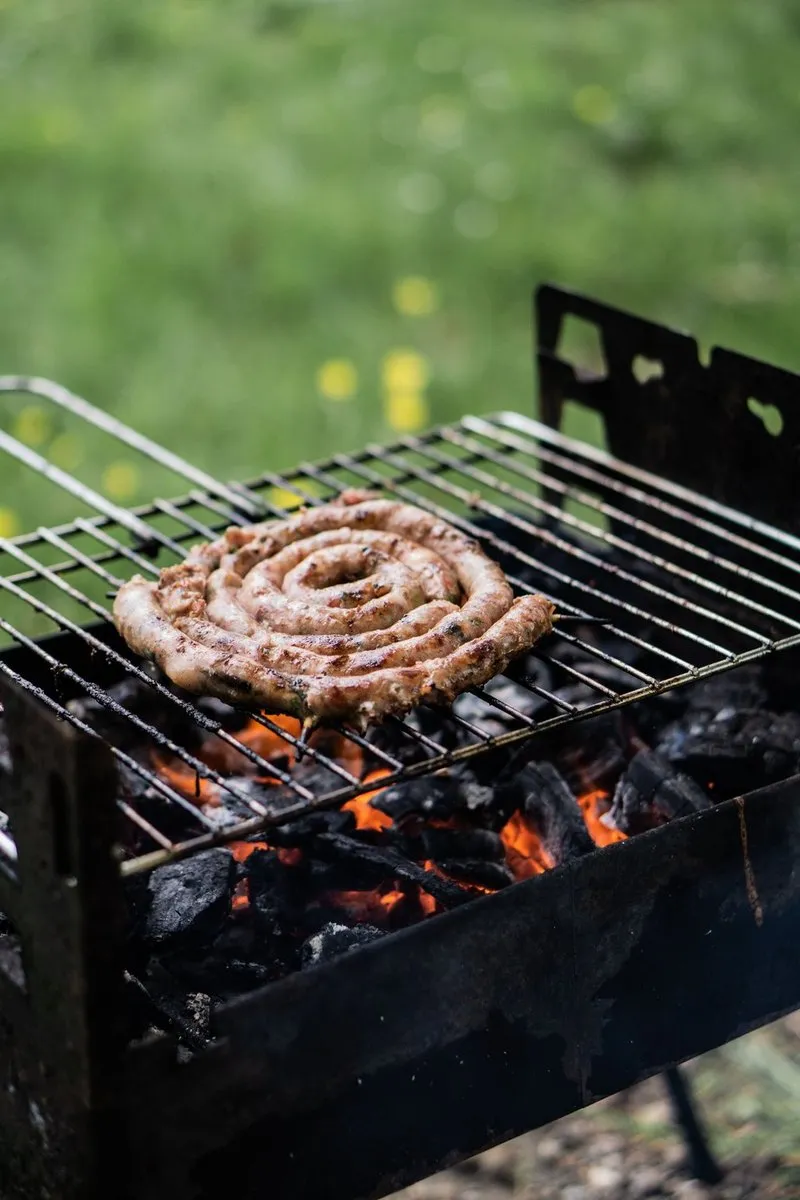
A coil of boerewors over the coals: the right way to close a long day in the dirt.