
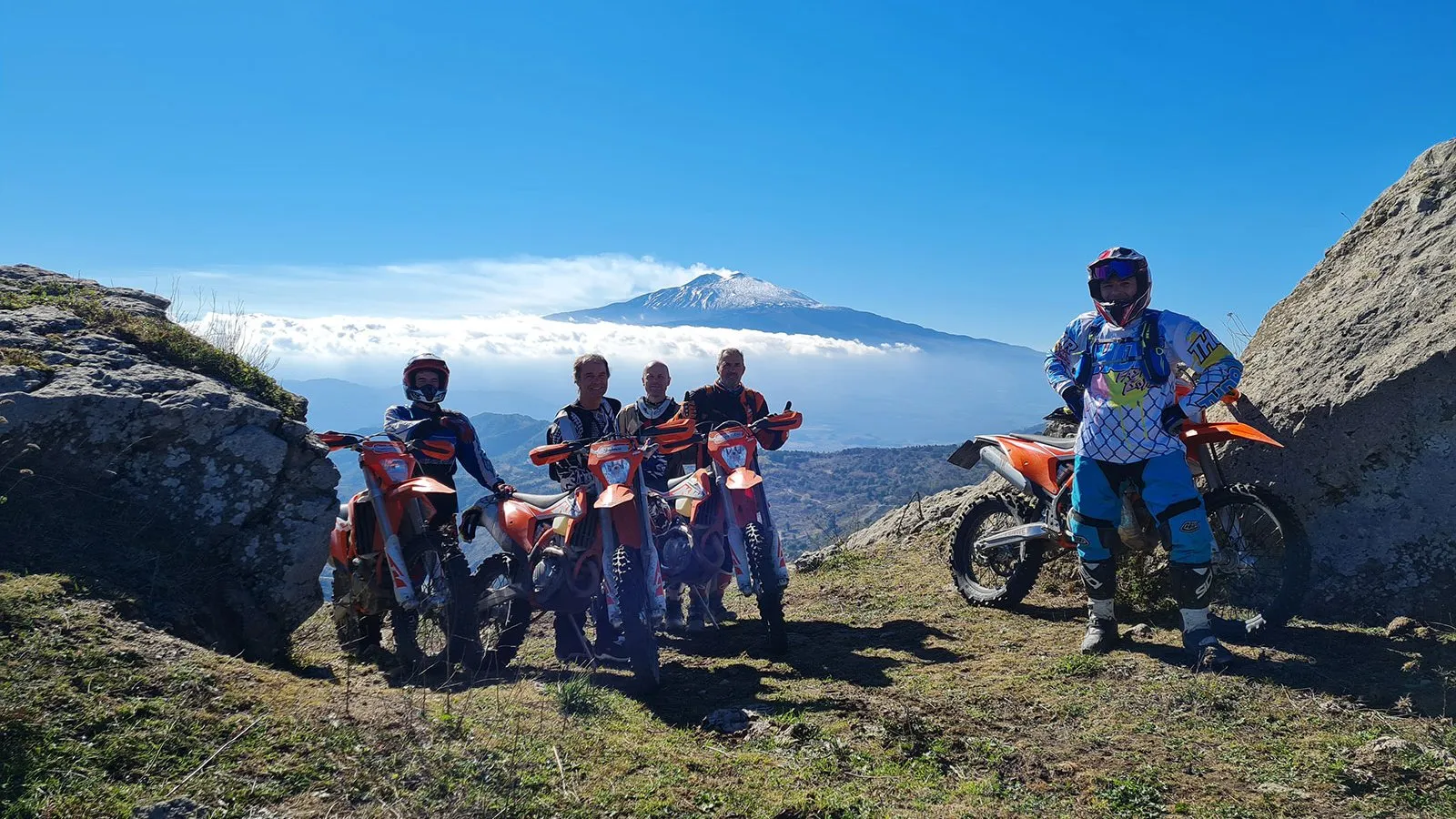
Beaches, lemon trees, pretty little towns. That’s the Sicily most people carry home from a summer vacation, and I get it. It just isn’t the island you’ll meet on an enduro. Here’s my one warning up front: don’t underestimate the variety of the terrain, and don’t underestimate the climbs.
Fire Above the Ionian Sea
Sicily is the largest island in the Mediterranean, and its loudest resident lives on the east coast, high above the Ionian Sea. Mount Etna is considered Europe’s highest active volcano. What gets me is how restless it is. It’s active almost nonstop, people have been writing down what it does for at least 2,700 years, and even its height won’t sit still: somewhere around 11,000 to 11,150 feet, depending on the latest eruption. Just below the summit spreads a barren, pitch-black lava landscape that looks different after every outbreak, and a cold wind often sweeps across it. On the eastern flank yawns the Valle del Bove, a huge basin left behind when the old eastern flank collapsed.
Then turn north and the island changes color. The rivers Alcantara and Simeto draw the line between Etna and the Nebrodi, and the Alcantara gorge squeezes ice-cold water between walls of lava. Beyond them, the Nebrodi, Peloritani and Madonie form the Sicilian Apennines along the northern side. The Nebrodi, Sicily’s largest protected area, top out at Monte Soro at 6,060 feet, mostly on soft, rounded ridges of clay and sandstone. Where limestone breaks through, as at the Rocche del Crasto, the skyline suddenly grows teeth.
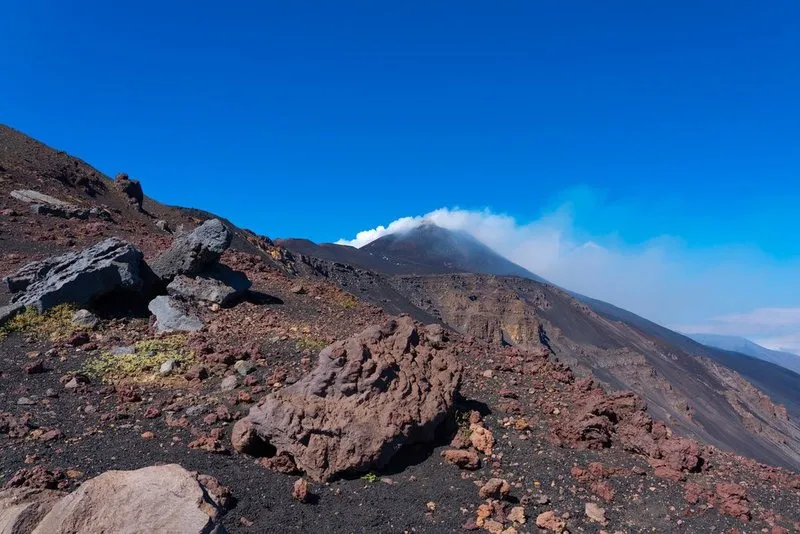
This is where the beach postcard ends. I’d want a whole afternoon up on the volcano.
The Island Behind the Beach
What sets Sicily apart is how much history is packed into one island. Many peoples left their mark here over thousands of years, and an off-road route across Sicily turns into a ride through all of it. Palermo was founded by the Phoenicians and later ruled by Romans, Arabs and Normans, among others. Arab-Norman Palermo, with the cathedrals of Cefalù and Monreale, is a UNESCO World Heritage Site and stands for a fusion of Western, Islamic and Byzantine culture. Near Agrigento, in the Valley of the Temples, Doric temples of a Greek colony date back to the 6th century BC.
That’s the famous part, and it’s worth a detour. The part I’d ride for sits inland, in high, rugged ranges that catch beach visitors completely off guard. Away from the busy coasts the interior turns wild and quiet. Off-road routes pass through old mountain villages, and a coffee or a snack in the square belongs to the day as much as the next climb. People up there are warm and hospitable, even when hardly any English gets spoken. My own Italian runs out somewhere around ordering a second espresso, and I suspect the villages have heard worse.
What the Ground Is Doing
Plenty of the off-road mileage runs on flowing gravel roads, the strade bianche. Then the surface keeps changing its mind: rock, dust, gravel, sand in the south, dark volcanic ground on Etna, tracks along the ridges. Around the volcano you’re riding on ash and lava sand, and the grip is loose. Routes run along and through dried-out riverbeds and gorges. Seasonal erosion chews on tracks and back roads, so a section can be washed away or signposted as closed.
On pavement, many back roads are bumpy and the asphalt is often slick. Some country roads hide blind corners with big potholes right at the exit, and crossing the island takes far longer than the map promises. On Etna’s mountain roads, black volcanic sand drifts onto the asphalt near the summit, so lean angle comes with caution there.
And then the payoff. A narrow, wildly twisting road climbs Etna’s southern slope through lava fields to the Rifugio Sapienza at just over 6,200 feet. The Madonie carried the Targa Florio, a legendary road race from 1906 to 1977, and riders treat that course as a twisting asphalt roller coaster. Portella Femmina Morta, at 5,000 feet in the heart of the Nebrodi, counts as Sicily’s highest road pass.
Climbs That Bite Back
Truth be told, the beach image makes people cocky. Here’s what it leaves out: between the flowing gravel stretches, unpaved and stony tracks tilt up steeply, and the climbs into the middle of the island go a long way up. In the winter months it can get fairly cold at the top. In July and August it’s the opposite problem. Heat becomes the biggest strain off-road, and a stony climb at those temperatures wears you down hard.
Without local knowledge you can find yourself on steep singletrack, rutted descents or deep rubble you never planned for, and navigation apps sometimes route you onto tracks that suit a four by four better than a motorcycle. Unpaved roads are plentiful, above all in the mountains, and a light enduro or an adventure bike fits them.
If you plan it yourself, the Trans Euro Trail, a network of asphalt and unpaved tracks, has its own Sicily stages, and enduro travelers ride it from Messina to Palermo. Its GPX tracks handle the navigation, and volunteer linesmen keep the route current.
In 2026 the Enduro World Championship, FIM EnduroGP, opened its season in Custonaci near Trapani, back on the island for the first time in almost 15 years, on dry, rocky ground. The terrain there is stony and technical, with mule paths, olive groves and old marble quarries.
Between Water and Fire
You’ll find the Sicilia Enduro on RIDE KTM, for example. It’s run by Powerride Enduro Tours, an official KTM partner for enduro tours and training, under the motto between water and fire. The program follows firebreaks toward Etna, runs through forests, crosses lava ash and drops through dried-out gorges to the beaches. There’s a six-day Sicilia Enduro and an eight-day Sicilia Enduro Week, both held in fall and both with the rental bike included. Home base is a small hotel with a pool, a garden and a view of Etna. The sea is within walking distance, and Powerride singles out the lunches as a culinary highlight.
Both formats are listed for riding levels 1 through 4 (of 5) on KTM’s off-road scale. They start at Level 1, which KTM rates as suitable for beginners, and Powerride sorts its groups by individual ability and preference. Levels 1 and 2, both beginner rated, run from gravel roads, farm tracks and singletrails without steep climbs or descents to washed-out gravel, ruts, firebreaks, dried-out riverbeds and simple river crossings. Firebreaks and dried-out gorges turn up in the program description too. Level 3 adds tight singletrail turns, extreme climbs and demanding stream crossings, with off-road practice recommended. At Level 4 you’re dealing with rock steps, loose rubble, deep sand and slippery ground, sometimes on steep climbs, and KTM expects regular off-road practice. Current details sit on the Ride KTM: dates, info and prices page.
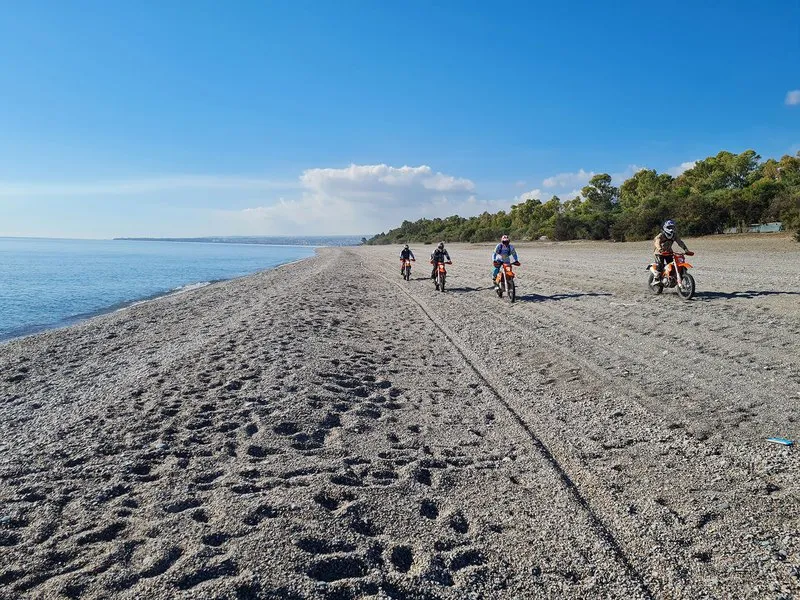
Some enduro days end at the water. That’s a finish line worth riding toward.
Heat Smoke and Snow
Sicily runs on a Mediterranean climate, with hot, dry summers and mild, wetter winters. Palermo’s daily mean hovers around 54°F in January and February and around 81°F in August. Near Syracuse the thermometer hit 119.8°F on August 11, 2021, recognized by the WMO as the record for continental Europe.
So aim for spring or fall, the best seasons for the interior. The RIDE KTM program schedules its Sicily tours in the fall as well. October stays mild, but the days get shorter and it can turn rainy and windy, so plan your off-road days around the daylight. Etna’s summit carries snow in winter and often in spring and fall too.
Late summer and early fall dry the island out. Many rivers and lakes are empty by then: plan your water. Sicily also ranks among the Italian regions hit hardest by wildfires, and off-road travelers see them along the way in late summer and fall.
In the Nebrodi woods, black pigs live semi-wild and look more like wild boar, so a forest track can come with company. Etna’s ash clouds repeatedly shut down Catania airport for a while.
Flying into Catania or Palermo and renting a bike there is the easy way in. The most comfortable option is a tour provider like RIDE KTM: fly in and ride. With your own bike, the overnight ferry from Genoa to Palermo spares you the long haul down Italy. Coming overland, you cross the Strait of Messina, which separates the island from Calabria, on the ferry from Villa San Giovanni to Messina.
Pistachios on Black Rock
Street food is everyday life here, and arancini and cannoli are the classic fuel stops from the bar, the bakery and the pasticceria. Arancini are stuffed, breaded and fried rice balls. In Catania and Messina the arancini al ragù come cone-shaped, modeled on Etna, so you can bite the volcano before you ride it. Cannoli are fried pastry tubes filled with sweetened ricotta, and in Catania chopped pistachios are a favorite.
The pistachio came to Sicily with the Arabs. The Pistacchio Verde di Bronte DOP grows on Etna, in Bronte, Adrano and Biancavilla, often on steep lava slopes, and it’s harvested by hand every second year from the end of August. Catania also gave the world pasta alla Norma: tomato sauce, fried eggplant, ricotta salata and basil, named after Bellini’s opera.
Up in the Nebrodi, look for sausage and ham from the black Nebrodi pig, a Slow Food Presidium, along with provola and ricotta. Etna DOC is the oldest DOC in Sicily, and its reds are built on the native Nerello Mascalese grape. My tip for lunch: stop a little away from the coast, where the menus aren’t multilingual.
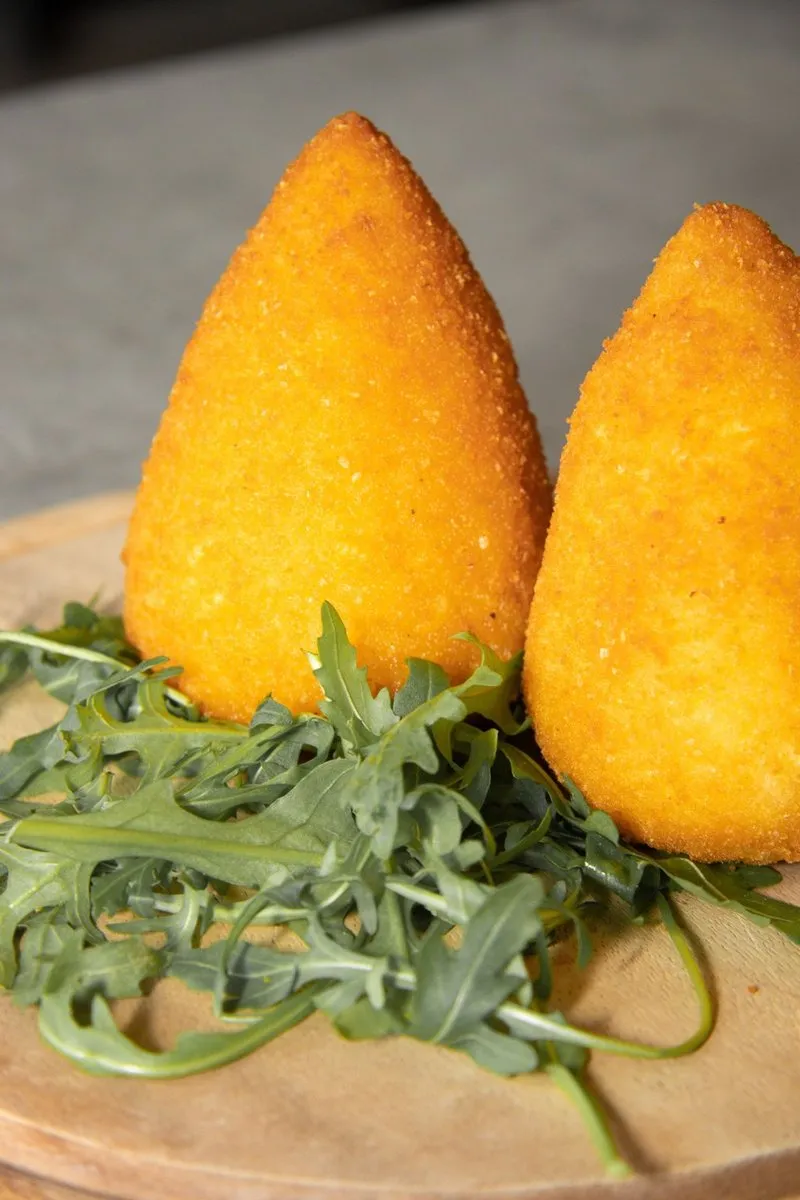
Crisp, filling and shaped like a volcano: the kind of fuel stop I’d plan a route around.