
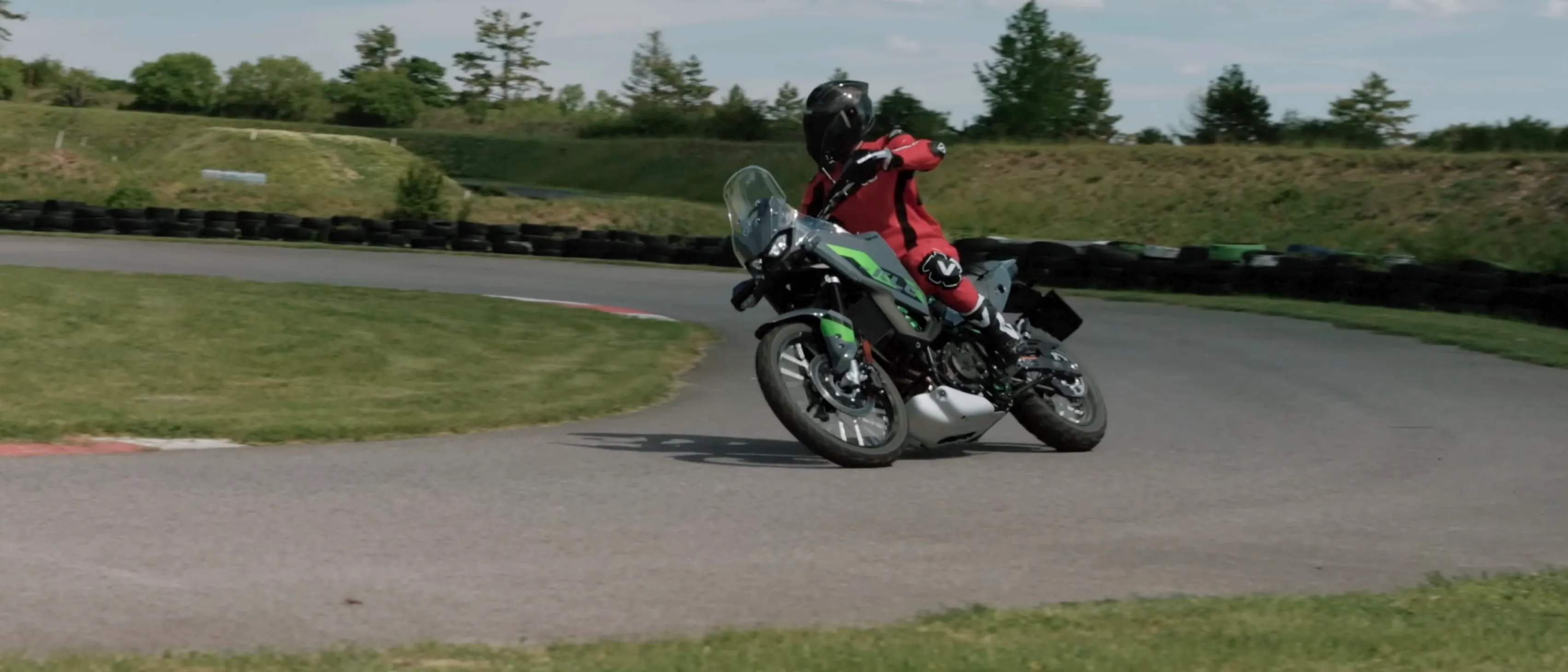
Ten warm-up laps. That’s the whole allowance before the clock starts on our Austrian supermoto circuit, and on most bikes it isn’t nearly enough. On the KLE 500 I could have skipped nine of them.
That’s not a compliment I hand out often. The little Kawasaki showed up wearing IRC Trial Winner knobbies, the asphalt was sitting at 88 degrees F, and the track is a tight, technical thing built out of hairpins, direction changes and short straights. Everything about that setup should have made me careful. It didn’t.
Knobbies on pavement mess with your head
Those IRC tires are roughly a 50/50 split, half dirt, half road. On gravel they’re great, and I’ve already had this bike out in the dirt. But here’s the honest part: when I look down and see knobs, I roll the throttle open a little slower. I don’t know how you’re wired, but with me that happens in my head long before my right hand does anything about it.
Trust on a motorcycle is rarely pure physics. A big chunk of it is theater your brain puts on for you. Which is exactly why a knobby tire on a tight circuit is such an interesting opponent. It doesn’t actually take much away from you. It just talks the whole time.
Then something odd happened
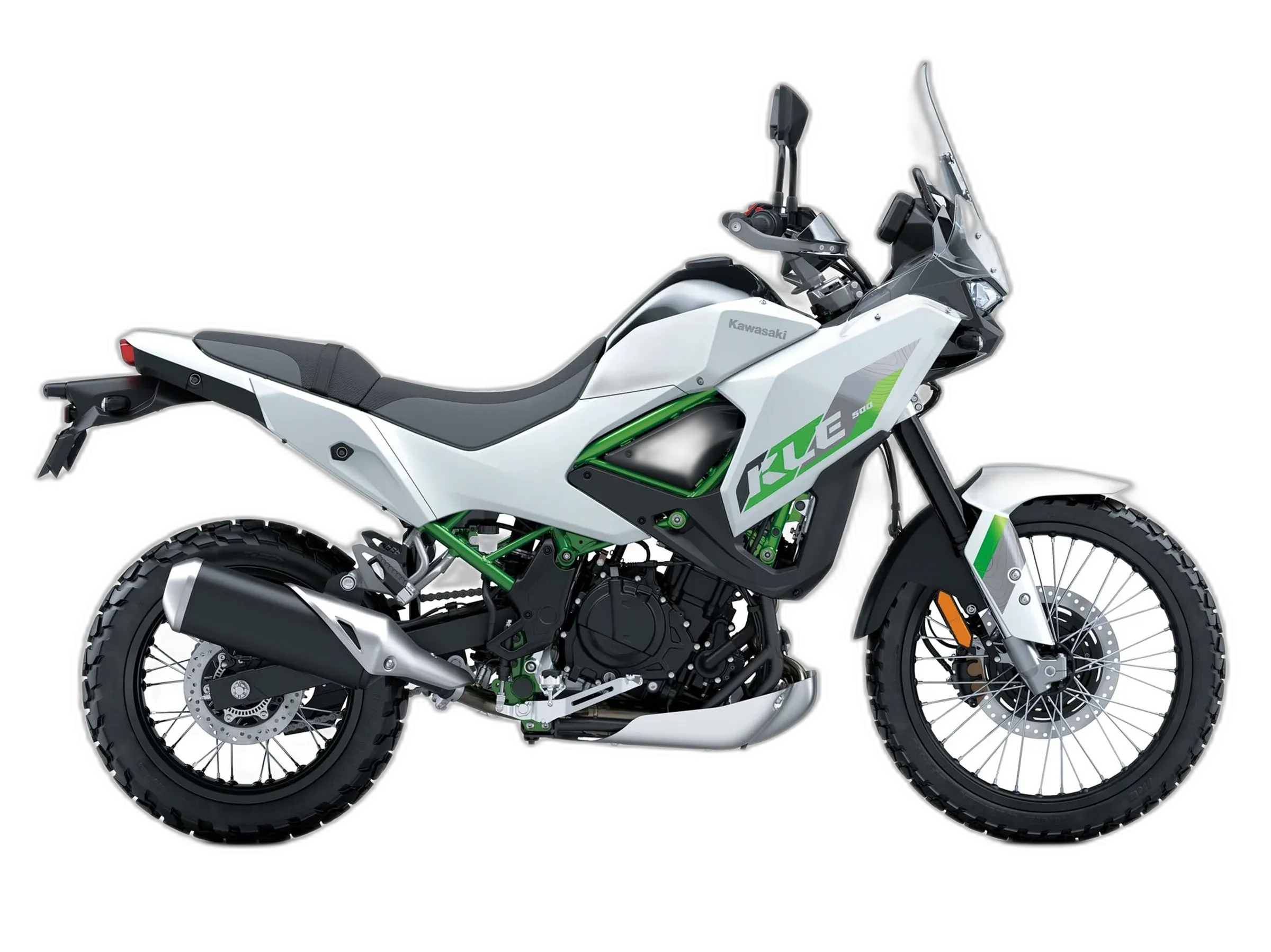
I got on the thing and the doubt evaporated. I still can’t fully explain it. The motor’s harmonious, the seating position works, and that wide bar hands you options. You swing a leg over and immediately feel at home, like you’re the one setting the terms: how fast this goes, how hard it accelerates, where it points.
45 hp out of 451 cc doesn’t sound like much drama, and that’s the entire point. This bike doesn’t push itself on you. It puts itself at your disposal, and you take the offer without thinking about it.
The bar does most of the work
The thing you notice first is that genuinely wide handlebar on an otherwise compact motorcycle. It lets you steer the bike rather than wrestle it. In tight hairpins that leverage is worth real time, because every correction costs you nothing.
On a circuit made of switchbacks and short straights, that’s what sets your rhythm. Not power, not brakes. Just how easily you can put the front wheel where you want it. The KLE makes that stupidly easy for a bike carrying a big front hoop.
A 21-inch front that doesn’t flop
For a 21-inch front wheel, the KLE turns in smooth and even. That’s not a given. Big front wheels tend to fight you on quick transitions, or feel tippy once you’re leaned over. Neither happens here.
I tip into the radius with real faith in the front end, and the bike just stays hooked up. Nothing vague, nothing wobbly. This is a proper street chassis that happens to also work in the dirt and on gravel, and I’ve now tried it both ways. When the video from that day goes up on the 1000PS channel, you’ll see how far I was willing to lean it. Those videos sometimes land weeks after the article, so this piece stands on its own.
How fast can you trust a stranger
That speed of trust feeds straight into any lap time. Honestly, I think I could’ve run my time after a single lap and been just as quick. I did the full ten, same as every other bike we run, but some machines need way longer than that. Multiple sessions before I’m anywhere near the limit.
The limit here sits lower than on a proper sportbike, sure. The difference is I can use all of it right away. Accessible throttle response, a comfortable seat, and the quiet confidence that comes with a solid Japanese product underneath you. On a mountain road full of blind corners, how fast you build that trust matters more than any number on a stopwatch.
Everything else just gets out of the way
The rest of the bike’s fundamentals never make a scene, and I don’t mean that as a knock. The brake is solid: not aggressive, but not mushy or unpleasant either. Well sized, enough for the job.
Controls, gearbox, shift action, all of it so unremarkable that there’s nothing to report. And there’s nothing to complain about either. That’s a quality in itself, even if it never makes a spec sheet look good. This is a genuinely universal, accessible motorcycle that does its job without constantly demanding you deal with it.
The segment filled up fast
There are a huge number of players in this class now. CFMOTO’s in it, Royal Enfield’s in it, KTM, Kawasaki. I’m honestly curious where they all shake out by the end of the year once the data piles up.
One piece of advice when you read any lap chart: always check what rubber was fitted. With adventure bikes and enduros that matters enormously, because the more off-road the tire, the harder the pavement gets. I still think the KLE did alright out there, purely because I got brave quickly enough to actually flow through the corners.
Where the time landed
The KLE 500 ran a 1:12.419 on IRC Trial Winner knobbies at 88 degrees F asphalt. For context, five bikes from our database that all sit above that time: the 2024 BMW R 1300 GS on Bridgestone A41 at 88 degrees F, at 1:07.2. The 2021 Ducati Multistrada V4 S on Pirelli Scorpion Trail II at 86 degrees F, at 1:07.3. The 2021 Kawasaki Z650 on Bridgestone S22 at 70 degrees F, at 1:07.4. The 2021 Harley-Davidson Pan America 1250 Special on Michelin Scorcher Adventure at 86 degrees F, at 1:08.7. And the 2024 Honda XL750 Transalp on Pirelli Scorpion Trail II at 91 degrees F, also at 1:08.7. Read every one of those alongside its tire and asphalt temperature, because both move the result more than you’d think.
About the track and how we run it
It’s a compact supermoto circuit in Austria: hairpins, direction changes, short straights. Deliberately not a big racetrack. It stands in for city traffic, alpine passes and narrow country roads, which is where a bike actually has to prove itself.
The procedure never changes. Ten warm-up laps, then one flying lap launched from a dead stop just 20 meters before the line. Clutch control and traction off the line feed directly into the result, and so does how quickly you’ve made peace with the machine. That last part is the whole reason I like running this format, and on the KLE 500 it took about one corner.